
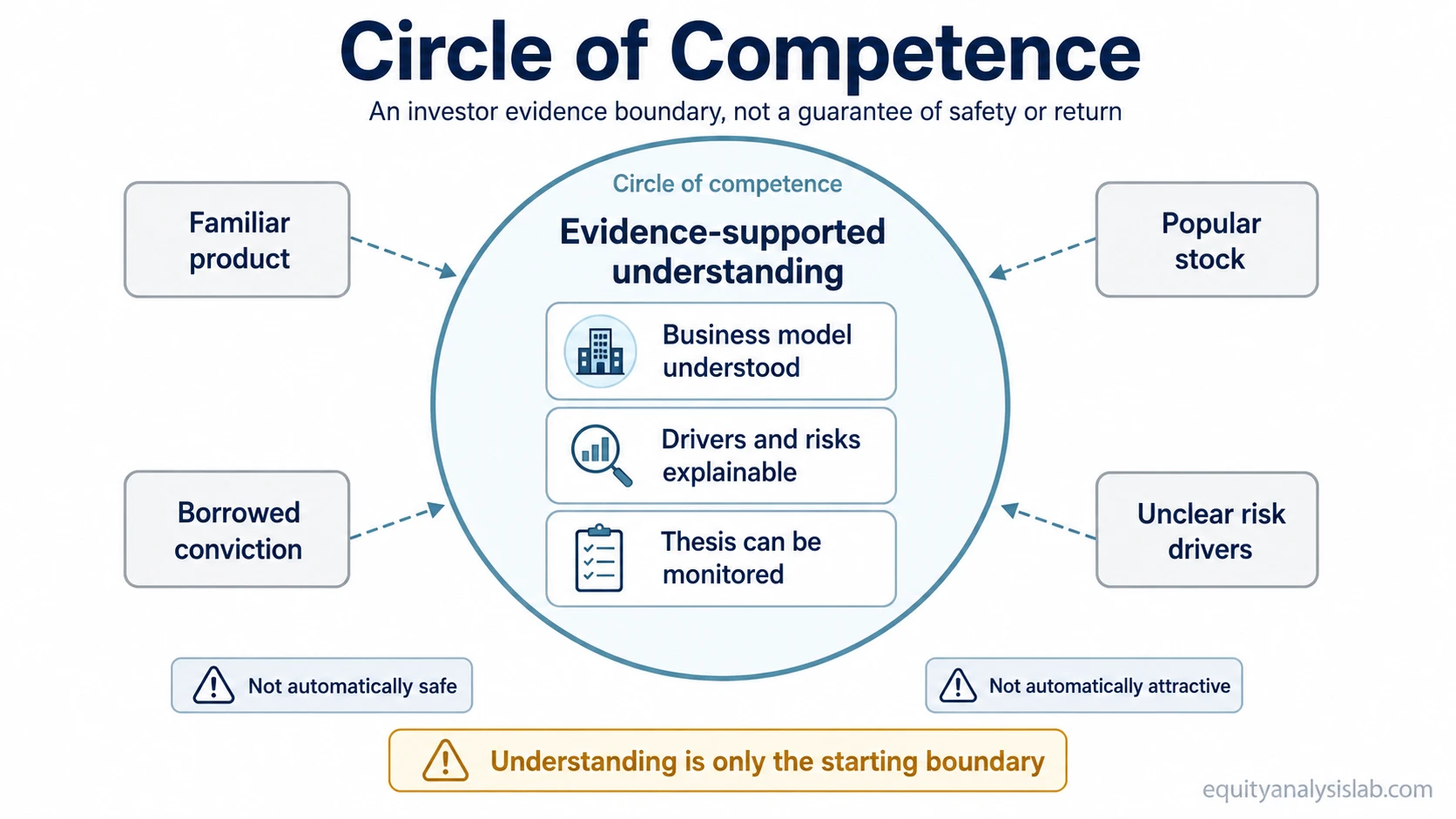
A circle of competence is the set of businesses and industries an investor can evaluate well enough to form an independent judgment. The practical boundary is whether the investor can explain how the business makes money, which variables drive the economics, what could damage the thesis, and what evidence would change the view.
Recognition is not enough. A familiar product, a popular stock, or a persuasive external thesis can still sit outside the circle when the underlying economics cannot be evaluated independently.
What Buffett’s Original Framing Establishes
In Berkshire Hathaway’s 1996 shareholder letter, Warren Buffett describes the investor’s task as correctly evaluating selected businesses and emphasizes knowing the boundaries of the circle. The 1999 shareholder letter returns to the same idea by discussing the importance of recognizing when analysis is approaching the perimeter of competence. The boundary test below is an operational research check used on this page; it is not presented as a checklist created by Berkshire Hathaway.
The Competence Boundary Test
A business is easier to place inside the circle when the investor can connect the investment case to specific economics, risks, and evidence rather than relying on general confidence.
| Question | What it tests | What a weak answer suggests |
|---|---|---|
| Can I explain how the business makes money? | Business model understanding | The company may be familiar while its economics remain unclear. |
| Can I identify the main drivers of revenue, margins, cash flow, and capital needs? | Financial statement interpretation | The analysis may rely on headline metrics without enough understanding of the underlying economics. |
| Can I identify the main risks that could damage the thesis? | Risk recognition | The upside case may be clearer than the failure conditions. |
| Can I explain what evidence would change my view? | Thesis discipline | The position may depend more on attachment or narrative than on a testable thesis. |
| Can I compare the business with relevant alternatives? | Industry and competitive context | The company may be understood in isolation but not within its competitive setting. |
| Can I monitor the thesis after purchase? | Ongoing evidence quality | The investor may be able to enter the position without being able to judge whether the underlying thesis is strengthening or weakening. |
Several weak answers do not establish that the business is unattractive. They indicate that the investor may not yet have enough basis to evaluate it independently.
Common Boundary Errors
Product familiarity can create a useful starting point for research, but using a product does not explain margins, capital intensity, dilution, cyclicality, competitive pressure, or valuation.
Borrowed conviction has a similar limit. Another investor’s thesis can help identify questions and evidence, but the position remains outside the investor’s own analytical competence when the assumptions cannot be explained or monitored independently.
Partial knowledge can also create false confidence. Understanding one part of a company does not establish equal understanding of its accounting, competitive position, regulation, capital requirements, or other material drivers.
Same Opportunity, Different Competence
Consider an investor who has spent years analyzing mature retailers and understands store economics, inventory, margins, working capital, and competitive pressure. The same investor may have much less ability to evaluate a specialized biotechnology company whose outcome depends on scientific, clinical, and regulatory evidence outside that experience.
The comparison does not rank the two businesses. It shows that the ability to evaluate evidence can differ materially across investment opportunities.
Circle of Competence and Related Investor Concepts
| Concept | Main question | How it differs from circle of competence |
|---|---|---|
| Investment objectives | What is the investor trying to accomplish with the capital? | Objectives define the purpose of the capital. Circle of competence defines which investment opportunities the investor can evaluate with enough understanding. |
| Investment policy statement | What rules should govern the investment process? | An IPS can document objectives, constraints, and decision rules. Circle of competence is the analytical boundary itself. |
| Ability to financially absorb risk | How much loss, illiquidity, or delay can the investor’s financial position withstand? | Risk capacity concerns financial resilience. Circle of competence concerns the ability to understand and evaluate the investment. |
| Emotional tolerance for risk | How much uncertainty or loss can the investor tolerate behaviorally? | Risk tolerance concerns behavioral comfort. Circle of competence concerns analytical understanding. |
| Investment goals | What future need or milestone should the investment plan serve? | Goals define the desired outcome. Circle of competence defines the boundary of investment decisions the investor can evaluate independently. |
Can the Circle of Competence Expand?
The boundary can move as the investor develops enough understanding to evaluate a new area with greater independence. Financial statement work, industry research, company comparison, repeated analysis, and review of past assumptions can all contribute to that process.
Expansion is more credible when the investor can explain the economics, material risks, competing explanations, and evidence that would change the thesis. Confidence by itself does not establish that the boundary has moved.
Limits of the Concept
Circle of competence addresses the investor’s ability to evaluate an opportunity. It does not establish business quality, valuation, expected return, portfolio fit, or suitability for the investor’s objectives. Those questions still require separate analysis.