
Stock selection frameworks are structured ways to narrow the equity universe, compare candidates, and decide which companies deserve deeper research.
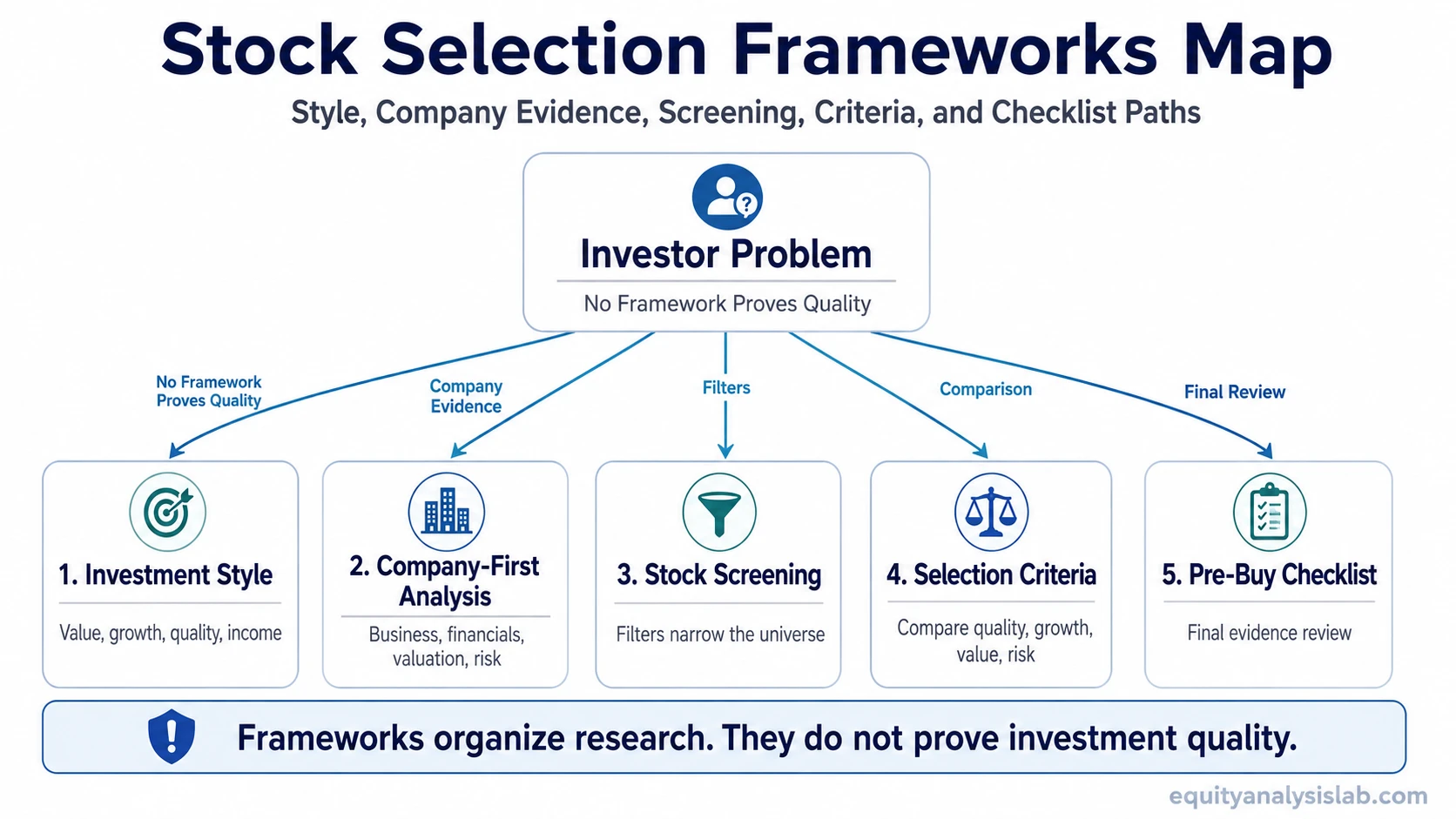
Different parts of the process solve different problems. An investment style defines a research lens, a stock screener reduces a large universe, selection criteria help compare the candidates that remain, company analysis tests the evidence in greater depth, and a checklist controls the final review.
For an investor starting with many possible stocks, a practical default sequence is: define the universe, screen, compare, analyze, then review. The key is that every stage should produce a specific output before the next stage begins.
Key Points
- A stock selection process can move from universe definition to screening, comparison, company analysis, and final review.
- Passing one stage only earns the candidate further research; it does not validate the next stage.
- Screening criteria reduce a broad universe, while selection criteria help compare the candidates that remain.
- A stock selection framework determines where research attention goes; a stock analysis framework examines a specific company in greater depth.
- Quantitative models can support either screening or selection depending on whether they filter stocks or rank the remaining candidates.
A Default Stock Selection Process
A framework becomes more useful when every stage has a defined question, output, and stopping point. That prevents an initial filter or favorable metric from carrying more weight than it deserves.
| Stage | Question | Output | Stage gate |
|---|---|---|---|
| 1. Define the universe | Which companies are eligible for research under the chosen style, mandate, or starting lens? | A clearly bounded research universe. | Companies outside the defined scope do not enter this research path. |
| 2. Screen | Which companies satisfy the initial measurable requirements? | A smaller shortlist. | Failing a non-negotiable filter can remove a candidate. Passing the screen only earns further review. |
| 3. Compare | Which shortlisted companies show stronger evidence when judged on the same dimensions? | A prioritized group of candidates. | Weak relative evidence can move a company down the list even when it passed every initial filter. |
| 4. Analyze | What do the business economics, financial statements, cash generation, valuation, and company-specific risks actually show? | A company-level assessment with explicit assumptions and risks. | Deeper evidence can overturn the reason the company originally entered the shortlist. |
| 5. Review | Which important assumptions, risks, or evidence gaps remain unresolved? | A documented research status before the investor moves into a separate decision process. | A checklist exposes unresolved issues; it does not repair weak evidence or make an incomplete thesis complete. |
The stage-gate logic matters because the output of one stage is the input to the next. A screen produces candidates, not conclusions. Comparison produces priorities, not a complete company thesis. Company analysis can strengthen or break the initial case. Final review should reveal what remains uncertain rather than hide uncertainty behind completed boxes.
Five Types of Stock Selection Framework
The components of a stock selection process can also be separated by the decision each one supports. Some organize the opportunity set, some remove unsuitable candidates, and others structure comparison or review.
| Framework type | Main job | Typical output | Where its job ends | Research path |
|---|---|---|---|---|
| Investment style | Defines the broad lens used to look for opportunities. | A research universe organized around value, growth, quality, income, GARP, or another style. | A style label does not establish company quality or valuation attractiveness. | Investment styles |
| Company-first framework | Starts with the business and builds the assessment from company evidence. | A company-level view of financial strength, business quality, valuation, and risk. | Deep analysis can be too slow when the starting universe contains hundreds or thousands of stocks. | bottom-up investing approach |
| Screening framework | Removes stocks that do not meet measurable requirements. | A smaller list that deserves further research. | A passed screen says little about risks that were not included in the filters. | stock screener |
| Selection criteria | Creates a consistent basis for comparing candidates. | A relative assessment across factors such as valuation, growth, profitability, financial strength, and business quality. | The criteria still require interpretation and may carry different significance across companies. | stock selection criteria |
| Pre-buy checklist | Tests whether the main parts of the thesis and risk review have been addressed. | A structured final review of the evidence already collected. | A checklist can expose omissions, but it cannot repair weak evidence. | stock buying checklist |
The broader Screening and comparison path connects the filtering and comparison stages when the starting universe is too large for immediate company-by-company research.
Stock Screening Criteria vs Stock Selection Criteria
Screening criteria and stock selection criteria sound similar, but they usually operate at different stages.
Screening criteria decide which stocks enter the research list. They work well with information that can be applied consistently across a large universe, such as profitability measures, growth rates, leverage limits, liquidity requirements, valuation ranges, or market-size thresholds.
Selection criteria become more useful after the universe has already been narrowed. At that point, the investor is comparing candidates rather than simply excluding them. Business durability, earnings quality, balance-sheet strength, valuation assumptions, competitive position, capital allocation, and company-specific risks can all affect how two stocks that passed the same screen are ranked.
Broad universe: Many companies may be eligible for consideration.
Screening: Measurable filters remove companies that do not meet the initial requirements.
Selection: The remaining candidates are compared using deeper financial and business evidence.
Analysis: Company-level research tests why the apparent strengths or weaknesses exist.
Review: A checklist tests whether important parts of the thesis or risk assessment were missed.
This boundary explains why a successful screen is not the same as successful stock selection. A stock can satisfy every numerical filter and still compare poorly once its business economics, accounting quality, valuation assumptions, or company-specific risks are examined.
Where Quantitative Stock Selection Fits
Quantitative methods can sit on either side of the screening and selection boundary. The distinction depends on how the model is used.
A model that removes stocks below predefined thresholds is functioning as a screen. A model that scores or ranks the remaining stocks is functioning as a selection system. A more complex process can do both, first excluding unsuitable candidates and then ranking the survivors.
The precision of a ranking does not make its inputs equally reliable. Results can change when factor definitions, data periods, accounting inputs, universe construction, weighting methods, or model assumptions change. A numerical score is an output of the framework, not independent evidence about the underlying company.
Stock Selection Framework vs Stock Analysis Framework
A stock selection framework answers candidate-level questions: Which companies deserve attention? Which should be removed from consideration? Which candidates appear stronger when judged on the same basis?
A stock analysis framework starts after a company has earned that attention. The research then moves deeper into the business model, financial statements, earnings quality, cash generation, balance sheet, valuation, management decisions, competitive position, and company-specific risks.
The two processes can overlap, but their outputs are different. Selection produces a smaller and more organized set of candidates. Analysis produces a deeper understanding of an individual company and the assumptions behind the investment thesis.
When price behavior or timing is also part of the process, technical analysis vs fundamental analysis separates market-behavior evidence from business, valuation, and financial evidence.
When the Default Sequence Changes
The universe-to-review sequence is useful when research begins with many possible stocks, but investors do not always start in the same place. A known company may enter directly at company analysis. A style-led process may define the opportunity set before any screening begins. A quantitative process may combine filtering and ranking in one model.
| Starting point | Possible sequence | Why the sequence fits |
|---|---|---|
| Style-led research | Investment style → screening → company analysis → checklist | The style defines the opportunity set before filters and company evidence narrow it further. |
| Large stock universe | Screening → selection criteria → company analysis → checklist | Filtering reduces the research burden before deeper comparisons begin. |
| Known company | Company-first analysis → selection criteria → checklist | There may be no need for a broad screen when research already begins with a specific business. |
| Quantitative process | Filter → rank → investigate exceptions and risks | The same model can narrow the universe and rank candidates, while separate review addresses information the model does not capture. |
The order can change, but the stage boundaries should remain visible. A company discovered through a value screen may later fail a balance-sheet review. A business found through bottom-up research may look strong operationally but compare poorly with alternatives at its current valuation. A useful framework allows later evidence to change the status of the candidate.
Common Stock Selection Framework Failures
| Failure | What goes wrong | Better process |
|---|---|---|
| Treating a screen as a thesis | A company passes several numerical filters and is assumed to be attractive without deeper investigation. | Use the screen to create a research list, then examine the company evidence behind the numbers. |
| Changing criteria for a favored stock | Standards become stricter or looser after the investor already prefers one candidate. | Define the comparison basis before ranking candidates and explain any justified exception separately. |
| Comparing numbers without their economic meaning | Similar ratios or growth rates are treated as equivalent even when the businesses, accounting inputs, or risk structures differ. | Use quantitative comparisons as inputs and connect them back to the economics of each company. |
| Letting early evidence anchor later research | A strong initial screen or attractive narrative makes contradictory evidence easier to dismiss during deeper analysis. | Allow every later stage to downgrade or reject a candidate when the evidence changes. |
| Using a checklist after the conclusion is already fixed | The review becomes box-ticking rather than a genuine test of the thesis. | Include questions that can weaken the original conclusion, not only questions that support it. |
| Confusing model precision with evidence quality | A detailed score or ranking creates confidence even when its data or assumptions are weak. | Review what drives the score and which important risks fall outside the model. |
What a Stock Selection Framework Should Produce
A useful framework should make the research trail visible. It should show why a company entered the process, which evidence allowed it to advance, which evidence weakened it, and which questions remain unresolved.
That is more useful than a single score or a long checklist with no stage boundaries. Screening is efficient when it removes candidates. Selection is useful when it makes comparison consistent. Company analysis explains the economics behind the initial observations. Review makes the remaining uncertainty explicit.
The framework has done its job when the investor can see how a large opportunity set became a smaller research list and why each remaining company still deserves, or no longer deserves, deeper attention.