
Equity Analysis Lab is a structured investor research library for company analysis, stock valuation, financial statement interpretation, portfolio construction, and investment decision frameworks.
Strong stock research connects the business, the numbers, the valuation, and the portfolio decision. A company can be familiar, popular, or fast growing and still require a disciplined review of cash flow, balance-sheet risk, earnings quality, valuation assumptions, and thesis risk.
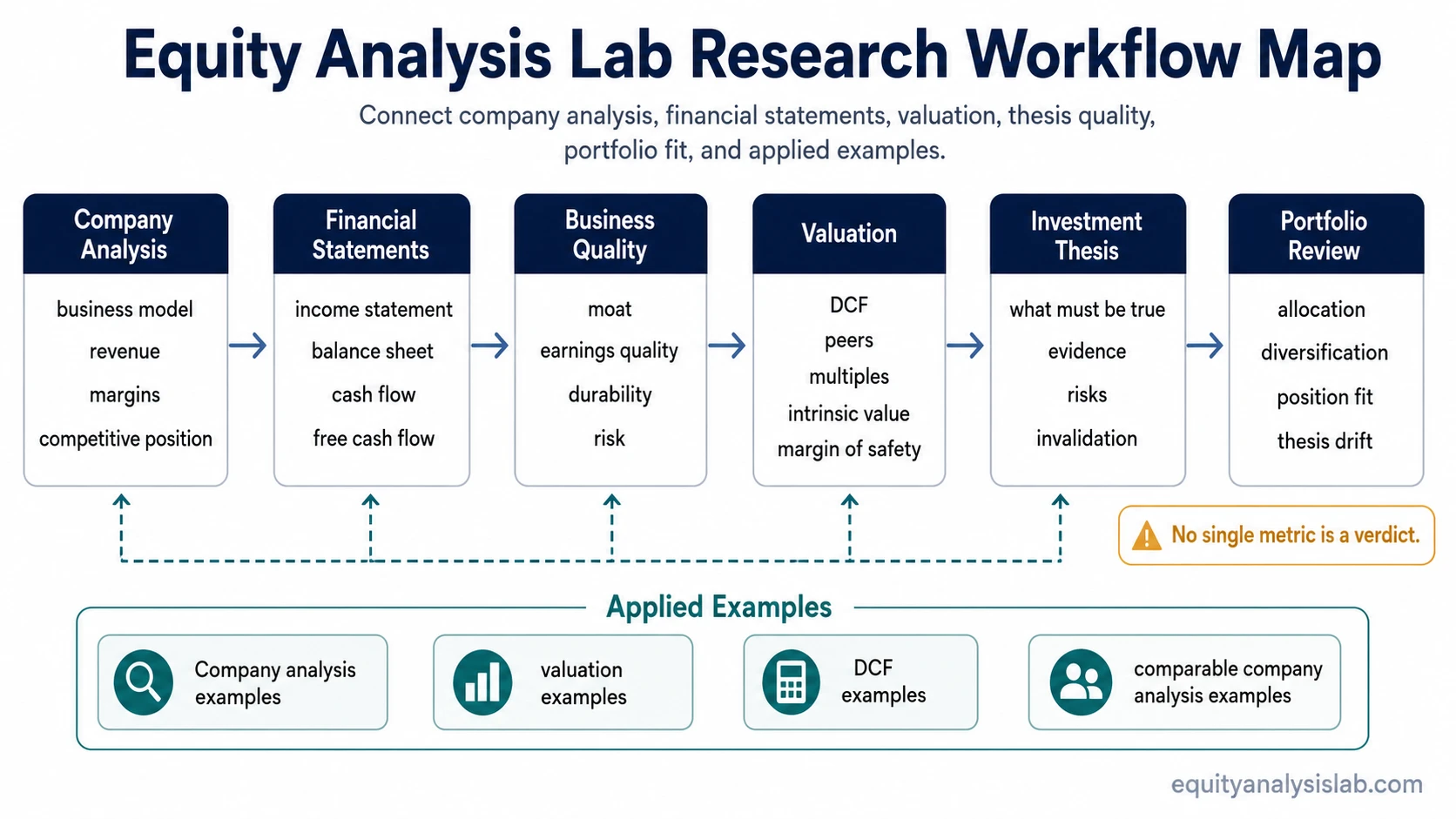
The research library organizes those questions into one sequence: understand the business, test the financial evidence, value the stock, define the thesis, and review how the idea fits inside a portfolio.
Key Points
- Company analysis starts with the business model, financial statements, earnings quality, cash flow, and balance-sheet risk.
- Valuation becomes more useful when DCF work, comparable-company analysis, multiples, intrinsic value, and margin of safety are treated as assumption checks rather than automatic verdicts.
- Portfolio decisions require position context, diversification, asset allocation, thesis quality, and review discipline.
- Applied examples help connect the research process to realistic company-analysis and valuation problems.
Start the Research Workflow
The research process begins with a clear order. First, understand the company. Then read the financial statements, test business quality, estimate value, define the investment thesis, and decide whether the risk fits the portfolio.
| Starting point | Research path | Best for |
|---|---|---|
| Beginning a stock review | how to analyze a stock | A full sequence from business understanding to risk review. |
| Building a valuation process | how to value a stock | Connecting value, assumptions, multiples, and margin of safety. |
| Organizing evidence | investment research process | Putting evidence in a defensible order before forming a thesis. |
| Checking the research file | stock due diligence checklist | Reducing reliance on one metric, story, or headline. |
Analyze the Company
Company analysis asks whether the business can create durable value and whether the reported numbers support the story. Revenue growth, margins, cash flow, debt, dilution, and competitive position all matter because a stock price is only one expression of the underlying business.
Financial statements: Start with the income statement for revenue, costs, and profit.
Use the balance sheet to review assets, liabilities, leverage, and financial strength.
Cash evidence: The cash flow statement helps separate reported profit from actual cash generation.
Free cash flow adds a stricter view of cash left after reinvestment needs.
Business quality: Business model analysis clarifies how the company makes money.
An economic moat review tests whether advantages can last.
Earnings reliability: Quality of earnings checks whether reported profit is supported by durable revenue, margins, cash flow, and conservative accounting.
Common mistake: A familiar product or strong brand is not the same as an investment thesis. Business quality, valuation, cash flow, debt, dilution, and forward risk still need to support the case.
Value the Stock
Valuation translates company evidence into assumptions about future cash flow, earnings, growth, risk, and market expectations. A useful valuation process does not depend on one formula or one multiple. It compares methods and checks whether the assumptions are consistent with the business.
| Valuation focus | Research path | Use when |
|---|---|---|
| Future cash flows | discounted cash flow | Forecast assumptions need to be tested directly. |
| Peer comparison | comparable company analysis | Multiples need peer, quality, and business-model context. |
| Estimated business value | intrinsic value | Market price needs to be compared with estimated value. |
| Uncertainty buffer | margin of safety | Forecast error or business deterioration needs room. |
| Earnings multiple | price-to-earnings ratio | Earnings quality, growth, and cyclicality are central. |
| Enterprise-value comparison | EV/EBITDA | Capital structure and operating earnings affect comparison. |
Valuation discipline: A low multiple is not automatically cheap, and a high multiple is not automatically expensive. Growth quality, cash conversion, leverage, reinvestment needs, cyclicality, and competitive durability change the interpretation.
Connect Research to Portfolio Decisions
A strong company thesis still needs portfolio context. Position size, diversification, asset mix, time horizon, and review discipline determine whether a researched idea fits the investor’s broader plan.
Portfolio structure: Asset allocation connects company-level research to the investor’s broader risk and return structure.
Diversification reduces dependence on one company, sector, factor, or thesis working perfectly.
Ongoing review: A portfolio review process compares current holdings with weights, risk, thesis drift, valuation changes, and new evidence.
Thesis quality: An investment thesis defines what must be true for the investment case to remain intact.
Research boundary: A stock can decline because the whole market is under pressure, because the company thesis is weakening, or because valuation expectations were too high. A disciplined review separates business damage from price movement before changing the thesis.
Study Applied Examples
Examples make the research sequence easier to test. A written analysis can show how financial statements, valuation assumptions, business quality, risk, and portfolio context interact in a realistic decision process.
| Example focus | Research path | What it demonstrates |
|---|---|---|
| Applied investor research | investment analysis examples | Organizing company, valuation, and portfolio evidence. |
| Company research format | stock analysis report example | Connecting business model, statements, valuation, and risks. |
| Valuation walkthrough | company valuation example | Organizing assumptions into an estimate of business value. |
| Cash-flow-based valuation | DCF valuation example | Testing forecasts, discount rates, and terminal value. |
| Peer-based valuation | comparable company analysis example | Comparing peer selection, business quality, growth, and margins. |