
A stock due diligence checklist is a structured review investors use before making an investment decision. It helps test whether the company’s business model, financial statements, valuation, management, ownership structure, and risks support deeper research or point to reasons to wait, revise, or reject the idea.
In public-equity research, due diligence is a control step. Its purpose is to reduce missing-information risk before capital is committed. It is different from an M&A diligence request list, an ETF review, or a trading signal.
Key Points
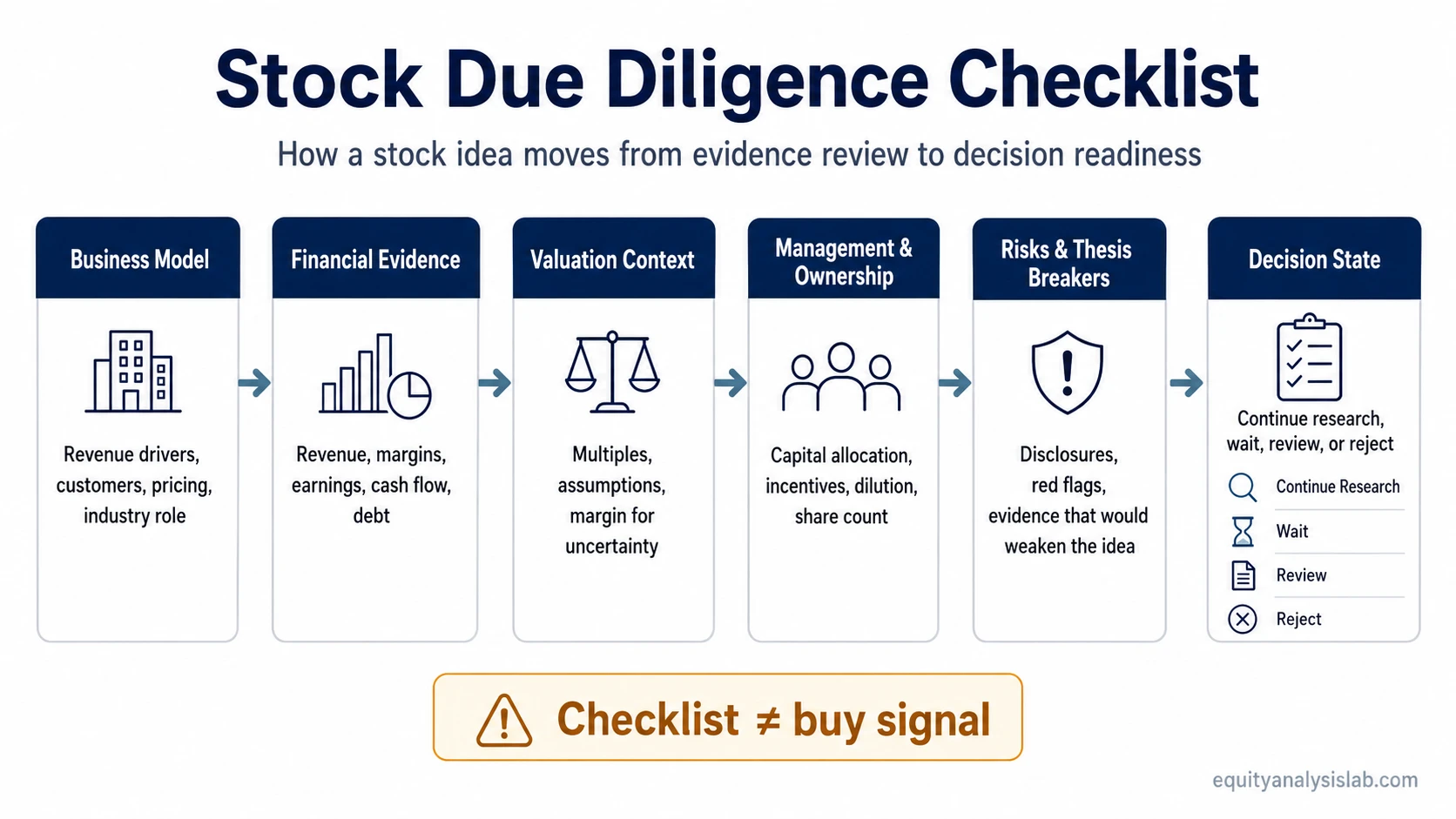
- A stock due diligence checklist helps investors review the evidence behind a stock idea before acting on it.
- The checklist should cover the business model, financial statements, cash flow, balance-sheet risk, valuation, management, dilution, ownership, and thesis breakers.
- The goal is not to force a yes-or-no answer too early. The goal is to reach a clearer decision state.
- The strongest checklists rely on primary sources such as company filings, financial statements, proxy materials, and official disclosures.
- A checklist can reduce omission risk, but it cannot remove uncertainty or replace investor judgment.
What Is a Stock Due Diligence Checklist?
A stock due diligence checklist is a pre-investment research framework that helps investors review the evidence behind a stock idea before turning it into an investment decision. It organizes the main questions around business quality, financial durability, valuation context, management behavior, ownership structure, risk disclosures, and thesis-breaking evidence.
The checklist does not make the decision by itself. It helps separate the company story from the evidence that supports or weakens that story. A stock can sound attractive on the surface and still fail due diligence if cash flow is weak, debt pressure is rising, dilution is changing the per-share picture, or valuation leaves little room for error.
The useful output is a decision state. Continue research if the evidence is strong enough to go deeper. Wait if the evidence is mixed. Return the stock to review if the information is incomplete or stale. Reject the idea if the core thesis is contradicted.
Practical Stock Due Diligence Checklist
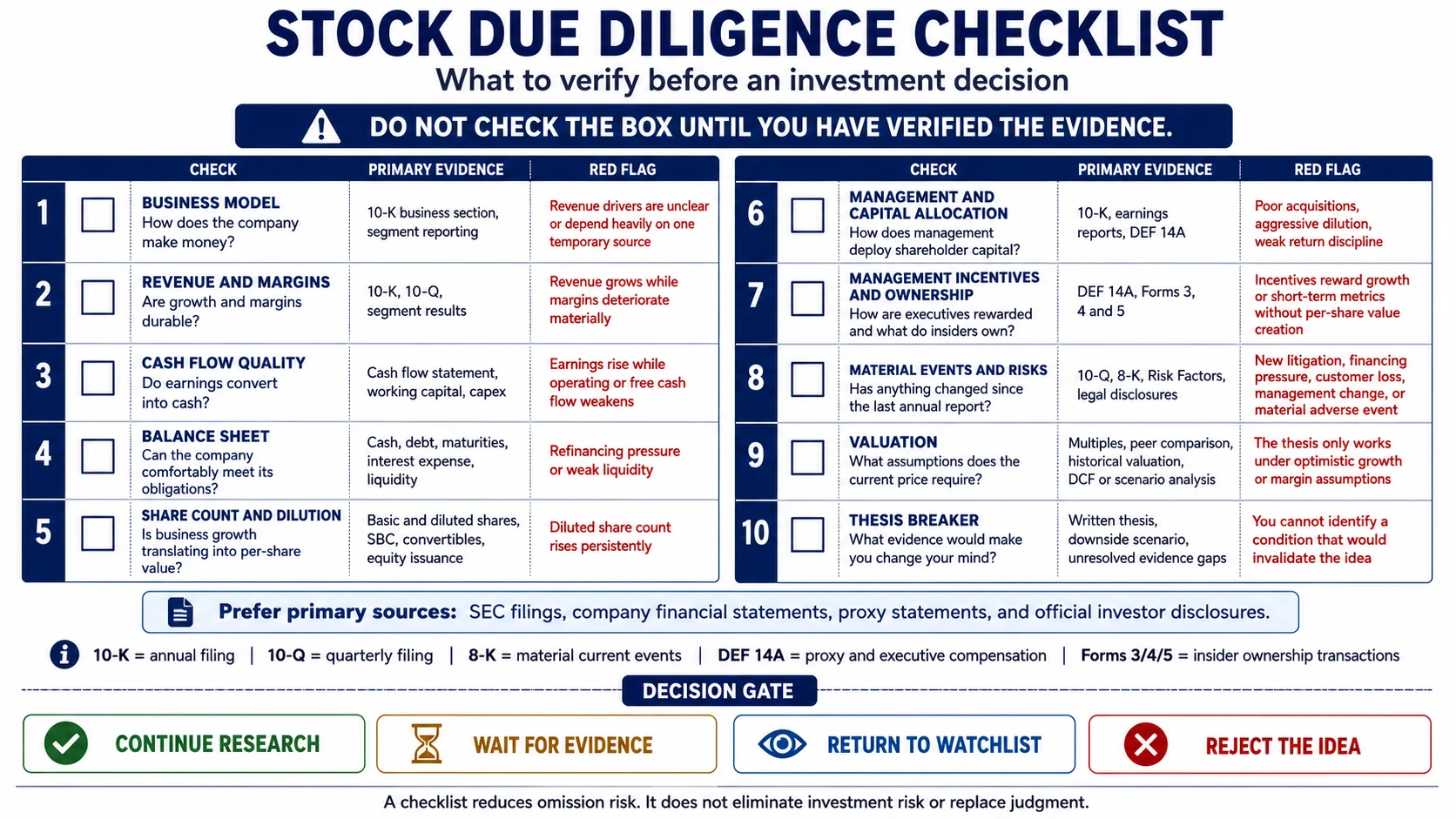
A useful checklist is concrete. Each item should point to evidence, explain why that evidence matters, and identify what would weaken the idea. The goal is not to collect boxes, but to verify what needs to be true for the thesis to make sense.
Stock Due Diligence Checklist: Questions, Evidence, and Thesis Impact
| Due diligence question | Evidence to review | Why it matters | What would weaken the thesis |
|---|---|---|---|
| Does the company have a clear business model? | Revenue sources, customer types, pricing model, product mix, segment reporting, and industry role. | The thesis needs a clear explanation of how the company creates and captures value. | The business depends on unclear revenue drivers, temporary demand, weak unit economics, or a story that cannot be tied to reported results. |
| Are revenue and margins durable enough to support the thesis? | Revenue growth, gross margin, operating margin, net margin, segment trends, backlog where relevant, and management commentary. | Growth becomes more useful when it can translate into durable profitability or operating leverage. | Revenue grows while margins compress, pricing power weakens, or growth depends on one unstable source. |
| Does cash flow confirm or contradict reported earnings? | Operating cash flow, free cash flow, working capital, capital expenditure needs, receivables, inventory, and cash conversion. | Earnings quality improves when profits are supported by cash generation instead of only accounting presentation. | Reported earnings rise while cash flow weakens, working capital absorbs cash, or receivables grow much faster than sales. |
| Is the balance sheet strong enough for the risk being taken? | Cash, debt, maturity schedule, interest expense, interest coverage, liquidity ratios, and refinancing needs. | Balance-sheet pressure can reduce flexibility even when the income statement still looks acceptable. | Debt is high relative to cash flow, liquidity is thin, or refinancing risk could pressure the thesis. |
| Is valuation reasonable relative to growth, quality, and risk? | Valuation multiples, peer context, historical range, DCF assumptions if used, margin of safety, growth expectations, and downside scenarios. | Valuation shows how much future success may already be reflected in the price. | The stock looks attractive only under optimistic assumptions, or looks inexpensive mainly because the business is weakening. |
| Does management allocate capital in a shareholder-aware way? | Buybacks, dividends, reinvestment, acquisitions, debt reduction, compensation incentives, and long-term capital allocation record. | Capital allocation affects whether business value becomes per-share value over time. | Management issues shares aggressively, overpays for acquisitions, or pursues growth without return discipline. |
| Is dilution or ownership structure changing the per-share story? | Basic and diluted shares outstanding, stock-based compensation, convertible securities, insider ownership, major holders, and share issuance history. | Per-share value can weaken even when the company grows if ownership is diluted faster than value is created. | Diluted share count keeps rising, stock-based compensation is heavy, or ownership incentives are unclear. |
| Are industry, customer, or competitive risks visible? | Customer concentration, supplier dependence, competition, regulation, cyclicality, pricing pressure, substitution risk, and industry growth. | A company can look strong in isolation but still face external pressure that changes future cash-flow durability. | One customer, supplier, product, region, or industry cycle carries too much of the thesis. |
| Do filings disclose risks that contradict the investment narrative? | Annual reports, quarterly filings, risk factors, footnotes, segment notes, related-party disclosures, legal proceedings, and management discussion. | Filings can reveal risks that are not obvious in summaries, headlines, or investor presentations. | Disclosures point to accounting uncertainty, legal exposure, liquidity pressure, customer loss, or assumptions that conflict with the thesis. |
| What evidence would invalidate or delay the decision? | Contradictory data, missing evidence, stale information, unresolved risks, valuation mismatch, and scenario assumptions. | A checklist becomes more useful when it defines what would stop the decision, not only what supports it. | The investor cannot name the evidence that would change the view, or ignores weak evidence because the stock price is moving. |
Where to Verify Each Due Diligence Check
A stock due diligence checklist is strongest when it is tied to primary sources. Public investors usually do their best verification work in company filings and official disclosures rather than in summaries or secondary commentary.
| Source | What it is most useful for | Why it belongs in due diligence |
|---|---|---|
| 10-K | Business model, annual financial statements, risk factors, MD&A, segment detail, and long-form disclosures | Provides the broadest yearly view of the company and its major risks. |
| 10-Q | Quarterly results, updated risk discussion, margins, cash flow, liquidity, and developing trends | Shows what has changed since the last annual filing. |
| 8-K | Material current events such as financing, acquisitions, management changes, impairments, or other major developments | Helps catch changes that may affect the thesis before the next 10-Q or 10-K. |
| DEF 14A | Executive compensation, governance, board structure, and voting matters | Useful for management incentives, ownership, and capital-allocation alignment. |
| Forms 3, 4, and 5 | Insider ownership and insider transactions | Helps investors see how insider ownership and trading activity relate to the broader thesis. |
| Earnings releases and investor presentations | Current company narrative, operational updates, guidance, and management framing | Useful context, but should be checked against filings and financial statements. |
Practical rule: use presentations and commentary for context, but use filings and reported statements for verification.
How to Use the Checklist in the Research Process
A stock idea usually begins with a reason to care: growth, profitability, quality, valuation, turnaround potential, or industry position. Due diligence is the stage where that early idea is tested against evidence.
The process does not need to be overly complicated. The investor checks the business model, then tests the financial statements, then reviews balance-sheet risk, valuation context, management behavior, dilution, and the evidence that could break the thesis.
| Decision state | What it usually means |
|---|---|
| Continue research | The core evidence is supportive enough to justify deeper thesis or valuation work. |
| Wait for better evidence | The idea may still be interesting, but the evidence is mixed or incomplete. |
| Return to watchlist | The company is worth monitoring, but the stock is not decision-ready yet. |
| Reject the idea | The evidence materially weakens or contradicts the original thesis. |
Inside the broader investment research process, due diligence acts as the evidence gate. If the evidence is promising but incomplete, the idea can move back to a stock watchlist instead of becoming an immediate decision.
Common Due Diligence Mistakes
| Mistake | Why it matters |
|---|---|
| Using the checklist after the decision is already emotionally made | The checklist turns into justification instead of a control step. |
| Relying too much on narrative and not enough on filings | Important risks, accounting details, or capital-structure issues can be missed. |
| Looking at earnings without checking cash flow | Reported profits may not reflect durable business economics. |
| Ignoring dilution and share count | Business growth does not always translate into per-share value creation. |
| Leaving valuation until the very end | A good business can still be a poor opportunity if the price already assumes too much success. |
| Failing to define thesis breakers | The investor loses a clear standard for changing the view later. |
Limits of a Stock Due Diligence Checklist
A stock due diligence checklist can reduce omission risk, but it does not remove uncertainty, predict returns, or replace investor judgment. A stock can pass many checklist items and still be unattractive if valuation, risk, thesis quality, or portfolio fit does not support the decision.
The checklist also cannot turn a weak thesis into a strong one. It cannot make valuation precise, guarantee that historical performance will continue, or solve the broader questions of position sizing, time horizon, and portfolio fit.
Its main strength is discipline. A good checklist slows down decisions driven by narrative, recent price movement, fear of missing out, or pressure to deploy capital before the evidence is strong enough.
Stock Due Diligence Checklist FAQ
Is stock due diligence the same as stock analysis?
No. Stock analysis is the broader process of studying a company and forming an investment view. Stock due diligence is a control step inside that process that checks whether the evidence is complete, consistent, and strong enough before a decision is made.
Does a due diligence checklist tell you whether to buy a stock?
No. A due diligence checklist does not create a buy signal or recommendation. It helps investors identify evidence, risks, gaps, and thesis breakers so the decision can be made with more discipline.
What should investors check before buying a stock?
Investors should review the business model, revenue drivers, margins, earnings quality, cash flow, debt, valuation, management, capital allocation, dilution, ownership structure, industry risks, filings, and the evidence that could weaken or invalidate the thesis.
When should a stock idea go back to the watchlist instead of becoming an investment?
A stock idea should go back to review when the evidence is incomplete, mixed, stale, or too dependent on optimistic assumptions. It can also return to review when valuation, risk, disclosures, or cash-flow quality do not yet support the thesis.