
Shares outstanding are the company’s current share count for ownership, market capitalization, and basic per-share analysis. Free float is the part of that share count normally available for public trading after restricted, insider, strategic, or otherwise non-freely tradable holdings are excluded.
The difference is not that one number is “better.” The difference is the question being asked. Shares outstanding answer the ownership-base question. Free float answers the tradable-share-base question.
Key Points
- Shares outstanding measure the company’s current share base held by shareholders, excluding treasury shares.
- Free float measures the portion of outstanding shares normally available for public trading.
- Free float is usually a subset of shares outstanding, not a replacement denominator.
- Float figures can vary because data vendors, exchanges, and index providers may classify non-float holdings differently.
Shares Outstanding vs Free Float: The Core Difference
Shares outstanding represent the company’s current share base after treasury shares are removed from issued shares. Investors use this count when they need the denominator behind ownership percentage, market capitalization, and basic per-share analysis.
Free float starts with outstanding shares and narrows the count to shares normally available for public trading. It can exclude restricted shares, locked-up shares, insider holdings, strategic stakes, or other holdings treated as non-float under a specific methodology.
Both numbers can be correct at the same time. Shares outstanding answer, “How many shares currently represent ownership claims?” Free float answers, “How many of those shares are normally part of the public trading supply?”
Shares Outstanding vs Free Float Comparison Table
| Comparison point | Shares outstanding | Free float |
|---|---|---|
| Basic meaning | The current shares held by shareholders, excluding treasury shares held by the company. | The portion of outstanding shares normally available for public trading. |
| Starting point | Issued shares minus treasury shares. | Shares outstanding minus restricted, insider, strategic, locked-up, or other non-float holdings under the relevant methodology. |
| Usually includes | Public shareholders, insiders, institutions, strategic holders, and other holders of currently outstanding shares. | Shares treated as available to public investors under the selected float methodology. |
| Usually excludes | Treasury shares held by the company. | Restricted shares, locked-up shares, certain insider holdings, strategic stakes, and other non-float holdings depending on the source. |
| Main investor question | What is the company’s current ownership denominator? | How much of the share base is normally available to trade? |
| Common use | Market capitalization, basic per-share analysis, ownership percentage, and share-count comparisons over time. | Free-float market capitalization, index weighting, tradable supply context, and liquidity interpretation. |
| Important limitation | It does not show how much stock is actually available for public trading. | It does not replace shares outstanding for the full ownership base, and the calculation can vary by source. |
Compact Formula View
Shares outstanding and free float can be shown as two related share-count formulas, but they should not be used for the same analytical job.
| Measure | Compact formula | What the formula isolates |
|---|---|---|
| Shares outstanding | Issued shares − treasury shares | The current shares held by shareholders outside the company’s treasury. |
| Free float | Shares outstanding − non-float holdings | The portion of outstanding shares normally available for public trading. |
Same-Company Example: One Share Base, Two Investor Questions
Assume a company has 120 million issued shares and holds 20 million of those shares as treasury stock. Its shares outstanding are 100 million.
| Input | Illustrative amount | Interpretation |
|---|---|---|
| Issued shares | 120 million | Total shares the company has issued. |
| Treasury shares | 20 million | Issued shares held by the company and excluded from shares outstanding. |
| Shares outstanding | 100 million | The current ownership share count. |
| Restricted, insider, or strategic holdings | 35 million | Outstanding shares not normally treated as freely tradable. |
| Free float | 65 million | The share count normally available for public trading under this simplified example. |
If the investor is calculating basic market capitalization or a current ownership percentage, the relevant share count is 100 million shares outstanding. If the investor is thinking about tradable supply, free-float market value, or index-style float adjustment, the relevant lens is the 65 million-share float.
Common Confusion: Free Float Is Not the Same Denominator
A common mistake is treating free float as if it replaces shares outstanding everywhere. It does not. Free float is a narrower view of the share base, not a separate larger count.
For basic per-share analysis, ownership percentage, and the standard market capitalization denominator, shares outstanding remain the relevant current share count. Free float becomes more useful when the question depends on public trading availability, float-adjusted market value, index methodology, or liquidity context.
A low free float is not automatically good, bad, bullish, or bearish. It only says that a smaller portion of the outstanding share base is normally available for public trading.
When to Use Shares Outstanding
Use shares outstanding when the analysis depends on the company’s current ownership base rather than the subset of shares available for public trading.
| Investor question | Why shares outstanding fits |
|---|---|
| What is the company’s standard market capitalization? | Market capitalization is usually calculated using share price multiplied by shares outstanding. |
| What ownership percentage does a shareholder hold? | The ownership percentage needs the current ownership share count, not only the public float. |
| What share count supports basic per-share analysis? | Basic per-share metrics normally use the current outstanding share base. |
| How has the company’s share count changed over time? | Changes in shares outstanding can reflect issuance, buybacks, treasury shares, and ownership dilution. |
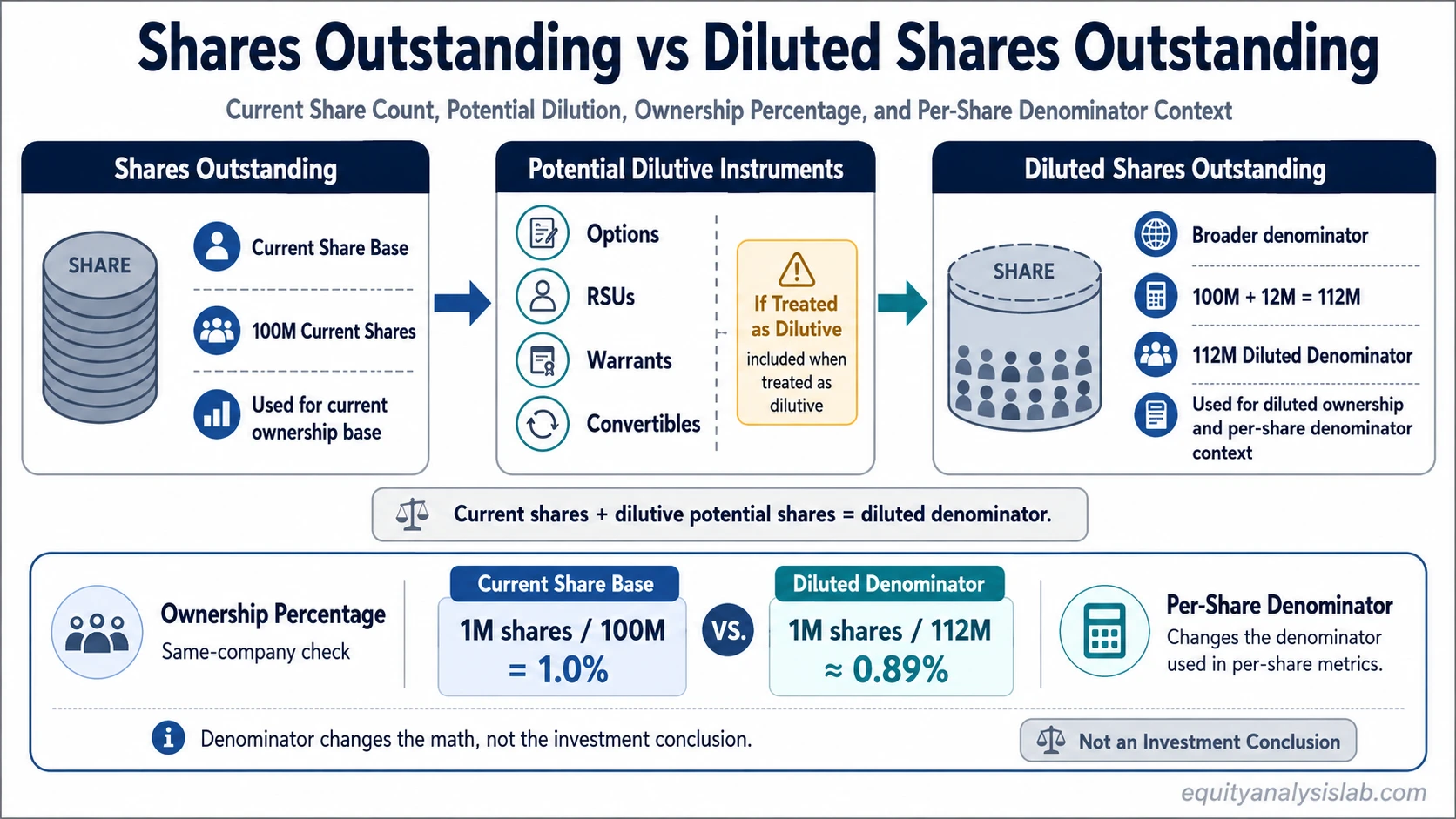
If potential future conversion or dilution is the issue, that is a separate question from current float and may require comparing the current count with diluted shares outstanding.
When to Use Free Float
Use free float when the question depends on the part of the company’s share base that is normally available for public trading.
| Investor question | Why free float fits |
|---|---|
| How much of the share base is normally available to trade? | Free float removes holdings that are not usually part of regular public trading supply. |
| How might an index provider weight the stock? | Some index methodologies use float-adjusted market capitalization rather than total market capitalization. |
| How should liquidity context be framed? | Float can help describe tradable supply, although it does not predict liquidity or price behavior by itself. |
| Why does the tradable share base differ from the ownership base? | Insider, strategic, restricted, or locked-up holdings can make the float smaller than shares outstanding. |
Free-Float Methodology Can Vary by Source
Shares outstanding are usually easier to reconcile because they follow the basic issued-shares-minus-treasury-shares structure. Free float requires more classification judgment because sources may define non-float holdings differently.
One methodology may exclude certain insider holdings, strategic stakes, government holdings, locked-up shares, or restricted shares. Another may use different thresholds or categories. That is why two reputable data sources can sometimes show different float figures for the same company.
When the exact float number matters, investors should compare the company’s filings, investor relations disclosures, exchange rules, index provider methodology, and the data vendor’s float definition rather than relying only on one summary field.
Shares Outstanding vs Free Float in Market Cap
Market capitalization is usually discussed as share price multiplied by shares outstanding. That version reflects the market value implied by the company’s current equity share count.
Free-float market capitalization narrows the calculation to the float-adjusted share base. It is relevant when an index, dataset, or analytical method focuses on the market value of shares available to public investors rather than the entire outstanding count.
These calculations are different lenses, not competing answers. Total market capitalization describes the full current equity value implied by shares outstanding. Free-float market capitalization describes the value of the float-adjusted share base under a specific methodology.
How to Choose the Right Share-Count Lens
Start with the investor question, then choose the share count that matches it.
| If the question is… | Use this lens | Reason |
|---|---|---|
| What is the company’s current ownership base? | Shares outstanding | It includes the current shares held by shareholders after treasury shares are excluded. |
| What share count supports basic per-share analysis? | Shares outstanding | Per-share denominators usually need the current share base, not only the float. |
| How much stock is normally available for public trading? | Free float | It removes shares that are not usually part of public trading supply. |
| Why might index weighting differ from total market value? | Free float | Float-adjusted index methods may focus on the publicly tradable share base. |
| How could future conversion affect the share count? | Diluted share count | This is a potential-dilution question, not the same as current float. |
Shares Outstanding vs Free Float FAQ
Is free float always smaller than shares outstanding?
Free float is normally smaller than or equal to shares outstanding because it starts with the outstanding share base and excludes shares that are not usually freely tradable. If nearly all outstanding shares are publicly tradable, the two numbers may be close.
Does free float replace shares outstanding for EPS?
No. Free float does not replace shares outstanding as the normal denominator for basic per-share analysis. Free float is mainly a tradable-share lens, while shares outstanding describe the broader current ownership base.
Why do different websites show different free-float numbers?
Different sources may apply different float methodologies. They may classify insider holdings, strategic stakes, locked-up shares, government holdings, or restricted shares differently.
Is a low free float automatically good or bad?
No. A low free float is not automatically good, bad, bullish, or bearish. It only tells investors that a smaller portion of the outstanding share base is normally available for public trading.