
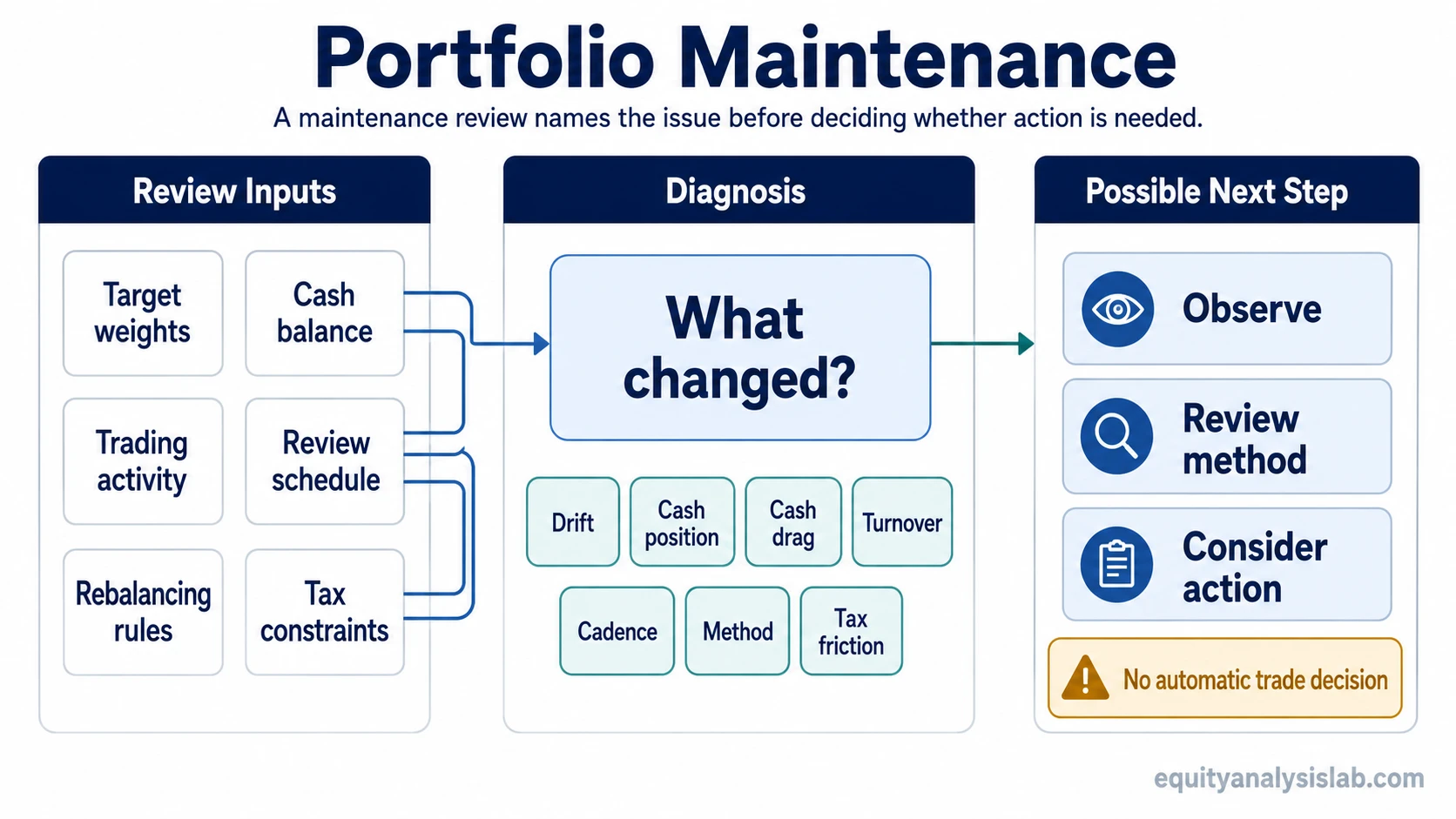
Portfolio maintenance is the review process that identifies what changed inside a portfolio before deciding whether any action is needed. Target weights may have drifted, cash may be too high, turnover may be rising, or the review process may no longer match the investor’s time horizon and risk capacity.
Portfolio maintenance definition: Portfolio maintenance is the ongoing review of portfolio exposures, cash, trading activity, rebalancing method, and implementation constraints. It is not the same as rebalancing. Rebalancing is one possible response after the maintenance review identifies a reason to act.
A useful maintenance review starts with diagnosis. The first question is not whether to trade. The first question is which part of the portfolio has changed: allocation, cash, turnover, review discipline, rebalancing method, or tax friction.
Where portfolio maintenance starts
- Drift: Market movement can push portfolio weights away from their target exposure.
- Cash: A cash balance can be intentional liquidity or an unplanned reduction in market exposure.
- Turnover: Frequent changes can raise costs, taxes, and decision noise.
- Review cadence: A portfolio needs a review rhythm that separates observation from unnecessary activity.
- Rebalancing method: Calendar-based and threshold-based approaches create different monitoring and trading behavior.
- Implementation limits: Taxes, account type, transaction costs, and investor constraints can change how a maintenance decision is applied.
Portfolio maintenance issues and where to go next
Portfolio maintenance works best when each issue is named before the investor chooses a response. The same review date can reveal several different problems, and each problem may call for a different kind of review.
| Reader sees | Likely issue | Read next | Why |
|---|---|---|---|
| Target weights changed after market moves | Portfolio drift | portfolio drift | Drift identifies the exposure gap before choosing whether to rebalance, add cash, trim, or do nothing. |
| Too many trades appear during review | Portfolio turnover | portfolio turnover | Turnover shows the activity and cost side of maintenance, especially when review becomes reactive. |
| Cash balance has grown | Cash position | cash position | Cash can be deliberate liquidity, a temporary parking place, or an unintended allocation shift. |
| Idle cash is changing portfolio behavior | Cash drag | cash drag | Cash drag describes how idle cash can affect exposure and return behavior over time. |
| Unsure whether to rebalance by date or band | Threshold vs calendar rebalancing | threshold vs calendar rebalancing | The method affects cadence, monitoring load, and trading frequency. |
| Review feels reactive or inconsistent | Portfolio review process | portfolio review process | The review process owns cadence, checklist behavior, and decision discipline. |
| Rebalancing creates possible tax friction | Tax-aware implementation | tax-efficient rebalancing | Tax-aware implementation belongs in a separate constraint layer because account type, jurisdiction, and investor circumstances matter. |
Drift and allocation movement
Portfolio drift is the difference between the intended allocation and the current allocation. A portfolio that began with a target weight can move away from that target as some holdings rise, others fall, cash enters, or distributions accumulate.
Drift does not automatically mean a trade is required. It identifies the exposure gap. The next decision depends on how large the drift is, whether it changes the portfolio’s intended risk profile, and whether acting would create costs or taxes that outweigh the benefit of tighter alignment.
Cash position and cash drag
A cash position is the cash allocation itself. It may exist because the investor is waiting to deploy capital, holding liquidity for withdrawals, managing uncertainty, or receiving dividends and sale proceeds.
Cash drag is different. It describes the effect of idle cash when the portfolio’s actual exposure becomes lower than intended. A cash position can be appropriate in one context and a source of drift in another, so maintenance should separate the allocation state from the portfolio consequence.
Turnover and transaction activity
Portfolio turnover measures how much trading or replacement activity occurs inside the portfolio. Maintenance can uncover turnover that is intentional, such as a planned rebalance, or turnover that comes from reacting to every review date, price move, or short-term concern.
High activity can be justified in one context, while low activity can still hide neglect in another. The useful question is whether the activity is connected to a defined maintenance issue: drift, cash allocation, risk capacity, rebalancing method, or implementation constraint.
Review cadence and rebalancing method
A review cadence sets the rhythm for checking the portfolio. A rebalancing method defines how the investor responds when allocations move away from target. These are related, but they are not the same decision.
A portfolio rebalancing strategy is easier to choose after the review identifies the actual issue. A calendar method may check the portfolio on a fixed schedule. A threshold method may wait until an allocation moves beyond a defined band. Each approach can change how often the investor looks, trades, and accepts drift.
Tax-aware implementation limits
Tax-aware maintenance treats tax friction as a constraint, not as the whole decision. A rebalancing action may look clean from an allocation perspective but still create taxable gains, transaction costs, or account-specific complications.
Tax-aware choices depend on account type, jurisdiction, holding period, available losses, contribution flows, and the investor’s broader constraints. For that reason, maintenance can identify where tax friction may matter, but it should not turn that observation into tax advice.
A practical maintenance scenario
For example, a portfolio can still need maintenance even when the holding count looks diversified. One asset class may have grown beyond its target weight, several smaller holdings may share the same earnings or interest-rate driver, cash may have accumulated after sales, and a full rebalance may create unnecessary turnover or tax friction.
The maintenance question is diagnostic: which issue is actually present? The answer may point to drift, cash position, cash drag, turnover, review process, rebalancing method, or tax-aware implementation. It does not automatically produce a buy or sell decision.
What portfolio maintenance does not replace
Portfolio maintenance does not replace asset allocation, security analysis, valuation work, risk-capacity assessment, or an investment policy. It checks whether the existing portfolio still reflects the intended structure and whether any change deserves review.
It also does not make rebalancing automatically correct. A portfolio may be outside target weights, but the investor may still need to weigh costs, taxes, liquidity needs, account type, concentration, and whether the target allocation itself still fits.
Portfolio maintenance limitations
- Portfolio maintenance does not guarantee profit.
- Rebalancing does not guarantee lower losses.
- Diversification and asset allocation do not ensure protection against loss.
- A fixed review schedule is not automatically better than a threshold method.
- Tax-aware choices depend on account type, jurisdiction, and investor constraints.
- Maintenance identifies issues. It does not make the decision automatically.
FAQ
Is portfolio maintenance the same as rebalancing?
No. Portfolio maintenance is the review process that identifies issues such as drift, cash, turnover, cadence, and tax friction. Rebalancing is one possible action after the review shows that allocation has moved away from the intended structure.
How often should a portfolio be reviewed?
The right review cadence depends on the investor’s process, time horizon, portfolio complexity, account constraints, and rebalancing method. A fixed calendar can work for some portfolios, while threshold-based review may be more relevant when allocation bands matter more than dates.
Can portfolio maintenance reduce risk?
Portfolio maintenance can help identify unintended exposure, concentration, cash buildup, or excessive activity. It does not guarantee lower risk, smaller losses, or better returns because market conditions, allocation choices, costs, taxes, and investor behavior still matter.