
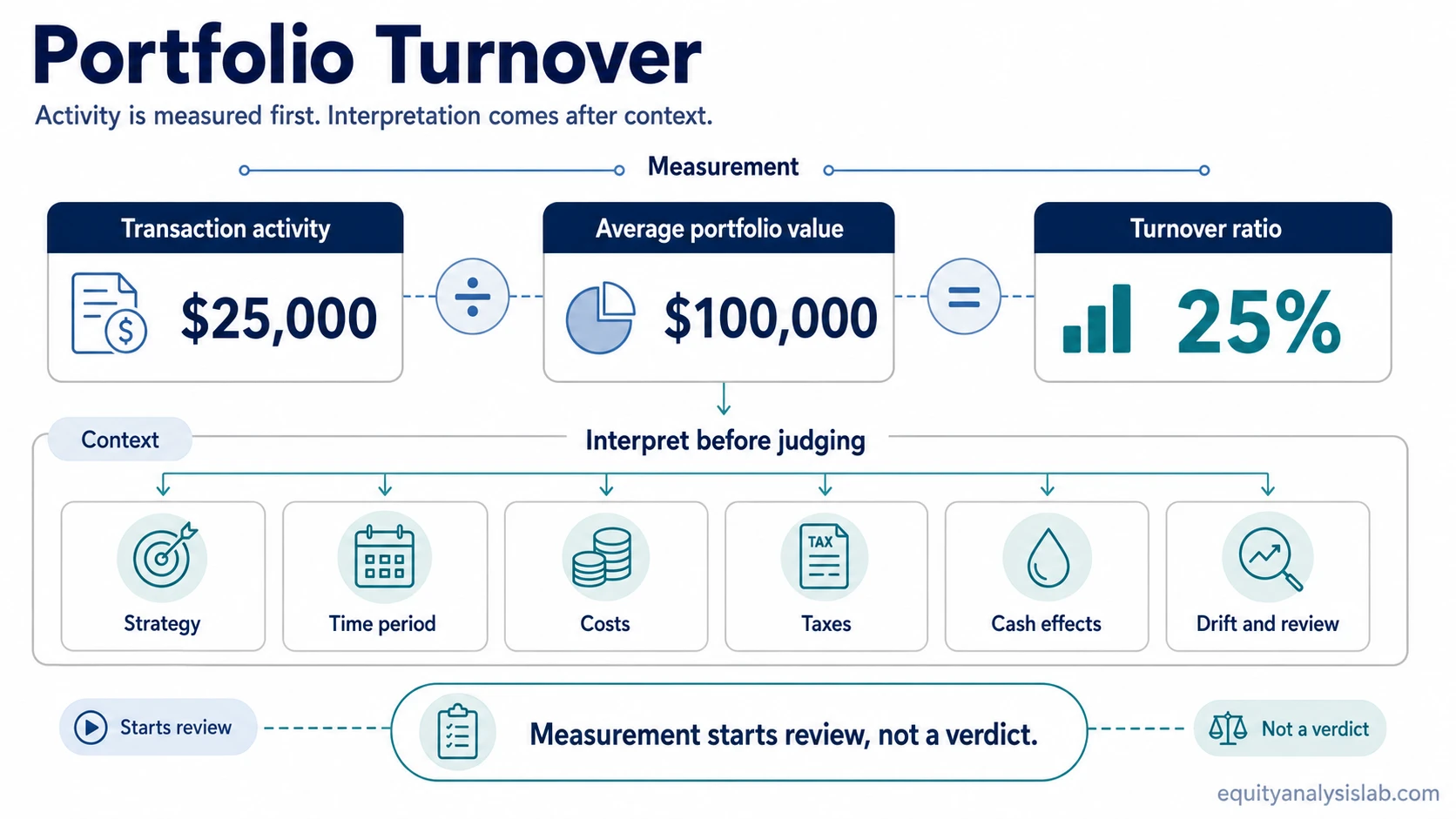
Portfolio turnover measures how much of a portfolio was traded or replaced during a defined period. It is usually expressed as a percentage of average portfolio value or average portfolio securities, so a higher number means more of the portfolio changed during that period.
Definition: Portfolio turnover is a measure of transaction activity relative to portfolio size over a measurement period. It helps show how active the portfolio was, but it does not prove whether the activity was good, bad, disciplined, or excessive.
Key Points
- Portfolio turnover measures transaction activity or portfolio replacement, not investment quality by itself.
- Standard fund-reporting conventions often use the lower of purchases or sales relative to average portfolio securities.
- The same amount of purchases can mean very different things, depending on whether the activity came from new cash or from replacing existing holdings.
- High turnover can raise cost and tax questions, while low turnover can still hide stale exposures or weak review discipline.
- Turnover should be read inside a broader maintenance process, not as a standalone instruction.
What Portfolio Turnover Measures
The useful interpretation starts with the measurement. A turnover number can reflect normal rebalancing, manager activity, cash deployment, security replacement, tax-sensitive decisions, or a change in the portfolio’s intended exposure.
That is why turnover is best treated as a diagnostic measure. It does not tell the investor whether the resulting portfolio is better or worse. It tells the investor that activity occurred and that the reason for the activity should be reviewed.
Main question: How much of the portfolio was actually replaced during the period, and why?
How Reported Fund Portfolio Turnover Is Calculated
A common fund-reporting convention compares portfolio replacement activity with the average portfolio base during the measurement period.
Portfolio turnover rate = lower of total purchases or total sales ÷ average portfolio securities
The result is usually expressed as a percentage. Using the lower of purchases or sales helps avoid double counting portfolio replacement activity. If a fund sells one security and buys another, adding both sides together can overstate how much of the portfolio was actually replaced.
For many registered funds, the reported turnover figure follows a regulatory reporting convention rather than a broad rule for every personal portfolio or brokerage account. Some fund calculations can also exclude certain short-term securities, depending on the reporting standard used.
| Formula component | What it means | Why it matters |
|---|---|---|
| Purchases | Securities bought during the period | Can reflect new deployment, replacement, or repositioning |
| Sales | Securities sold during the period | Can reflect exits, trimming, risk reduction, or replacement |
| Lower of purchases or sales | The smaller side of qualifying activity | Helps approximate portfolio replacement rather than gross trade flow |
| Average portfolio securities | The average portfolio base during the period | Scales the activity to the size of the portfolio |
| Measurement period | The month, quarter, year, or other review window | Short periods can exaggerate temporary activity, while long periods can smooth it |
If qualifying purchases or sales equal $25,000 and the average portfolio securities value is $100,000, the portfolio turnover rate is 25%.
Portfolio Replacement Is Not the Same as Gross Trading Activity
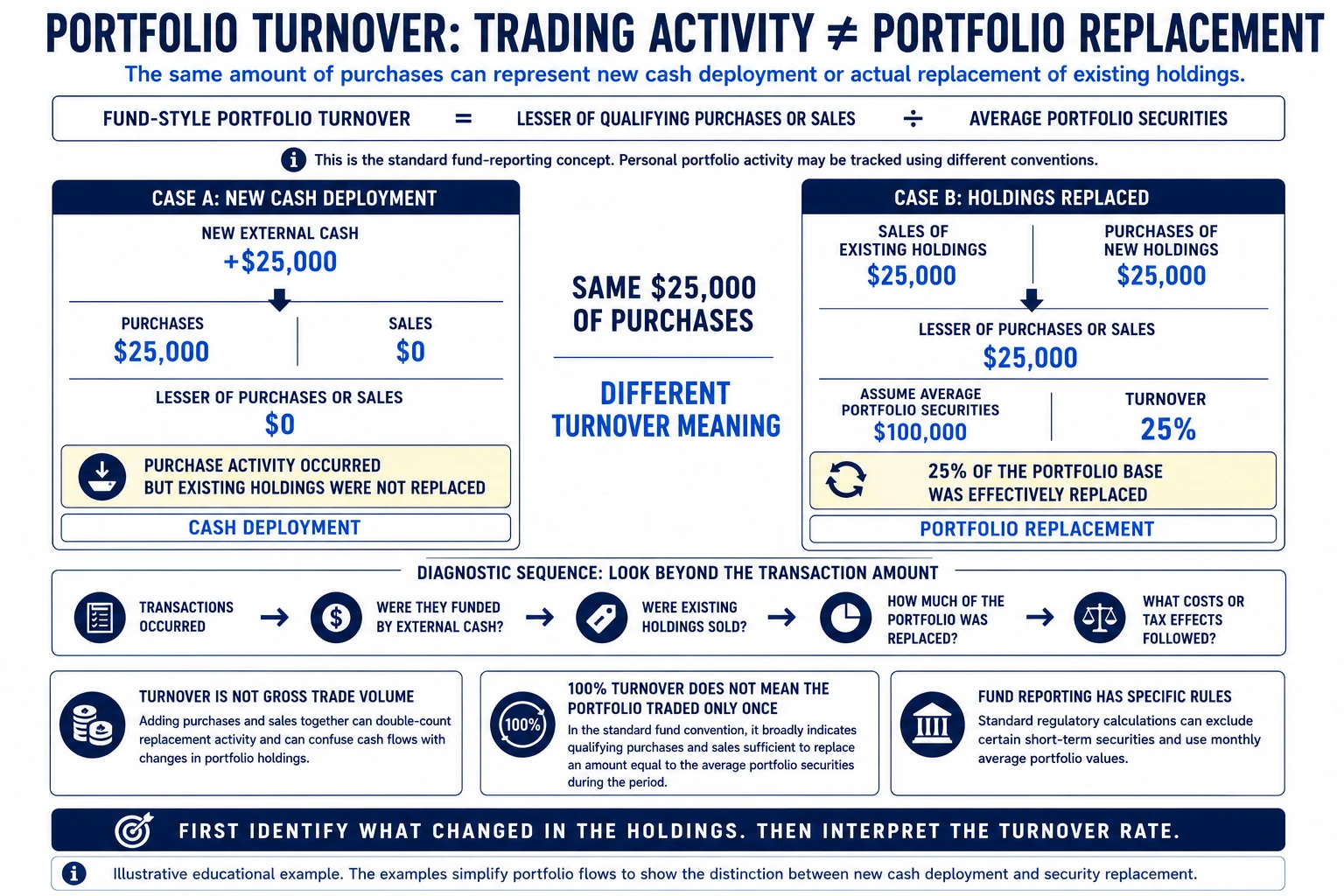
This is the most useful distinction for understanding turnover. Gross buying activity is not always the same as replacing existing holdings.
Suppose a portfolio receives $25,000 of new external cash and uses all of it to buy securities. Purchases occurred, but no existing holdings were sold. Under a fund-style turnover convention, the lower of purchases or sales is zero, so the turnover reading linked to portfolio replacement is very different from the gross purchase amount.
Now consider a second case. The portfolio sells $25,000 of existing holdings and buys $25,000 of new holdings. If average portfolio securities are $100,000, the lower of purchases or sales is $25,000 and the turnover rate is 25%. In this case, a meaningful part of the existing portfolio base was actually replaced.
| Case | Purchases | Sales | Lower of purchases or sales | Interpretation |
|---|---|---|---|---|
| New cash deployment | $25,000 | $0 | $0 | Cash was invested, but existing holdings were not replaced |
| Holdings replaced | $25,000 | $25,000 | $25,000 | Part of the portfolio base was actually replaced |
Practical takeaway: Before interpreting turnover, first ask whether the activity came from cash entering or leaving the portfolio, or from changing the holdings already inside the portfolio.
How to Interpret High or Low Portfolio Turnover
High portfolio turnover usually means more of the portfolio changed during the measured period. That may raise questions about transaction costs, taxable gains, manager discipline, strategy consistency, and whether the activity was part of a deliberate review. It may also be normal for a portfolio designed to adjust frequently.
Low portfolio turnover usually means less of the portfolio changed. That may suggest patience, low transaction activity, or a longer holding period. It may also create false comfort if the portfolio has not been reviewed, if exposures have become stale, or if the portfolio has moved away from its intended structure without action.
High turnover is not automatically bad. It may reflect active management, security replacement, risk reduction, cash deployment, or rebalancing after major market moves.
Low turnover is not automatically good. It may reflect discipline, but it may also reflect neglect, legacy holdings, unrealized tax concerns, or a portfolio that has not adjusted to changing objectives.
The better question is whether the activity matches the portfolio’s mandate, review period, cost structure, tax setting, and intended exposure.
Costs, Taxes, and Cash Effects
Turnover matters because transactions are not frictionless. Buying and selling can create direct trading costs, spread costs, taxable events in some account types, and timing gaps between sale proceeds and redeployment.
When sales leave money uninvested for longer than intended, the turnover discussion can overlap with cash drag. The issue is not turnover alone, but whether transaction activity creates idle cash exposure that changes the portfolio’s intended return and risk profile.
Turnover may also change the portfolio cash position. A sale raises cash until it is redeployed, while a purchase reduces cash and changes exposure. That cash movement can be temporary, deliberate, or a sign that the review process is incomplete.
Tax interpretation remains account-specific. A turnover number does not show tax basis, holding periods, jurisdiction, account type, or the realized gain and loss profile. It only flags that transaction activity occurred and may deserve closer review.
Portfolio Turnover vs Portfolio Drift
Portfolio turnover and portfolio drift are related, but they measure different things. Turnover measures buying and selling activity. Drift measures how far portfolio weights moved from a target or intended allocation.
A portfolio may have high turnover without much allocation drift if trades replace securities inside the same category. A portfolio may also have low turnover and still show meaningful drift in portfolio weights if market prices move and the investor does not rebalance.
| Concept | What it measures | Common confusion |
|---|---|---|
| Portfolio turnover | How much buying and selling occurred during a period | It can be mistaken for portfolio quality or discipline |
| Portfolio drift | How far current weights moved from intended weights | It can be mistaken for transaction activity |
Fund Reporting and Personal Portfolio Activity Are Not the Same Measurement
A published mutual fund or ETF turnover figure is usually a regulated reporting metric. A personal portfolio, separately managed account, or custom investor report may track activity differently.
That distinction matters because a personal portfolio review may care about questions that a published fund turnover ratio does not fully answer, such as contribution flows, withdrawal flows, partial rebalancing, tax lots, or how much of the exposure was changed without fully replacing the underlying holdings.
Measurement caution: A single turnover label does not guarantee that two reports used the same calculation method. Before comparing turnover figures, confirm the reporting basis and the period measured.
When Portfolio Turnover Can Mislead
Portfolio turnover can mislead when it is compared across different strategies, account types, tax settings, reporting bases, peer sets, or review periods. The number shows activity, but not automatically the reason for the activity.
A turnover number can create a false alarm when activity looks high but the portfolio was intentionally adjusted after a major contribution, withdrawal, mandate change, risk review, or security replacement. The number can also create false comfort when activity looks low but the portfolio has not been reviewed or has drifted away from its intended structure.
Common mistake: treating turnover as a standalone verdict. Turnover is most useful when it starts a question: what changed, why did it change, what did it cost, and does the resulting portfolio still match the intended structure?
How Turnover Fits Portfolio Maintenance
Portfolio turnover belongs inside a broader portfolio review process. The ratio can flag activity, but the review has to connect that activity to holdings, costs, taxes, cash, allocation drift, and the investor’s stated objectives.
A useful review does not treat turnover as an instruction. It treats turnover as evidence that something changed. The next step is to understand whether the change was intentional, whether it improved the portfolio’s structure, and whether costs, taxes, cash, or exposure changes remain after the transactions.
FAQ
What is portfolio turnover?
Portfolio turnover is a measure of transaction activity or portfolio replacement over a defined period, usually scaled to average portfolio value or average portfolio securities and expressed as a percentage.
How is portfolio turnover calculated?
A common fund-reporting approach uses the lower of qualifying purchases or sales divided by average portfolio securities for the same period. Other portfolio reports may use different tracking conventions, so the reporting basis should be confirmed before comparison.
Why use the lower of purchases or sales?
Using the lower side helps approximate how much of the portfolio was actually replaced, rather than double counting both sides of the same replacement activity or confusing new cash deployment with portfolio turnover.
Is high portfolio turnover bad?
High portfolio turnover is not automatically bad. It can raise cost, tax, and discipline questions, but its meaning depends on the strategy, period, account type, and reason for the activity.
Is low portfolio turnover good?
Low portfolio turnover is not automatically good. It can reflect patience or low costs, but it can also hide stale exposures, allocation drift, or a lack of review if the portfolio has changed around the investor’s objectives.