
Investment thesis development is the investor process of turning a stock idea into a testable research claim. The useful next step depends on whether you need the thesis concept, the build process, or the point where evidence becomes decision-ready.
Scope: a stock thesis is not a prediction, a target price, or a recommendation by itself. It is a structured claim about why a company may deserve investor attention, what evidence supports that claim, what could weaken it, and what still needs to be reviewed before action.
- Start with the core thesis concept if you need the definition and role of a thesis.
- Move into the build process when you need to connect business evidence, financials, valuation, risk, and review conditions.
- Use the decision path only after the thesis has been tested against risk, valuation context, and portfolio fit.
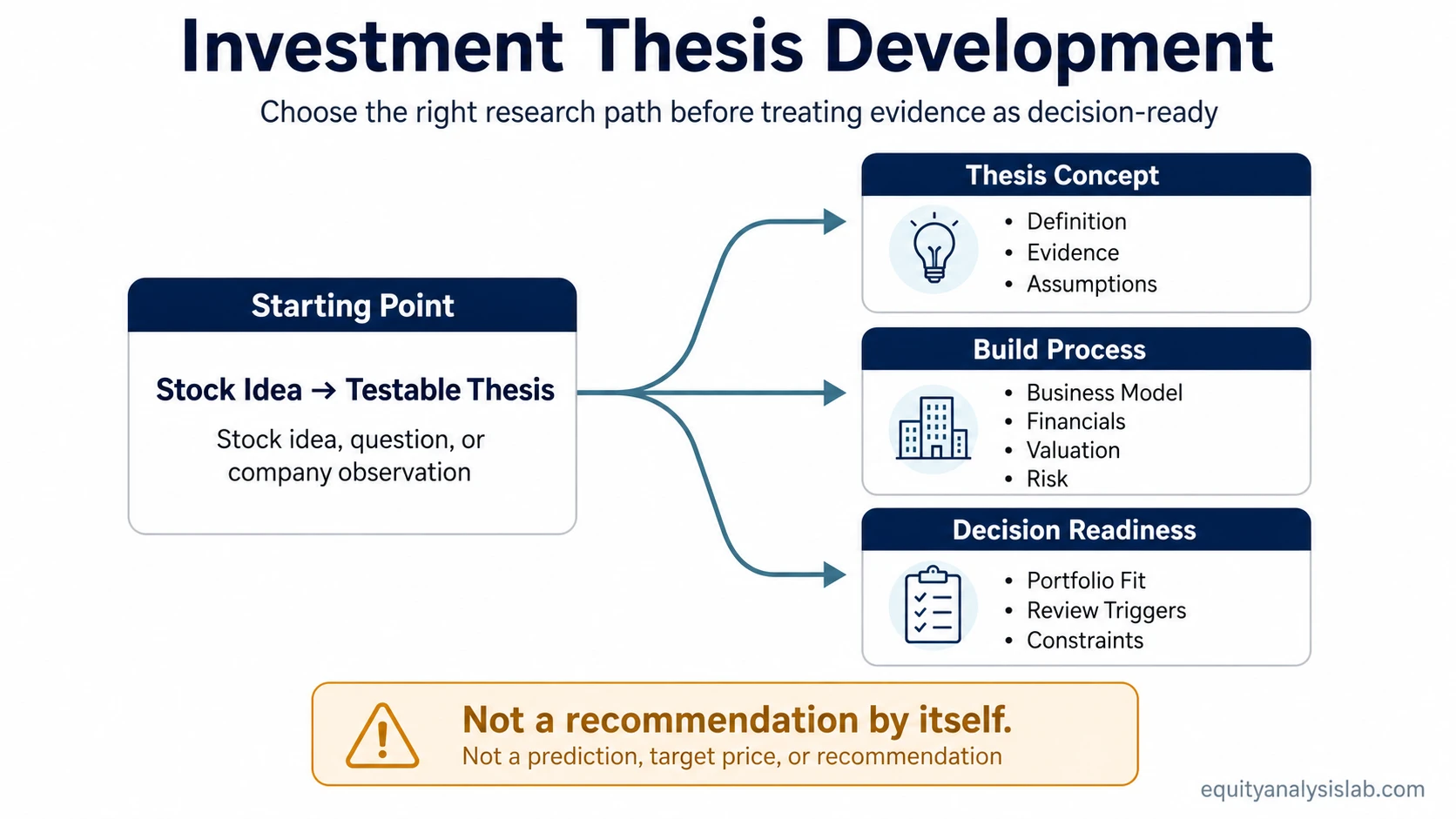
Choose the Right Thesis Development Path
Different readers arrive at thesis development with different gaps. Some need the concept, some need the research process, and some need to understand when evidence is strong enough to review a stock for possible action.
| Reader need | Best next path | What that path helps clarify |
|---|---|---|
| You need to understand what a thesis is | investment thesis | The purpose of a thesis, what it should contain, and why it is different from a simple opinion about a stock. |
| You have a stock idea but need to structure the evidence | how to build an investment thesis | How business quality, financial statements, valuation, risk, and review triggers connect inside a research process. |
| You want to know whether the evidence is actionable | when to buy a stock | How thesis evidence, valuation context, risk, and portfolio fit can be reviewed before a buy decision is considered. |
What Belongs in Thesis Evidence
A useful investment thesis is built from evidence categories, not from conviction alone. Each category answers a different part of the investor question.
| Evidence area | Question it answers | Why it matters in thesis development |
|---|---|---|
| Business model | How does the company make money? | The thesis needs a clear economic engine before valuation or narrative can be useful. |
| Financial statements | Do revenue, margins, cash flow, and balance-sheet quality support the story? | Strong narrative should still be checked against earnings quality, cash generation, leverage, and durability. |
| Valuation | What expectations appear to be reflected in the current price? | Valuation gives context for the thesis, but it does not replace business quality or risk review. |
| Risk | What could make the thesis wrong or less attractive? | A thesis is stronger when the downside case, uncertainty, and invalidating evidence are visible. |
| Portfolio fit | Does the idea fit the investor’s existing exposure and time horizon? | Even a well-supported thesis may be unsuitable if it creates concentration, liquidity, or time-horizon mismatch. |
| Decision boundary | What evidence would justify review, waiting, reducing enthusiasm, or rejecting the idea? | The thesis should define what would change the conclusion instead of relying on vague confidence. |
How a Stock Idea Moves Through Thesis Development
A stock idea usually becomes more useful when it moves through a sequence: the initial observation, evidence collection, thesis statement, risk test, and decision-readiness review. Skipping the sequence can make a thesis sound confident before it is actually supported.
| Stage | Investor task | Output |
|---|---|---|
| Idea | Identify the business, valuation, quality, or change that makes the company worth researching. | A research candidate, not a conclusion. |
| Evidence collection | Review business model quality, financial statements, valuation context, risks, and portfolio relevance. | A structured evidence base. |
| Thesis statement | Turn the evidence into a testable claim about the company and the reason it may matter. | A concise thesis with assumptions and conditions. |
| Risk test | Ask what would weaken the thesis, contradict the evidence, or make the valuation less attractive. | A clearer boundary between supported evidence and unresolved uncertainty. |
| Review / decision readiness | Check whether the thesis is strong enough to continue research, monitor, reject, or move into a decision framework. | A next research action rather than an automatic buy or sell instruction. |
A Simple Thesis Development Example
A stock idea may begin with a business-quality observation, such as improving margins or stronger cash generation. That observation is not yet a thesis. It becomes more useful only after the investor checks whether the financial statements support it, whether valuation already reflects it, what risks could offset it, and what evidence would require the thesis to be reviewed.
Top-Down and Bottom-Up Inputs Can Both Matter
Some thesis work begins with a company-specific observation, such as earnings quality, cash flow, or competitive advantage. Other thesis work begins with a broader industry or economic theme and then narrows toward individual companies. In either case, the thesis still needs company-level evidence before it becomes useful for investor decision-making.
Common Thesis Development Mistakes
Thesis development is most useful when it prevents a stock idea from becoming a conclusion too early. The common mistakes usually come from treating narrative, valuation, or confidence as enough evidence by themselves.
- Confusing a thesis with a recommendation: a thesis organizes evidence; it does not automatically tell an investor to buy, hold, or sell.
- Writing a narrative without testable evidence: a compelling story should still be checked against financial statements, cash flow, competitive position, and risk.
- Using valuation without business-quality context: a low multiple or high implied upside is not enough if the business quality, earnings durability, or balance-sheet risk is weak.
- Treating conviction as confirmation: confidence does not replace evidence that can be reviewed, challenged, or updated.
- Jumping to decision language too early: buy, sell, or add decisions require a separate review of thesis support, valuation, risk, position size, and portfolio fit.
FAQ
Is thesis development the same as an investment thesis?
No. Thesis development is the process of forming, testing, and refining the claim. An investment thesis is the resulting evidence-based claim about why a company may deserve investor attention.
Is an investment thesis a buy recommendation?
No. An investment thesis organizes evidence and assumptions. A buy decision requires a separate review of valuation, risk, position size, portfolio fit, and the investor’s own constraints.
When should an investment thesis be reviewed?
An investment thesis should be reviewed when new evidence changes the business case, financial quality, valuation context, risk profile, or portfolio fit. The review should focus on whether the original claim is still supported.