
An emerging markets ETF is an exchange-traded fund that gives investors exposure to securities from emerging-market economies. The label does not define the full exposure by itself, because two funds can use different indexes, country classifications, weighting rules, holdings, costs, liquidity profiles, distributions, and tracking behavior.
Definition: An emerging markets ETF is an ETF category built around exposure to companies, bonds, or other securities linked to emerging-market economies. Many funds in this category hold emerging-market equities, but the actual exposure depends on the fund mandate, benchmark, portfolio construction, and management style.
Key Points
- An emerging markets ETF is a category label, not a guarantee that every fund has the same country mix, holdings, or risk profile.
- Passive funds usually track an emerging-market index, while active funds may select securities differently from the benchmark.
- Country classification can vary by index provider, so one fund may treat a market differently from another fund.
- Expense ratio matters, but spread, liquidity, tracking difference, distributions, and portfolio concentration also affect the ownership experience.
What Is an Emerging Markets ETF?
An emerging markets ETF is a fund traded on an exchange that packages exposure to securities from economies commonly classified as emerging rather than developed. The most common version is an emerging markets equity ETF, but the same broad label can also appear in funds with narrower country, regional, factor, bond, or actively managed mandates.
The important first distinction is between the ETF label and the actual exposure engine. One emerging markets ETF may track a broad index of companies across many countries. Another may focus on a subset of countries, a narrower theme, a particular factor, or an active manager’s security selection process.
That means the first question is not whether the fund is called an emerging markets ETF. The more useful question is what the fund actually owns, how it chooses those holdings, how concentrated the portfolio is, and how closely the fund behaves relative to the benchmark investors expect.
How Emerging Markets ETF Exposure Works
Emerging markets ETF exposure usually starts with a fund mandate. The mandate defines whether the fund aims to track an index, hold a selected basket of securities, follow a factor process, invest in emerging-market debt, or use a more active approach.
In a passive structure, the fund normally follows an index provider’s rules. Those rules determine which countries qualify, which securities enter the index, how companies are weighted, when the index rebalances, and how much concentration can build in the largest markets or companies.
An actively managed ETF can use a different process. It may overweight or avoid certain countries, sectors, companies, or currencies based on the manager’s research. That can make the fund less tied to a benchmark, but it also makes the manager’s process more important to inspect.
Some emerging-market classifications also differ across index providers. A market that appears in one provider’s emerging-market universe may be treated differently by another provider. This can change country exposure even when two funds appear to target the same broad category.
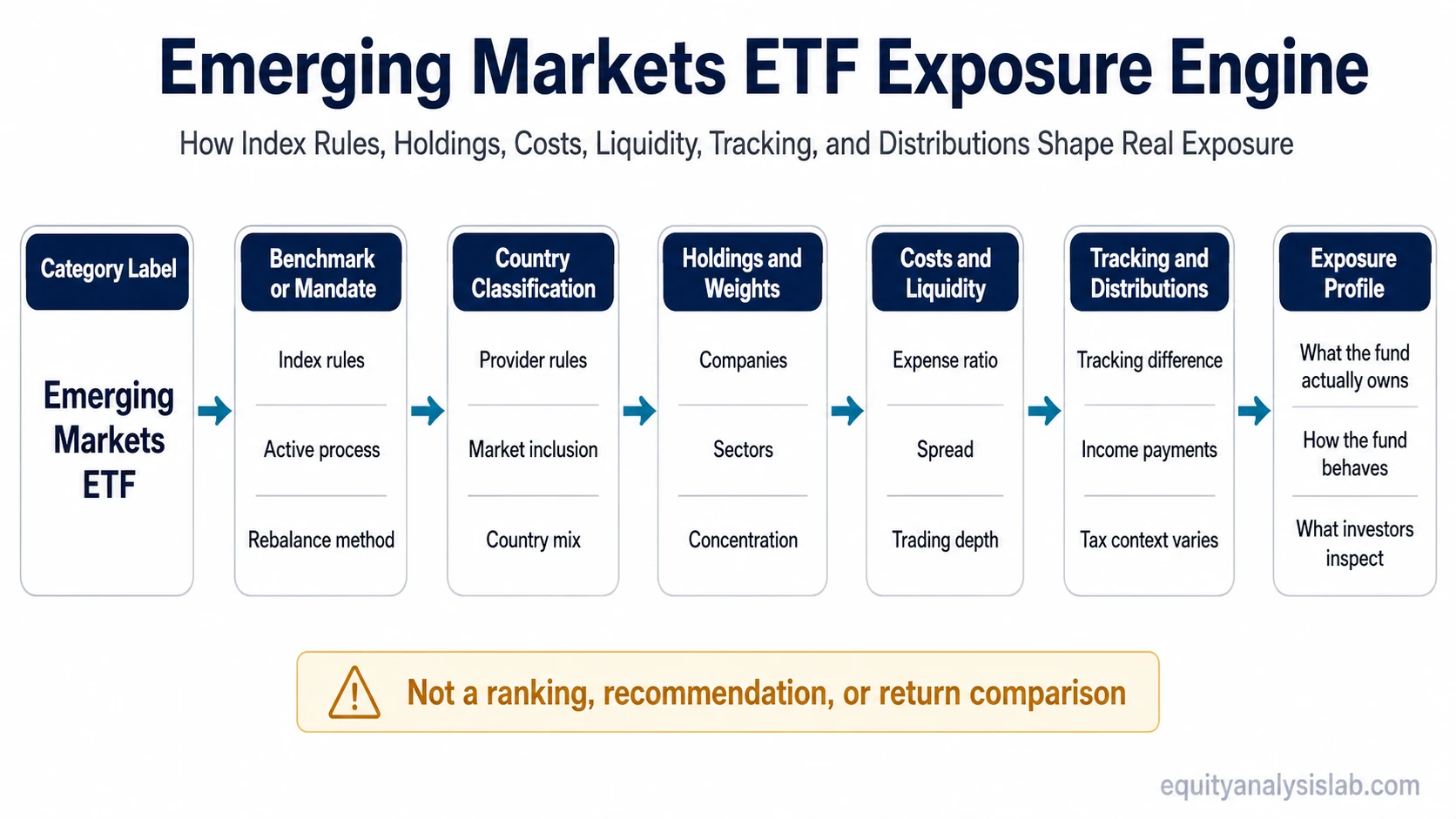
What To Check Before Comparing Emerging Markets ETFs
The strongest comparison starts with the portfolio, not the label. Investors can review the benchmark, holdings, country weights, sector weights, expense ratio, trading spread, liquidity, distributions, and tracking behavior before assuming that two emerging markets ETFs are interchangeable.
| Check | What it tells you | Why it matters |
|---|---|---|
| Benchmark or mandate | The index or process the ETF follows | Defines the fund’s intended exposure |
| Country mix | Which markets dominate the portfolio | Shows whether exposure is broad or concentrated |
| Holdings and weights | The companies, issuers, sectors, and position sizes inside the fund | Reveals what the investor actually owns |
| Expense ratio | The stated annual fund cost | Useful, but not the only cost variable |
| Spread and liquidity | How efficiently shares may trade | Can affect real execution cost, especially in less liquid products |
| Tracking behavior | How closely the fund follows its benchmark or mandate | Helps identify whether exposure behaves as expected |
| Distributions | Income, capital gains distributions, and payment pattern | Affects the ownership experience and may matter by account type |
Emerging Markets Equity ETF vs Broader Emerging-Market Exposure
An emerging markets equity ETF normally focuses on company shares from emerging-market economies. That makes company selection, sector mix, index weighting, and country concentration central to the exposure.
Broader emerging-market exposure can also involve bonds, currencies, regional funds, single-country funds, factor strategies, or active management. These are not identical exposures even when they share the emerging-market label.
This distinction matters because a fund built around emerging-market equities will not behave the same way as a fund built around emerging-market debt or a narrow country allocation. The label may be similar, but the risk drivers can be different.
Costs, Liquidity, Tracking, and Distributions
Cost analysis should not stop at the expense ratio. A lower expense ratio can be useful, but the ownership experience also depends on trading spread, market liquidity, tracking difference, portfolio turnover, and how the fund handles distributions.
Liquidity has two layers. The ETF shares trade on an exchange, but the underlying securities may trade in markets with different hours, liquidity conditions, settlement practices, or access constraints. This can affect spreads and premiums or discounts in stressed conditions.
Tracking difference is also important. A passive fund may not match its benchmark perfectly because of costs, sampling, taxes, cash drag, local-market frictions, securities lending, or timing differences. An active fund may differ from a benchmark by design.
Distributions can include dividends, income, or capital gains distributions depending on the fund structure and portfolio activity. Tax treatment varies by investor, jurisdiction, account type, and fund design, so distributions should be reviewed as part of the fund’s documents rather than assumed from the category label.
Risks and Limitations of Emerging Markets ETFs
Emerging markets ETFs can provide diversified access to markets that may be difficult for some investors to access directly, but they still carry risks. These can include country risk, currency risk, political risk, liquidity risk, governance differences, concentration risk, and benchmark-construction risk.
A broad fund may also be less diversified than the name suggests if a small number of countries, sectors, or companies dominate the portfolio. The investor may think they are buying broad emerging-market exposure while actually taking a large allocation to a narrower group of markets or issuers.
Limitation: An emerging markets ETF does not remove the need to inspect holdings, benchmark rules, concentration, liquidity, and costs. The ETF wrapper can simplify access, but it does not make the underlying exposure risk-free or uniform.
Related ETF Types
Emerging-market exposure can overlap with several other ETF categories. A broad equity fund may behave differently from a single-country ETF, a regional ETF, a factor ETF, or an active strategy that selects securities across emerging economies.
Asset class also changes the category. A bond ETF structure becomes the closer comparison when emerging-market exposure comes from debt securities rather than stocks. The investor is then comparing credit, duration, currency, and issuer risk, not only company equity exposure.
Commodity exposure through ETFs is a different question again. A commodity ETF may hold or reference physical commodities, futures, producer equities, or broad commodity baskets, while an emerging markets ETF is usually organized around country, company, or issuer exposure.
FAQ
What is an emerging markets ETF?
An emerging markets ETF is an exchange-traded fund that gives investors exposure to securities from emerging-market economies. The exact exposure depends on the fund’s benchmark, holdings, country mix, weighting method, management style, costs, liquidity, and tracking behavior.
Are all emerging markets ETFs the same?
No. Two emerging markets ETFs can differ by index provider, country classification, holdings, sector weights, expense ratio, liquidity, currency exposure, distributions, and tracking behavior.
Is the lowest-cost emerging markets ETF always better?
No. Expense ratio is important, but it is only one variable. Spread, liquidity, tracking difference, holdings concentration, distribution policy, and benchmark fit can also affect the ownership experience.
Does an emerging markets ETF automatically provide broad diversification?
No. Some funds are broad, while others may be concentrated in certain countries, sectors, companies, or strategies. Holdings and country weights must be inspected before assuming diversification.