
ETF types are categories of exchange-traded funds grouped by what they hold, how they get exposure, and how their strategy or structure works.
The label is only the starting point. Holdings, weighting, costs, tracking behavior, liquidity, distribution policy, tax mechanics, and structural complexity can change how a fund behaves for an investor.
Use ETF type labels to sort the category first, then move into the specific concept that explains the exposure, methodology, or structure more precisely.
Key Points
- ETF type labels group funds by exposure, strategy, structure, or objective.
- The label does not fully describe holdings, weighting, costs, liquidity, tracking behavior, distributions, or tax mechanics.
- Start with the exposure category, then check the methodology and structure behind the fund.
- Detailed mechanics are better handled in the individual ETF type explanations.
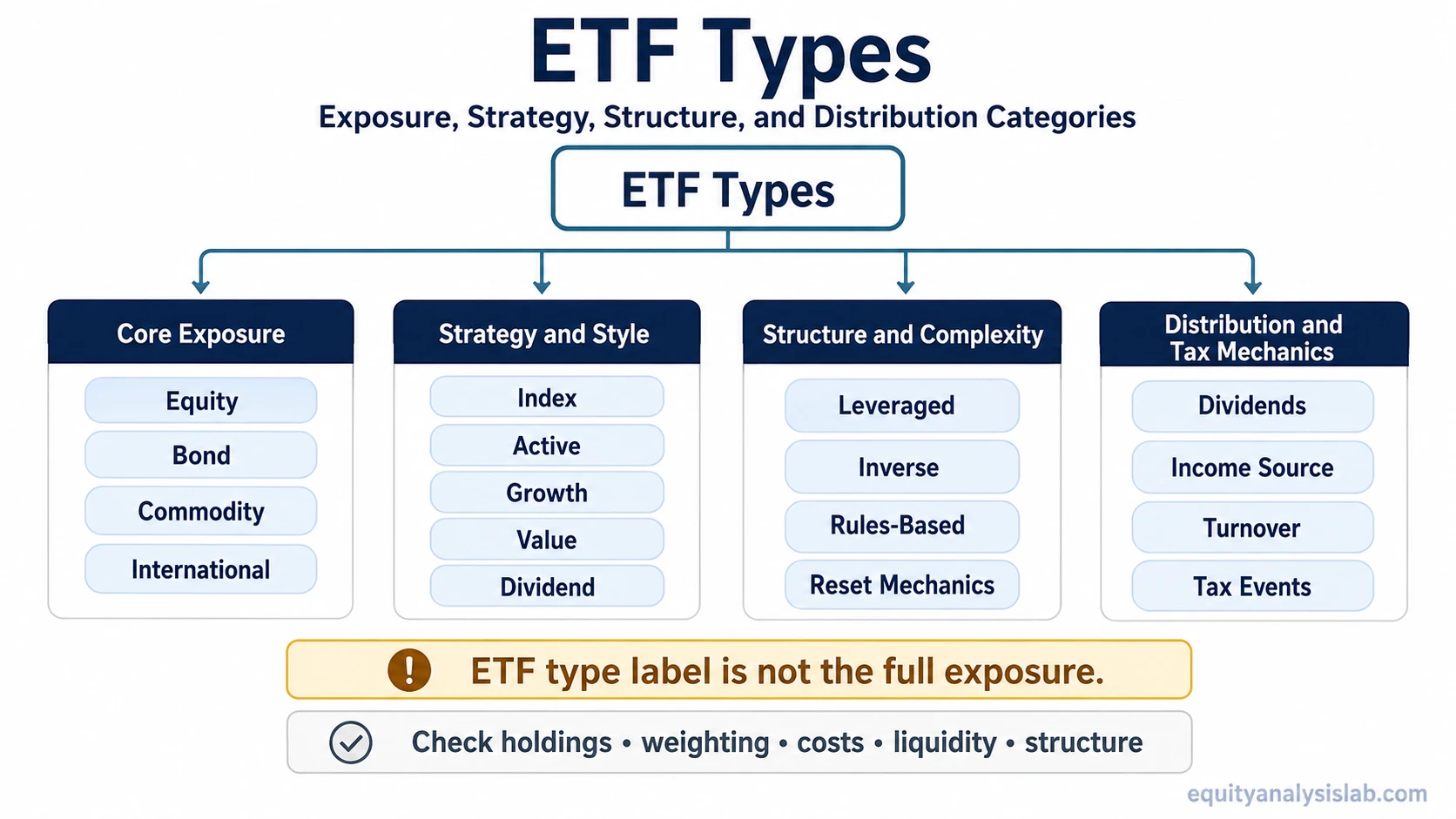
ETF Types by Exposure and Structure
ETF categories usually sort funds by what they own, how they select holdings, how they weight exposure, or whether the structure adds complexity. The same broad label can still contain very different risk, cost, liquidity, and tracking profiles.
| ETF type group | What it sorts by | Examples of concepts | What to check next |
|---|---|---|---|
| Core exposure | The main asset or market the fund is designed to represent. | Equity, bond, commodity, gold, silver, international, and emerging-market exposure. | Check holdings, region, issuer type, duration, commodity method, and concentration. |
| Strategy and management style | How the fund selects, weights, or manages its holdings. | Index, active, growth, value, dividend, sector, and thematic strategies. | Check index rules, active mandate, factor exposure, turnover, and weighting method. |
| Structure and complexity | Whether the fund uses mechanics that can change daily behavior or compounding effects. | Leveraged ETFs, inverse ETFs, and leveraged-vs-inverse distinctions. | Check reset mechanics, holding-period sensitivity, volatility effects, and objective wording. |
| Distribution and tax mechanics | How fund income, dividends, and taxable events may reach the investor. | Dividend-focused ETFs and distribution-sensitive categories. | Check distribution policy, income source, turnover, account type, and tax mechanics where relevant. |
How to Sort ETF Types by the First Question
The first question is not which ETF type is best. The first question is what kind of exposure the label is trying to describe.
| Starting question | Best first concept | Why it comes first |
|---|---|---|
| You want to understand stock-market exposure inside an ETF wrapper. | Equity ETF | It separates broad stock ownership from more specific style, sector, regional, or thematic filters. |
| You want to understand fixed-income exposure inside an ETF wrapper. | Bond ETF | Bond funds require attention to duration, credit quality, income behavior, and rate sensitivity. |
| You want to understand broad non-stock exposure. | Commodity ETF | Commodity exposure can differ from company equity exposure, especially when futures, physical holdings, or producer equities are involved. |
| You want to understand passive market tracking. | Index ETF | The index rulebook often explains the fund’s holdings, weighting, rebalancing, and tracking behavior. |
| You want to understand manager-directed ETF decisions. | Actively managed ETF | The fund’s mandate, manager discretion, turnover, transparency, and cost structure become more important. |
| You want to understand daily reset or inverse exposure mechanics. | Leveraged vs inverse ETF | The structure can make outcomes path-dependent, especially over holding periods longer than the stated daily objective. |
Core Exposure ETF Types
Core exposure categories describe the main market or asset base of the ETF. These labels help narrow the first layer of analysis, but they still require a holdings-level review.
| ETF type | Primary routing role |
|---|---|
| Equity ETF | Start here when the fund mainly owns stocks or stock-index exposure. |
| Bond ETF | Use this route for fixed-income exposure, duration, credit, yield, and rate-sensitivity mechanics. |
| Commodity ETF | Use this route for broad commodity exposure and the difference between physical, futures-based, or related equity exposure. |
| Gold ETF | Use this route when the main question is gold exposure, structure, custody, or fund mechanics. |
| Silver ETF | Use this route when the main question is silver exposure, metal structure, or commodity-specific behavior. |
| International ETF | Use this route for non-domestic equity exposure, region mix, currency effects, and country allocation. |
| Emerging market ETF | Use this route when the fund targets developing-market exposure with different country, currency, liquidity, and governance considerations. |
Strategy and Style ETF Types
Strategy and style categories describe how the ETF chooses, weights, filters, or manages its exposure. These labels can sit on top of the same broad asset class, so the methodology often matters as much as the category name.
| ETF type | Primary routing role |
|---|---|
| Index ETF | Use this route when the fund tracks an index and the index rules drive the exposure. |
| Actively managed ETF | Use this route when manager discretion, mandate design, turnover, transparency, and fees are central to the fund. |
| Growth ETF | Use this route when the fund emphasizes companies with growth-oriented characteristics. |
| Value ETF | Use this route when the fund emphasizes valuation-sensitive or value-style stock selection rules. |
| Dividend ETF | Use this route when the fund focuses on dividend-paying companies, distribution profile, or income-oriented screening. |
| Sector ETF | Use this route when the fund concentrates exposure in one industry or sector group. |
| Thematic ETF | Use this route when the fund is organized around a theme rather than a traditional sector, region, or broad market index. |
Structure and Complexity ETF Types
Some ETF types need a separate structure review because the category name does not describe behavior well enough. This is especially important when the fund uses leverage, inverse exposure, derivatives, or daily reset mechanics.
Structure Review Comes Before Category Shortcuts
Leveraged and inverse ETF labels can describe the direction or multiplier, but they do not fully explain compounding effects, reset periods, volatility drag, derivative exposure, or holding-period sensitivity.
| ETF type | What needs special review |
|---|---|
| Leveraged ETF | Multiplier objective, daily reset language, compounding effects, derivatives, volatility, and intended holding period. |
| Inverse ETF | Inverse objective, daily reset language, path dependency, derivatives, and difference from direct ownership or long-only exposure. |
| Leveraged vs inverse ETF | Use this comparison when the main issue is the difference between magnified exposure and opposite-direction exposure. |
Distribution and Tax-Sensitive ETF Categories
Some ETF categories are especially sensitive to how income, distributions, turnover, structure, and taxable events move through the fund. The type label can point to the issue, but it does not determine the investor’s final tax result.
| Concept | Why it matters |
|---|---|
| ETF dividends | Explains how portfolio income can move through the fund and reach shareholders as distributions. |
| ETF tax efficiency | Explains why ETF structure can reduce some fund-level capital gains distribution pressure, while taxes still depend on many investor-specific and fund-specific factors. |
ETF Types vs Types of ETFs
Types of ETFs is a broader educational phrase that often describes the same category map in beginner language. ETF types is the shorter category label, while types of ETFs is the search-friendly phrasing readers may use when they want a list of fund categories.
Both phrases should lead to the same routing logic: identify the exposure first, then check the strategy, structure, costs, holdings, liquidity, and distribution mechanics before treating the label as meaningful.
What This ETF Type Map Does Not Decide
This classification map does not rank ETF types, recommend products, compare current performance, or decide whether a fund is suitable for any investor. It also does not replace review of the fund’s prospectus, holdings, costs, liquidity, distributions, tax mechanics, and structural risks.
The narrow purpose is to identify the category, understand what the label can and cannot tell you, then continue with the specific ETF type explanation that covers the mechanics more precisely.
FAQ
What are the main ETF types?
The main ETF types are usually grouped by exposure, strategy, structure, or objective. Common groups include equity ETFs, bond ETFs, commodity ETFs, sector ETFs, thematic ETFs, index ETFs, active ETFs, dividend ETFs, leveraged ETFs, and inverse ETFs.
Is an ETF type the same as ETF holdings?
No. The ETF type label is a category shortcut. The holdings, weighting method, index rules, strategy, liquidity, costs, distributions, and structure determine the actual exposure more precisely.
Are leveraged and inverse ETFs normal ETF categories?
They are ETF categories, but they require separate structure review because leverage, inverse exposure, daily objectives, and volatility effects can make behavior differ from simple long-only exposure funds.
Do ETF types determine tax mechanics?
No. ETF type can point to tax-sensitive mechanics, but actual outcomes depend on structure, holdings, turnover, distributions, account type, jurisdiction, and investor-specific factors.