
A dividend ETF is an exchange-traded fund that holds a portfolio of dividend-paying stocks or follows a strategy focused on dividend income, dividend growth, or dividend-related screening.
The ETF wrapper makes the fund tradable on an exchange, but the dividend label does not guarantee stable income, low risk, strong diversification, favorable taxes, or easy trading liquidity. The real interpretation depends on what the fund owns, how it selects and weights holdings, how it distributes income, what it costs, and how its shares trade relative to net asset value.
Definition: A dividend ETF is an ETF designed to provide exposure to companies that pay dividends or meet dividend-related criteria. It is still an equity fund unless its holdings say otherwise, so investors should read the dividend label as a starting point, not as a complete risk description.
Key Points
- A dividend ETF usually owns a basket of dividend-paying stocks inside an exchange-traded fund wrapper.
- The strategy may focus on current yield, dividend growth, dividend quality screens, sector exposure, or a mix of these inputs.
- Dividend ETF distributions can change when the underlying companies, fund methodology, or portfolio income profile changes.
- A high dividend ETF yield is not automatically better; it can reflect price declines, concentration, payout pressure, or a higher-risk portfolio mix.
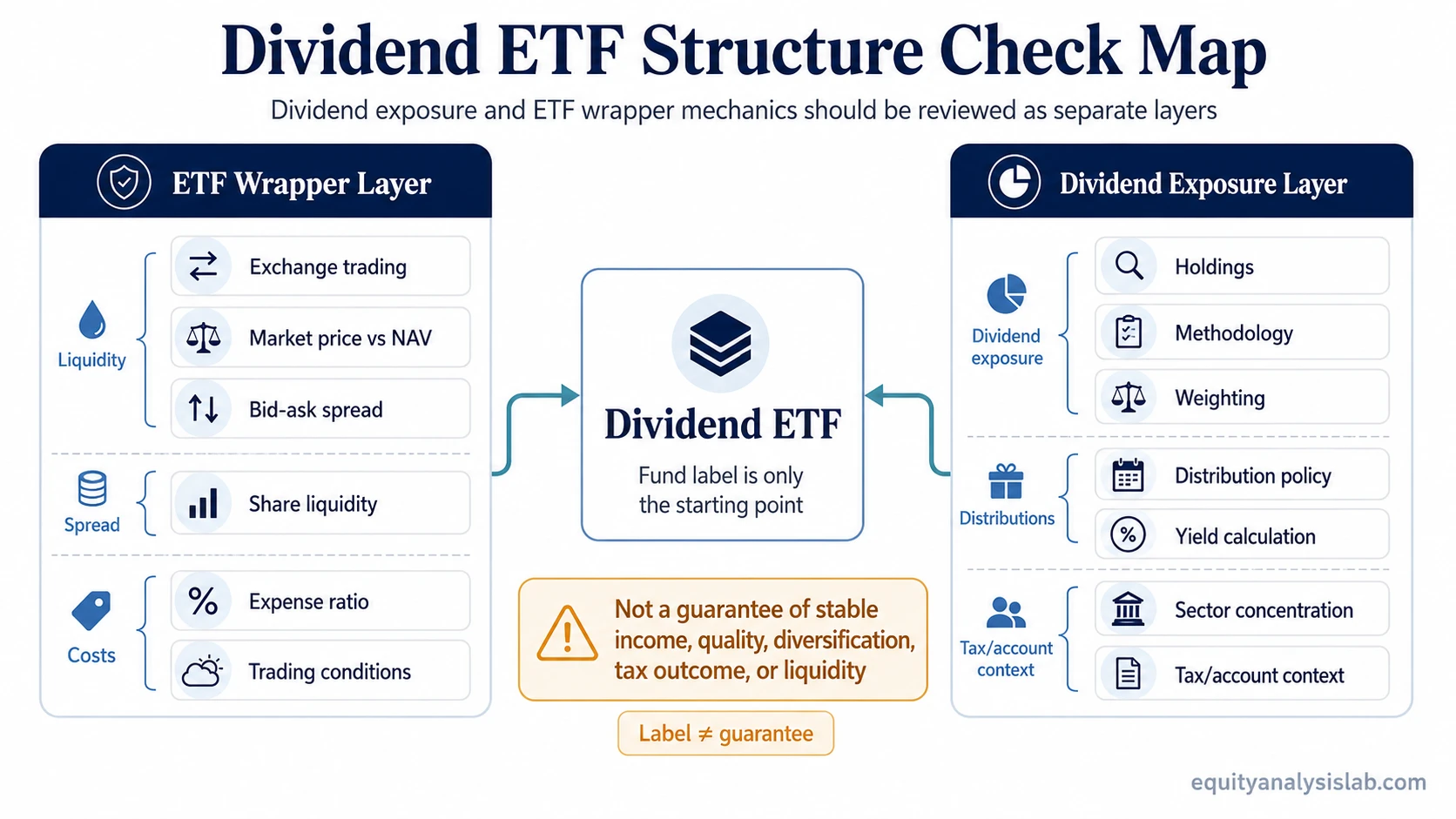
- The most useful review starts with observable mechanics: holdings, rules, weighting, distribution policy, fees, tracking, liquidity, and tax/account context.
What Is a Dividend ETF?
A dividend ETF is a fund that packages dividend-oriented equity exposure into an ETF structure. The fund may track an index of dividend-paying companies, follow dividend-growth criteria, screen for higher current yields, or use an active process to select income-oriented stocks.
The word “dividend” identifies a portfolio focus, not the full risk profile. A dividend ETF can still decline in market price, hold companies that later reduce payouts, become concentrated in certain sectors, or distribute less income than investors expected. The ETF wrapper affects trading, cost, transparency, and liquidity mechanics, while the holdings and methodology drive the income profile.
How Dividend ETFs Work
A dividend ETF starts with a portfolio rule. Some funds track indexes that select companies with dividend histories, dividend yields, payout screens, or quality metrics. Others use active management, where a portfolio manager has more discretion over security selection, weighting, and risk control.
After the portfolio is built, the ETF collects dividends from its underlying holdings. The fund may distribute income to shareholders on a stated schedule, and shareholders may receive cash or reinvest distributions depending on their brokerage settings and account structure. The amount can vary because underlying company dividends, portfolio turnover, expenses, and fund policies can change.
The ETF trades during the market day, so investors see a market price as well as an underlying net asset value. In normal conditions, creation and redemption mechanics can help keep the trading price close to the value of the holdings, but bid-ask spreads, trading volume, underlying liquidity, and market stress can still affect the price an investor actually receives.
Mechanics note: The dividend ETF label sits on top of several separate layers: the underlying stocks, the selection rules, the weighting method, the distribution policy, the expense ratio, and the exchange-traded wrapper. A strong review separates those layers instead of treating the label as a complete answer.
Dividend Growth vs High Dividend ETFs
Dividend growth ETFs and high dividend ETFs can both sit inside the dividend ETF category, but they usually emphasize different trade-offs.
A dividend growth ETF generally looks for companies with a record or policy of increasing dividends over time. The focus is often durability, consistency, and business quality, although the future path of dividends is never guaranteed.
A high dividend ETF usually gives more attention to current yield. That can be useful for investors comparing income profiles, but a higher yield can also come from falling share prices, mature industries, concentrated sector exposure, or companies facing payout pressure.
Useful distinction: Dividend growth focuses more on the history or durability of dividend increases. High dividend focuses more on current yield. Neither structure guarantees future income, total return, capital preservation, or lower risk.
What to Check Before Interpreting a Dividend ETF
The most useful dividend ETF review starts with observable mechanics. The goal is not to decide from the fund name alone, but to see how the dividend exposure is actually built and what could change the investor experience.
| What to check | Why it matters | What can go wrong |
|---|---|---|
| Holdings | Shows which companies and sectors drive the fund’s income and risk. | The ETF may be concentrated in a few sectors, regions, or large holdings. |
| Index or active methodology | Explains how stocks enter, leave, and receive weight in the portfolio. | A simple yield screen may select companies with stressed prices or weaker payout durability. |
| Weighting method | Determines whether the fund is led by market value, dividend yield, dividend dollars, equal weighting, or another rule. | Weighting can increase exposure to slower-growing, highly leveraged, or sector-heavy companies. |
| Distribution policy | Shows how often the ETF distributes income and how variable those distributions may be. | Recent distributions may not represent a stable future income stream. |
| Yield calculation | Clarifies whether the quoted yield reflects trailing distributions, indicated income, SEC yield, or another method. | Different yield measures can make similar funds look less comparable than they appear. |
| Expense ratio | Costs reduce the return that reaches shareholders over time. | A higher-cost fund needs enough structural value to justify the fee drag. |
| Tracking and turnover | Shows how closely the fund follows its stated approach and how often holdings change. | High turnover or persistent tracking difference can change realized results. |
| Liquidity and spread | Shows how easily ETF shares may trade near fair value. | Wide spreads or thin trading can raise the practical cost of entering or exiting. |
| Tax and account context | Distribution classification and account type can affect after-tax interpretation. | The same ETF distribution can have different after-tax implications in a taxable account than in a tax-advantaged account. |
Why Dividend ETF Yield Can Be Misleading
A higher dividend ETF yield is not automatically better. It can reflect a falling ETF price, a portfolio tilted toward distressed or slower-growing companies, concentrated exposure to high-yield sectors, or a methodology that favors current income over dividend durability.
Underlying companies can reduce, suspend, or fail to grow dividends. When that happens across enough holdings, the ETF’s future distributions can change even if the fund still carries a dividend label. A yield figure is therefore a measurement to investigate, not a quality score by itself.
Limitation: Dividend ETF tax treatment should not be inferred from the label alone. Distribution type, holding period, fund structure, investor account type, and local tax rules can all affect the final result. Tax treatment depends on individual circumstances and should not be treated as personal tax advice.
Common mistake: Treating a dividend ETF like a bond substitute can create a false sense of stability. A dividend ETF usually owns equities, so its market price and income profile can move with company fundamentals, sector risk, valuation, and broader equity-market conditions.
A Simple Dividend ETF Scenario
Consider two dividend ETFs with similar names and similar headline yields. One holds a broad basket of companies with long dividend histories and moderate sector exposure. The other reaches its yield through a narrower set of high-yield stocks concentrated in a few mature industries.
The second fund may look more attractive from the yield line alone, but a more complete review compares holdings, payout durability, sector concentration, weighting, expense ratio, distribution history, and trading liquidity. The useful question is not only “Which yield is higher?” but “What mechanics produced that yield, and what would make it less stable?”
How Dividend ETFs Fit Beside Other ETF Types
A dividend ETF is one type of equity-focused ETF. If the strategy uses manager discretion rather than a fixed index rule, it may overlap with the decision process behind an actively managed ETF.
Dividend ETFs should also be separated from fixed-income exposure. A bond ETF holds bonds or bond-like instruments, while a dividend ETF usually holds stocks that pay dividends. Both can distribute income, but the source of risk is different.
Other ETF types can make the boundary clearer. A commodity ETF, for example, is not built around company dividend payments. That contrast helps show why the ETF wrapper and the underlying exposure should be reviewed as separate layers.
Related ETF type route: Use the dividend ETF label to identify the broad category, then compare it with nearby ETF types only after the fund’s own holdings, methodology, distributions, costs, and liquidity are clear.
Dividend ETF FAQs
Are dividend ETF dividends guaranteed?
No. A dividend ETF can distribute income only from what the fund receives and realizes under its structure. Underlying companies may reduce or suspend dividends, and the ETF’s future distributions can change.
Is a higher dividend ETF yield always better?
No. A higher yield can reflect a falling share price, concentrated exposure, payout pressure, or higher-risk holdings. Yield should be reviewed alongside holdings, methodology, costs, liquidity, and distribution history.
Can a dividend ETF lose value?
Yes. A dividend ETF usually holds equities, so its market price can fall even if it continues to make distributions. Dividend income does not remove equity-market, sector, valuation, or liquidity risk.
How do dividend ETFs pay income?
A dividend ETF typically collects dividends from underlying holdings and distributes income to shareholders according to the fund’s policy and schedule. The amount and classification of distributions can vary by fund and account context.