
Asset allocation is the way a portfolio is divided across asset classes and exposures, such as stocks, bonds, cash, funds, sectors, regions, or other investment categories. The allocation is expressed through weights, not just through the names of the investments held.
In portfolio construction, asset allocation is a structure decision. It helps define where portfolio risk and return exposure may come from, but it does not guarantee safety, prevent losses, forecast returns, or create a personalized investment mix.
Definition: Asset allocation is the combined result of what a portfolio owns, how much each part weighs, how exposures overlap, and how those exposures fit the investor’s time horizon, risk capacity, and rebalancing rule.
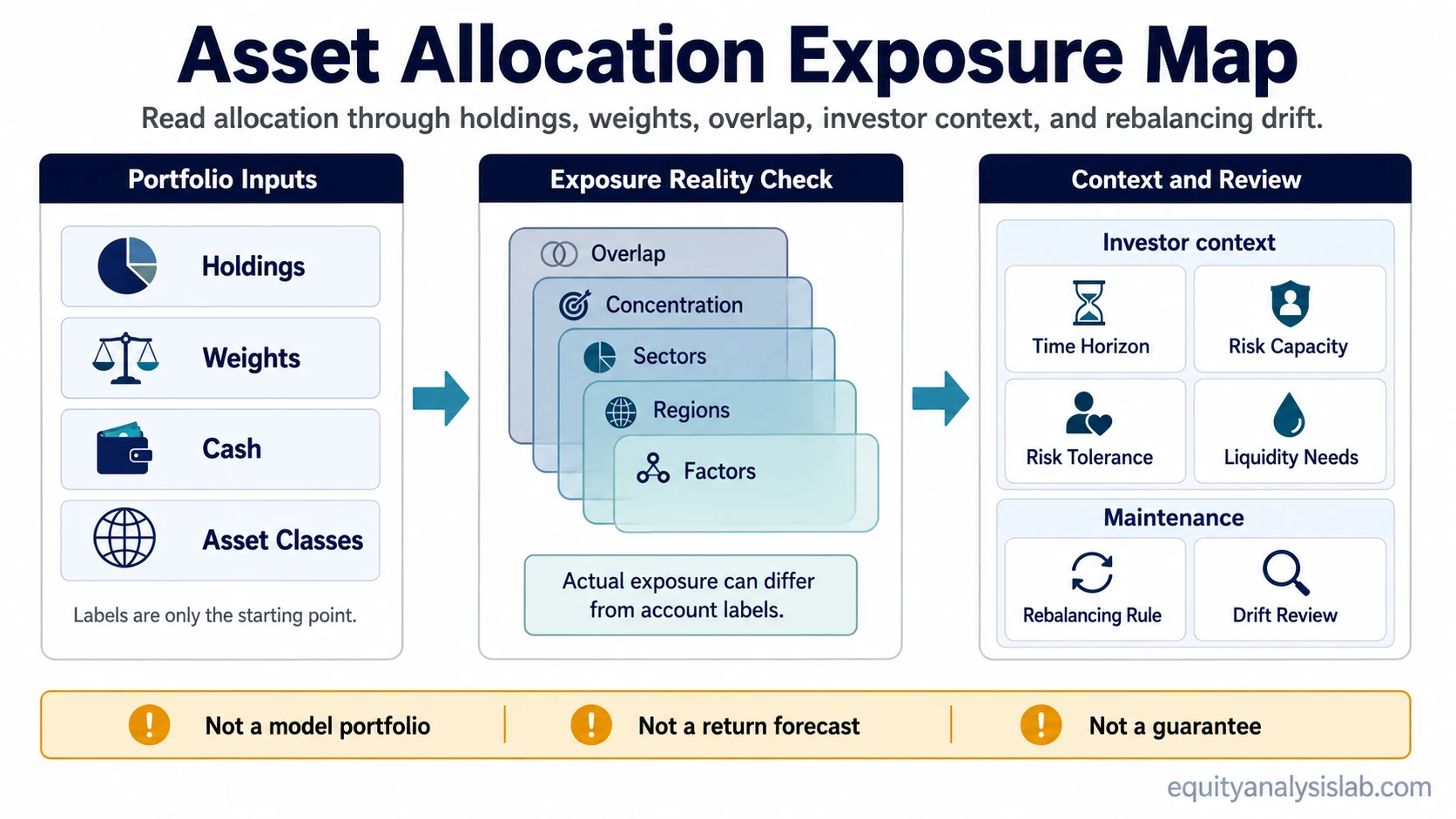
Key Points About Asset Allocation
- Asset allocation describes the portfolio mix across asset classes and exposures.
- Weights matter because large positions influence portfolio behavior more than small positions.
- Holdings overlap can make a portfolio less varied than it appears from fund count alone.
- Time horizon, risk capacity, risk tolerance, liquidity needs, and investment objectives all affect allocation decisions.
- Rebalancing drift can change the allocation over time as market prices move.
What Asset Allocation Means
Asset allocation is a portfolio structure decision. It describes how capital is divided across broad categories and exposures, and how those weights shape the portfolio’s overall risk and return profile.
A simple label such as stock fund, bond fund, or cash can be useful, but the label alone is not enough. Two investments with different names can still share similar underlying securities, sectors, regions, or risk factors. Asset allocation should therefore be read through actual holdings and weights.
That is why allocation is not only about what the portfolio owns. It is also about how much the portfolio owns, how the exposures interact, and whether the resulting mix fits the investor’s broader financial context.
How Asset Allocation Works in a Portfolio
Asset allocation starts with the broad mix of exposures. A portfolio may hold stocks, bonds, cash, funds, real assets, or other categories. Each category affects the portfolio differently because each one has its own risk, liquidity, income, volatility, and return characteristics.
The next layer is weighting. A holding that represents a large share of the portfolio can dominate the result, while a small holding may have limited effect even if it looks important on a list of positions.
Allocation also depends on what sits underneath each position. A portfolio can own several funds and still have repeated exposure to the same large companies, sectors, or factors. That repeated exposure can increase concentration even when the account appears broad at first glance.
Cash is part of the allocation too. It can reduce market exposure, provide flexibility, or reflect liquidity needs, but it also changes the portfolio’s expected behavior. The role of cash depends on the investor’s objectives, time horizon, and need for access to capital.
Target Allocation, Drift, and Rebalancing
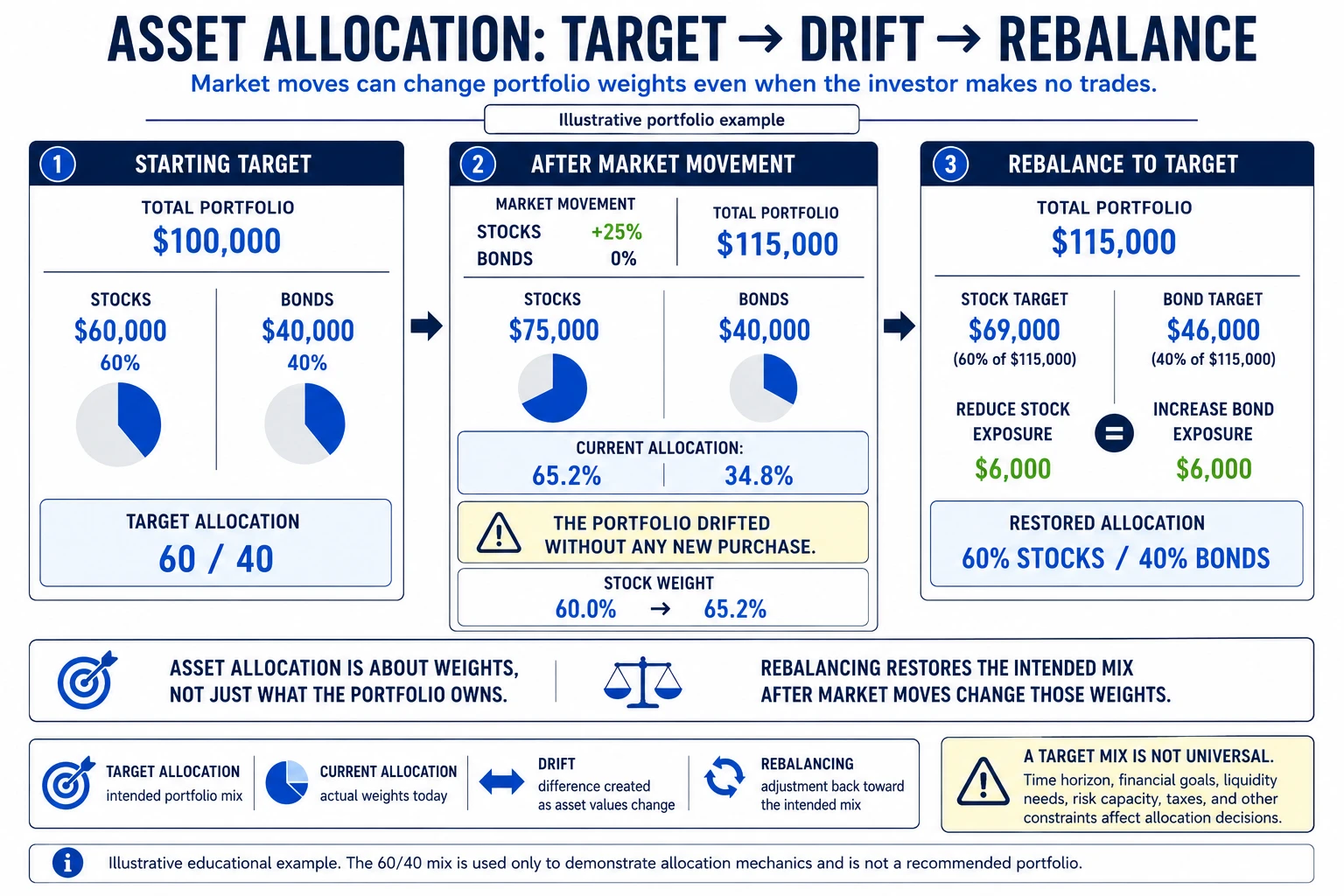
Asset allocation is easiest to understand when it is viewed as a target mix rather than as a static list of holdings. Market moves can change portfolio weights even if the investor does nothing, which means the current allocation can gradually drift away from the intended structure.
For example, assume a portfolio starts with $100,000 and a target allocation of 60% stocks and 40% bonds. That means $60,000 is allocated to stocks and $40,000 to bonds. If stocks rise by 25% and bonds remain unchanged, the stock allocation becomes $75,000 while bonds remain $40,000. The total portfolio becomes $115,000.
At that point, the current allocation is no longer 60/40. Stocks now represent about 65.2% of the portfolio, while bonds represent about 34.8%. The investor made no new trade, but the allocation drifted because one part of the portfolio grew faster than the other.
If the investor wants to restore the original 60/40 target, the portfolio would need about $69,000 in stocks and $46,000 in bonds. That means shifting about $6,000 from stocks to bonds.
Main lesson: asset allocation is about weights, not only about what the portfolio owns. Rebalancing is the process that brings actual weights back toward the intended mix after market moves change them.
Asset Allocation Inputs
The main inputs behind asset allocation are not limited to risk preference. A useful allocation view connects the portfolio’s structure to the investor’s financial situation, time horizon, and ability to tolerate uncertainty without turning the mix into a model recommendation.
Risk capacity and risk tolerance are related, but they are not the same. Risk tolerance describes emotional comfort with volatility or losses. Risk capacity describes the financial ability to absorb losses, illiquidity, or a delayed recovery without disrupting the investor’s actual needs.
Time horizon changes the interpretation. Capital needed soon usually has less room to absorb volatility than capital that can remain invested for many years. Liquidity needs, income needs, tax constraints, and existing holdings can also change the way an allocation should be understood.
Observable Inputs That Shape Asset Allocation
| Allocation input | What it shows | Why it matters |
|---|---|---|
| Holdings | What the portfolio actually owns | Allocation depends on real exposure, not only account labels. |
| Weights | How much each holding or asset class contributes | Small and large positions do not affect the portfolio equally. |
| Concentration | Whether exposure is clustered in a few holdings, sectors, or factors | Clustered exposure can dominate portfolio risk even when the asset-class mix looks balanced. |
| Overlap | Whether funds or holdings share the same underlying exposures | Multiple funds can still repeat exposure to the same securities, sectors, or risk factors. |
| Time horizon | How long the investor expects capital to remain invested | A longer or shorter horizon can change how much volatility the portfolio can absorb. |
| Risk capacity | The financial ability to withstand losses or illiquidity | Capacity can differ from emotional risk tolerance. |
| Risk tolerance | The emotional comfort level with volatility and uncertainty | A portfolio can feel acceptable in calm markets but become difficult to hold during stress. |
| Rebalancing rule | How drift is corrected over time | Without a rule, the allocation can change as markets move. |
Asset Allocation vs Diversification vs Rebalancing
Asset allocation, diversification, and rebalancing are connected, but they solve different portfolio questions.
| Concept | Main question | Portfolio role |
|---|---|---|
| Asset allocation | How is the portfolio divided across exposures? | Sets the broad structure of the portfolio mix. |
| Diversification | How spread out is the risk inside or across that mix? | Reduces dependence on a narrow set of holdings, sectors, or drivers. |
| Rebalancing | How is the mix brought back after it drifts? | Maintains the intended structure when market moves change weights. |
A portfolio can have an allocation without being well diversified. It can also drift away from its intended allocation if no rebalancing rule exists.
Common Asset Allocation Mistakes
- Treating fund count as exposure spread: Owning many funds does not automatically mean the portfolio has many different underlying exposures.
- Ignoring overlap: Several funds can hold similar companies, sectors, regions, or factors.
- Confusing risk tolerance with risk capacity: Comfort with volatility is not the same as the financial ability to withstand losses or illiquidity.
- Using age as the only input: Age can be a rough simplification, but it cannot replace time horizon, objectives, liquidity needs, existing holdings, and risk capacity.
- Counting positions without checking weights: The number of holdings matters less than how much exposure each holding creates.
- Ignoring drift after strong market moves: A portfolio can move far from its intended allocation even when the investor makes no trade.
Strategic and Tactical Asset Allocation
Strategic asset allocation usually refers to a longer-term target mix. Tactical asset allocation usually refers to shorter-term adjustments around that mix. The distinction can be useful, but it should not turn asset allocation into a market-timing claim by default.
For a basic portfolio-construction view, the more important question is whether the portfolio’s current exposures match the investor’s objectives, constraints, time horizon, and risk capacity. Tactical changes can add complexity if they are not tied to a clear process.
Limits of Asset Allocation
Asset allocation can shape portfolio exposure, but it cannot remove uncertainty. A portfolio can still lose value, suffer volatility, or experience drawdown risk even when the allocation looks reasonable.
Allocation also does not replace company analysis, fund analysis, valuation work, liquidity review, or risk review. A weak investment does not become strong simply because it fits a category. A category label is only a starting point for understanding exposure.
Age-based rules and model portfolios can be useful as simple references, but they are too broad to resolve every investor’s situation. Time horizon, liquidity needs, income needs, existing assets, risk capacity, tax constraints, and behavior under stress can all change the interpretation.
Asset Allocation FAQ
Is asset allocation the same as diversification?
No. Asset allocation describes how a portfolio is divided across asset classes and exposures. Diversification describes how risk is spread within or across those exposures.
Does asset allocation guarantee lower risk?
No. Asset allocation can shape risk exposure, but it cannot eliminate losses, guarantee returns, or prevent drawdowns.
Is asset allocation only based on age?
No. Age can be one rough input, but asset allocation also depends on time horizon, risk capacity, objectives, liquidity needs, existing exposure, and rebalancing rules.
Why does a portfolio drift away from its target allocation?
A portfolio drifts because different parts of the portfolio change in value at different speeds. Even without new trades, stronger-performing assets can become a larger share of the portfolio over time.
What is rebalancing in asset allocation?
Rebalancing is the process of adjusting portfolio weights after market moves change the actual allocation. It helps move the portfolio back toward its intended target mix.