
Portfolio construction is the process of organizing holdings, weights, diversification, cash, and review rules into a portfolio that fits an investor’s objectives and risk boundaries.
It organizes exposure and review discipline, but it does not provide a model allocation, provider tool, suitability recommendation, or promise of safety. The useful question is which portfolio problem needs the next layer of analysis: exposure mix, diversification, position weight, rebalancing, cash, drift, turnover, or strategy choice.
Simple definition: portfolio construction turns investment ideas into a working portfolio by deciding what belongs in the portfolio, how much weight each holding receives, how exposures interact, and how the portfolio will be reviewed as prices and fundamentals change.
Key Points About Portfolio Construction
- Portfolio construction connects investment objectives with actual exposure, weights, cash, and review discipline.
- A portfolio can contain many holdings and still be concentrated if the holdings share the same driver, sector, factor, or risk exposure.
- Asset mix, position size, rebalancing, cash drag, drift, and turnover solve different portfolio problems.
- Good construction does not prove that a portfolio is safe, undervalued, or likely to outperform.
- The most useful next step is usually the concept that matches the portfolio problem, not a broader list of investing terms.
What Portfolio Construction Organizes
Portfolio construction starts with what the investor owns, but the real work is in the relationships between holdings. Two portfolios can hold the same number of positions and still carry very different risk if one is spread across independent drivers while the other is dominated by a few similar exposures.
| Portfolio element | Question it answers | Why it matters |
|---|---|---|
| Holdings | What is actually owned? | The portfolio begins with the assets, funds, or securities that create exposure. |
| Weights | How much influence does each holding have? | A small holding and a dominant holding do not create the same portfolio outcome. |
| Asset mix | Which broad exposure groups are represented? | Asset mix shapes the baseline sensitivity of the portfolio. |
| Diversification | Are risks spread across different drivers? | Diversification is about exposure differences, not only the number of holdings. |
| Concentration | Where is risk clustered? | Concentration can appear through a single position, sector, factor, currency, region, or theme. |
| Cash | How much portfolio weight is not invested? | Cash can provide flexibility, but it can also create opportunity cost when the rest of the portfolio compounds. |
| Rebalancing | When should weights be brought back toward plan? | Price movement can change the portfolio even if the investor makes no new decision. |
| Drift and turnover | How much has the portfolio moved away from its intended shape? | Maintenance rules help separate deliberate changes from accidental exposure changes. |
Where to Start With Portfolio Construction
The best starting point depends on the problem the investor is trying to solve. A portfolio with unclear exposure needs a different next step than a portfolio with one oversized position, too much idle cash, or repeated trading that creates unnecessary turnover.
| Portfolio question | Concept to study next | Why it matters | Go next to |
|---|---|---|---|
| How should broad exposure be organized? | Asset allocation | It sets the broad mix of portfolio exposure before individual position details dominate the discussion. | asset allocation |
| Does owning more holdings actually reduce risk? | Diversification | It checks whether holdings depend on different drivers or only look different on the surface. | diversification |
| Is too much of the portfolio exposed to one idea? | Concentration | It identifies dominant positions, overlapping themes, and hidden exposure clusters. | concentration |
| How large should each holding be? | Position sizing | It connects conviction, uncertainty, and downside tolerance to the weight each idea receives. | position sizing |
| What should happen when winners or losers change the weights? | Rebalancing | It creates a review process so portfolio weight changes are not left entirely to price movement. | rebalancing |
| Is cash helping flexibility or becoming a drag? | Cash position | It separates intentional liquidity from accidental underinvestment. | cash position |
| Has the portfolio moved away from its intended structure? | Portfolio drift | It shows how price movement and weight changes can alter the portfolio after it is built. | portfolio drift |
| Are portfolio changes becoming too frequent? | Portfolio turnover | It helps distinguish useful maintenance from unnecessary activity and friction. | portfolio turnover |
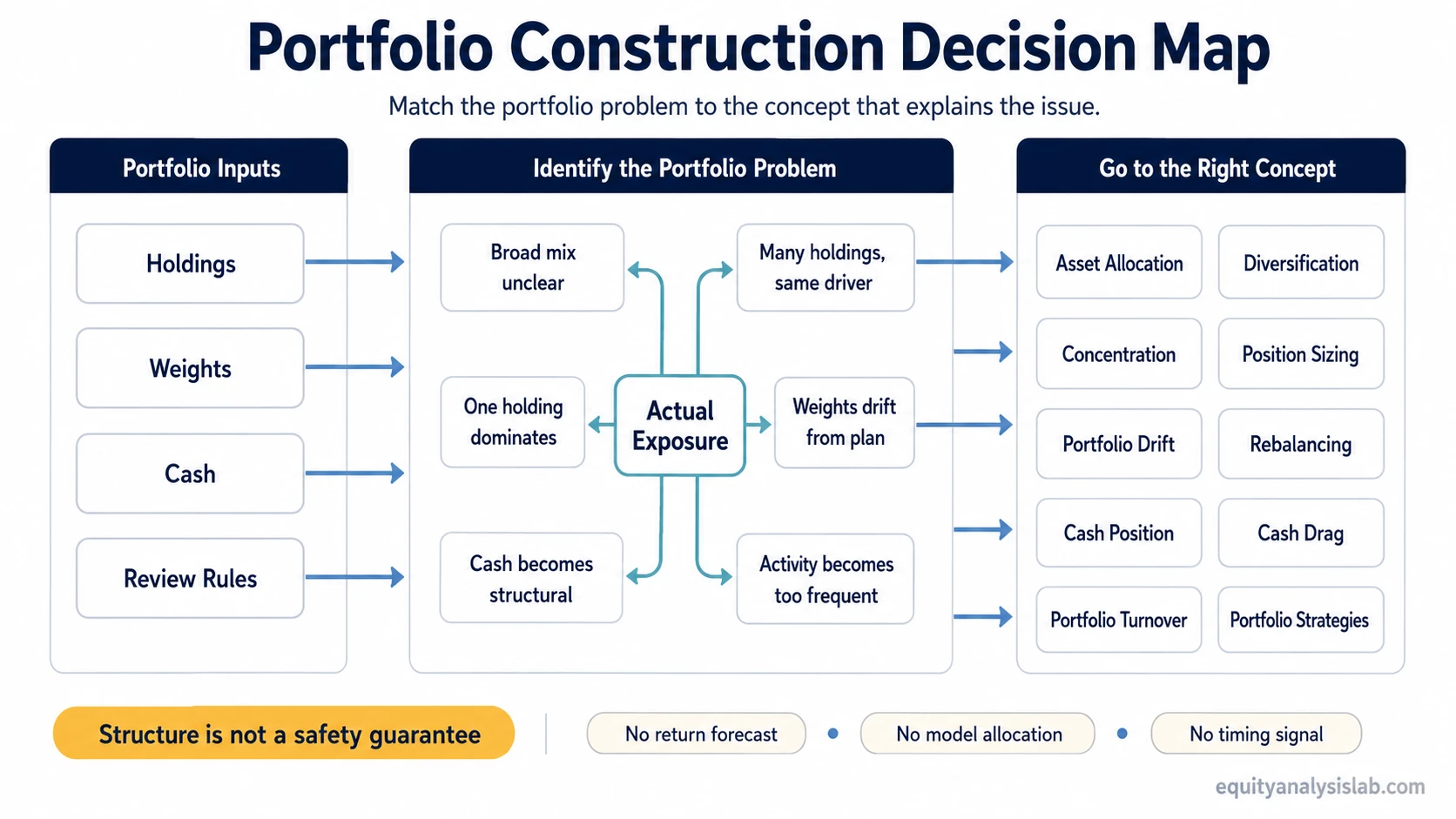
Portfolio Construction Decision Map
Different portfolio problems point to different concepts. The goal is not to study every topic at once. The goal is to match the portfolio question with the concept that best explains the issue.
| Portfolio problem | Best next concept | Use this when |
|---|---|---|
| The portfolio lacks a clear starting structure. | portfolio basics | The investor needs the base vocabulary before separating allocation, diversification, position size, and rebalancing. |
| The broad mix is unclear. | Asset allocation | The main issue is how exposure is divided across broad categories. |
| The portfolio looks diversified but behaves like one bet. | Concentration and diversification | The investor needs to separate number of holdings from actual risk distribution. |
| One holding has too much influence. | Position sizing | The key question is how much weight one idea should carry inside the portfolio. |
| Portfolio weights have moved away from plan. | Portfolio drift and rebalancing | The issue is whether price movement has changed the portfolio’s intended risk profile. |
| Cash is becoming a structural part of the portfolio. | Cash position and cash drag | The investor needs to distinguish liquidity reserve from long-term opportunity cost. |
| Portfolio changes are becoming too frequent. | Portfolio turnover | The question is whether activity is improving the portfolio or simply increasing friction and instability. |
| The investor needs a repeatable approach. | portfolio strategies | The next question is which organizing method fits the investor’s objectives, constraints, and review discipline. |
| The portfolio needs an ongoing review process. | portfolio maintenance | The investor is no longer only building the portfolio. The work shifts to checking whether the portfolio still matches its intended role. |
What Portfolio Construction Does Not Decide by Itself
Portfolio construction can improve structure, but it does not make the underlying holdings attractive. A well-organized portfolio can still be built from overvalued assets, weak businesses, unstable cash flows, or exposures that behave poorly in the same environment.
- It does not predict returns. Weights and rules organize exposure, but they do not make future performance certain.
- It does not prove safety. A portfolio can be structured and still lose value.
- It does not replace valuation. Portfolio design and investment analysis answer different questions.
- It does not guarantee diversification. Many holdings can still share one economic driver or factor exposure.
- It does not remove review work. Prices, fundamentals, cash levels, and weights can change the portfolio after it is built.
Simple Portfolio Construction Example
An investor may own twelve stocks and assume the portfolio is diversified. A closer look could show that eight of the holdings depend heavily on the same growth theme, several positions overlap through similar revenue drivers, and one winner has grown into a much larger weight than intended.
The next useful question is not whether twelve holdings are enough. The next question is which issue is driving the portfolio problem: diversification if the holdings share the same driver, concentration if one exposure dominates, rebalancing if price movement changed the intended weight, or portfolio drift if the entire portfolio has moved away from its original structure.
Common Portfolio Construction Mistakes
| Mistake | Why it matters |
|---|---|
| Treating holding count as diversification | More positions can reduce single-name dependence, but they do not automatically reduce exposure to the same sector, factor, business model, or macro driver. |
| Ignoring overlap | Funds, stocks, and themes can look separate while holding similar underlying exposure. Overlap can make a portfolio more concentrated than it appears. |
| Letting one position dominate by accident | A successful holding can become a much larger part of the portfolio if the investor never reviews weight and risk contribution. |
| Failing to rebalance | Without a review rule, the portfolio can drift away from its intended structure through price movement alone. |
| Treating cash as neutral | Cash can reduce volatility and create flexibility, but a large cash weight can also reduce participation when invested assets rise. |
| Using strategy labels without checking exposure | A portfolio may be called balanced, defensive, income-oriented, or growth-oriented while its actual holdings and weights tell a different story. |
Next Steps in Portfolio Construction
Start with portfolio basics if the structure is still unclear. Move to portfolio maintenance when the portfolio already exists but needs review rules. Use portfolio strategies when the main question is how the portfolio should be organized around a repeatable approach.
For most investors, the more specific concept comes first: allocation defines broad mix, diversification checks risk spread, concentration finds hidden dominance, position sizing controls weight, rebalancing manages changes, and cash analysis separates flexibility from drag.
FAQ
Is portfolio construction the same as asset allocation?
No. Asset allocation is one part of portfolio construction. Portfolio construction also considers position size, diversification, concentration, cash, rebalancing, drift, turnover, and review rules.
Does portfolio construction guarantee diversification?
No. A portfolio can hold many positions and still be concentrated if the holdings share the same sector, factor, business driver, or macro sensitivity.
Why does rebalancing matter in portfolio construction?
Rebalancing matters because price movement can change portfolio weights without any new investment decision. A review rule helps decide when those changes should be accepted or adjusted.
Can cash be part of portfolio construction?
Yes. Cash affects liquidity, flexibility, risk exposure, and opportunity cost. The important distinction is whether cash is held intentionally or has become an unreviewed drag on the portfolio.