
Portfolio drift occurs when current portfolio weights move away from the intended reference mix. The change can come from market performance, contributions, withdrawals, partial transactions, changing cash balances, or overlapping holdings that make real exposure different from the visible holding list.
Definition: Portfolio drift is the gap between a portfolio’s intended or reference exposure and its current exposure. It is an observation about portfolio structure, not an automatic instruction to rebalance, sell, buy, or change allocation.
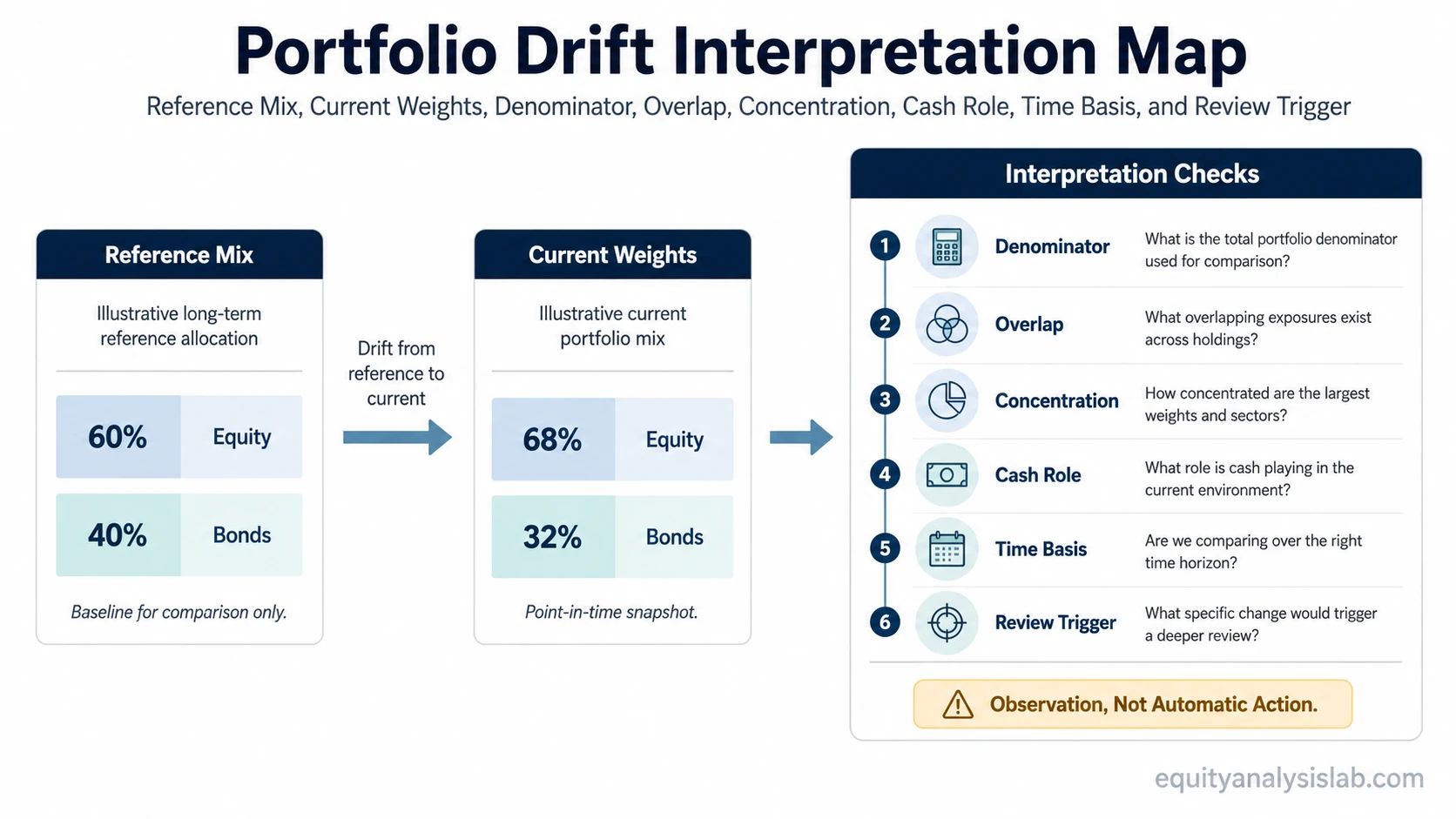
The useful question is not only whether a percentage has moved. A clearer interpretation depends on the reference mix, current denominator, cash role, overlap, time basis, and review trigger being visible together.
Key Points
- Portfolio drift compares intended exposure with current portfolio weights.
- Drift depends on relative performance across the portfolio, not on the return of one asset in isolation.
- An asset can become overweight even if its own value does not rise.
- Drift is a review input. It does not prove that rebalancing, trading, or any other action is required.
- The same drift amount can mean different things depending on concentration, cash role, time horizon, and risk capacity.
What Portfolio Drift Means
Portfolio drift means the actual portfolio no longer matches the reference structure used to monitor it. That reference may be a target allocation, a policy mix, a model portfolio, or a personal planning baseline. Without that reference point, the word drift becomes loose because there is nothing stable to compare the current portfolio against.
A portfolio can drift even when no new decision has been made. If one asset class, sector, factor, region, or individual holding rises faster than the rest, its weight can become larger. If another part falls, receives less new capital, or is diluted by new deposits, its weight can shrink. The portfolio may still contain the same holdings while the exposure profile changes.
That distinction matters because portfolio drift is about actual exposure, not simply the number of positions owned. A list of ten holdings can look diversified while two or three positions, sectors, or overlapping funds carry most of the portfolio’s risk.
How Portfolio Drift Is Calculated
Current weight = current sleeve value ÷ current total portfolio value
Weight drift = current weight − target weight
The arithmetic seems simple, but the interpretation often is not. A portfolio weight is a relative share of the current portfolio total, so the same asset return can create very different drift outcomes depending on what the rest of the portfolio did at the same time.
The Same Asset Return Can Produce Different Portfolio Drift
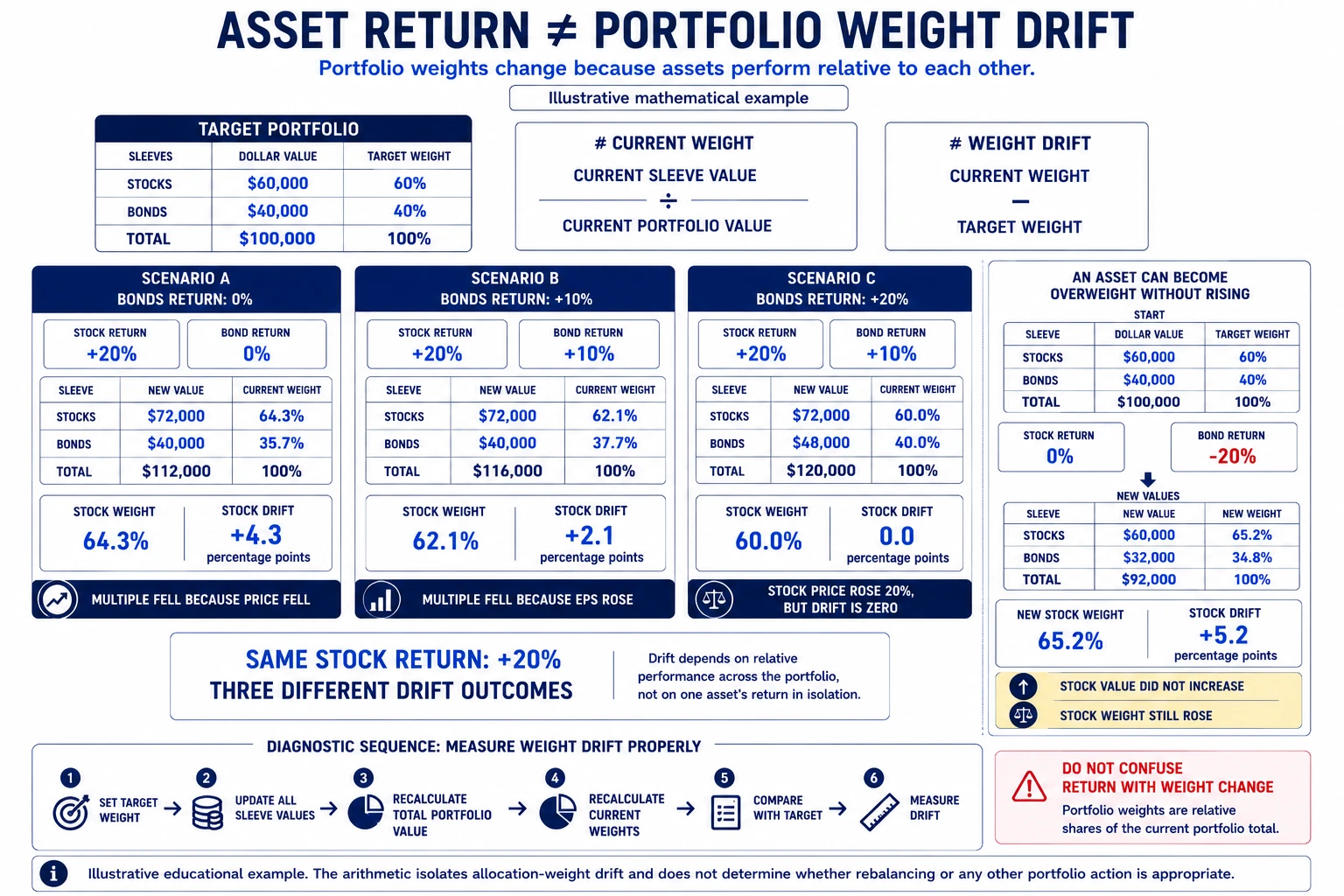
Start with a target portfolio of 60% stocks and 40% bonds:
Starting portfolio: Stocks = $60,000, Bonds = $40,000, Total = $100,000.
Now assume the stock sleeve rises by 20% in every scenario. The resulting drift still changes depending on how bonds performed.
| Scenario | Stock return | Bond return | New stock value | New bond value | New stock weight | Stock drift |
|---|---|---|---|---|---|---|
| A | +20% | 0% | $72,000 | $40,000 | 64.3% | +4.3 percentage points |
| B | +20% | +10% | $72,000 | $44,000 | 62.1% | +2.1 percentage points |
| C | +20% | +20% | $72,000 | $48,000 | 60.0% | 0.0 percentage points |
The stock sleeve produced the same return in all three cases, yet the portfolio drift result was different each time. In other words, asset return is not the same thing as portfolio weight drift. Drift depends on relative performance across the portfolio, not on one sleeve in isolation.
Core insight: a strong return can lead to large drift, small drift, or no drift at all, depending on what happened to the rest of the portfolio.
A Sleeve Can Drift Higher Without Rising in Value
The reverse case is just as important. A sleeve can become overweight even if it did not go up at all.
Starting point: Stocks = $60,000, Bonds = $40,000, Total = $100,000.
Next period: Stocks return 0%, Bonds return -20%.
New values: Stocks = $60,000, Bonds = $32,000, Total = $92,000.
New stock weight: $60,000 ÷ $92,000 = 65.2%.
Stock drift: 65.2% − 60.0% = +5.2 percentage points.
Stocks did not increase in value, but their portfolio weight still rose because bonds declined. This is why a portfolio drift reading should never be confused with a return reading. The number is about relative shares of the portfolio, not only about absolute gains and losses.
Inputs That Make a Drift Reading Stronger
A portfolio drift comparison becomes more useful when the measurement basis is explicit. The same current weight can be harmless, unresolved, or material depending on what the investor is comparing it against and why that comparison exists.
| Input checked | What it clarifies |
|---|---|
| Target or reference mix | Shows the baseline used to define whether exposure has moved. |
| Current denominator | Shows whether weights are measured against total portfolio value, invested assets, or a narrower sleeve. |
| Overlap and concentration | Shows whether different holdings still create repeated exposure to the same underlying risk. |
| Cash role | Shows whether cash is temporary, strategic, pending deployment, or required for liquidity. |
| Time basis and review trigger | Shows whether the drift is temporary, persistent, or meaningful enough to justify closer review. |
The cleanest sequence is detection, interpretation, and then a portfolio maintenance check. Detection identifies the current exposure. Interpretation asks what changed. The final check belongs to a broader review discipline, not to the drift observation by itself.
Portfolio Drift vs Rebalancing
Portfolio drift is the condition. Rebalancing is a possible response that may be considered after the exposure change is understood. Blending the two too early creates a common error: the investor sees a gap between target and current weights, then treats the gap as if it already contains the answer.
A cleaner sequence is detect, interpret, then decide whether closer inspection is warranted. Detection answers what changed. Interpretation asks whether the change affects exposure, concentration, cash role, or risk capacity. The later decision may include action, delay, or no change.
Limitation: Portfolio drift does not say which action is correct. It does not set a rebalance schedule, define a threshold, solve tax questions, or determine whether a position should be bought or sold.
Portfolio Drift vs Cash Drag, Cash Position, and Portfolio Turnover
Cash drag describes the effect of cash sitting outside intended exposure. Portfolio drift is broader because any portfolio component can move away from the reference mix, not only cash.
A portfolio cash position describes the role and weight of cash inside the portfolio. Portfolio drift asks whether that cash weight, along with other portfolio weights, still matches the intended structure.
Portfolio drift also differs from activity-driven changes. A portfolio can drift without trades if market prices move unevenly, while changes caused by buying and selling holdings create a separate activity and cost question.
Common Portfolio Drift Mistakes
| Mistake | Safer interpretation |
|---|---|
| Treating drift as automatic action | A drift comparison identifies a change in exposure; it does not decide the response. |
| Confusing return with weight change | A sleeve may rise in weight because it outperformed the rest of the portfolio, or because another sleeve declined more sharply. |
| Ignoring overlap | Multiple funds can create repeated exposure to the same large holdings or market segment. |
| Mixing denominators | A position can look different when measured against total assets, invested assets, or a single sleeve. |
| Confusing temporary cash flow with structural drift | New deposits, withdrawals, dividends, or pending transactions can change weights before the portfolio’s longer-term structure has changed. |
When a Portfolio Drift Reading Is Incomplete
An exposure check is incomplete when the reference mix is unknown, the current weights are stale, the denominator is unclear, or the time basis is missing. A single snapshot can identify a possible gap, but it cannot explain whether the gap is persistent, temporary, intentional, or relevant to the investor’s risk boundary.
The interpretation is also incomplete when overlap and cash role are not checked. A portfolio can appear close to its reference allocation while hidden fund overlap increases exposure to the same group of companies. Another portfolio can appear to drift because cash has grown, while the cash is actually reserved for a known liquidity need.
Drift interpretation sequence: reference mix → current weights → denominator → overlap → concentration → cash role → time basis → review trigger. Skipping the middle steps turns a structural observation into a premature conclusion.
FAQ
What is portfolio drift?
Portfolio drift is the movement of current portfolio weights or exposures away from an intended reference mix. It can happen because holdings perform differently, cash flows change the denominator, or overlapping holdings alter real exposure.
Is portfolio drift the same as rebalancing?
No. Portfolio drift is the observed condition. Rebalancing is one possible process that may be reviewed after the drift is understood, but drift alone does not require a specific action.
Can a portfolio drift without any trades?
Yes. A portfolio can drift when some holdings rise or fall more than others. The holdings may stay the same while their weights and exposure contribution change.
Why can an asset become overweight without rising?
A sleeve can become overweight when other parts of the portfolio fall more sharply. Portfolio weights are relative shares of the current total portfolio value, so weight change does not require the sleeve itself to rise.