
Cash drag is the opportunity cost or performance effect created when part of a portfolio remains in cash instead of the exposure it was otherwise meant to hold. The useful question is not whether cash exists, but whether the cash balance still matches its purpose, its duration, and the exposure it is replacing.
Definition: Cash drag describes the return effect created when cash remains outside intended market exposure longer than its role requires. The effect depends on cash weight, the return spread between cash and the exposure it replaces, the reason the cash is held, and how long the balance remains in place.
Key Points
- Cash drag is not the same thing as simply holding cash.
- The effect depends on both cash weight and the return difference between cash and the exposure the cash replaces.
- The same cash balance can create a small drag, a large drag, or even a temporary benefit, depending on market conditions and the intended exposure.
- Cash with a clear liquidity, spending, or risk-control role is different from cash that remains unreviewed after that role has passed.
- Cash drag belongs inside a broader portfolio-maintenance process, not as a standalone verdict.
What Cash Drag Means
Cash drag exists because cash usually participates in markets differently from the risk exposure a portfolio was intended to hold. If part of a portfolio remains in cash, the portfolio may capture less of the return, and sometimes less of the risk, of the intended allocation.
That does not make all cash inefficient. Cash can be deliberate and useful when it supports liquidity, planned withdrawals, pending allocation, near-term obligations, or a risk-control decision. The problem starts when the cash remains after the purpose becomes less relevant, or when the balance is not actively reviewed against the portfolio’s intended exposure.
Main question: What exposure is the cash replacing, and is the current cash balance still justified by role, duration, and liquidity need?
Cash Drag Depends on the Return Spread, Not Cash Weight Alone
A useful simplified framework is:
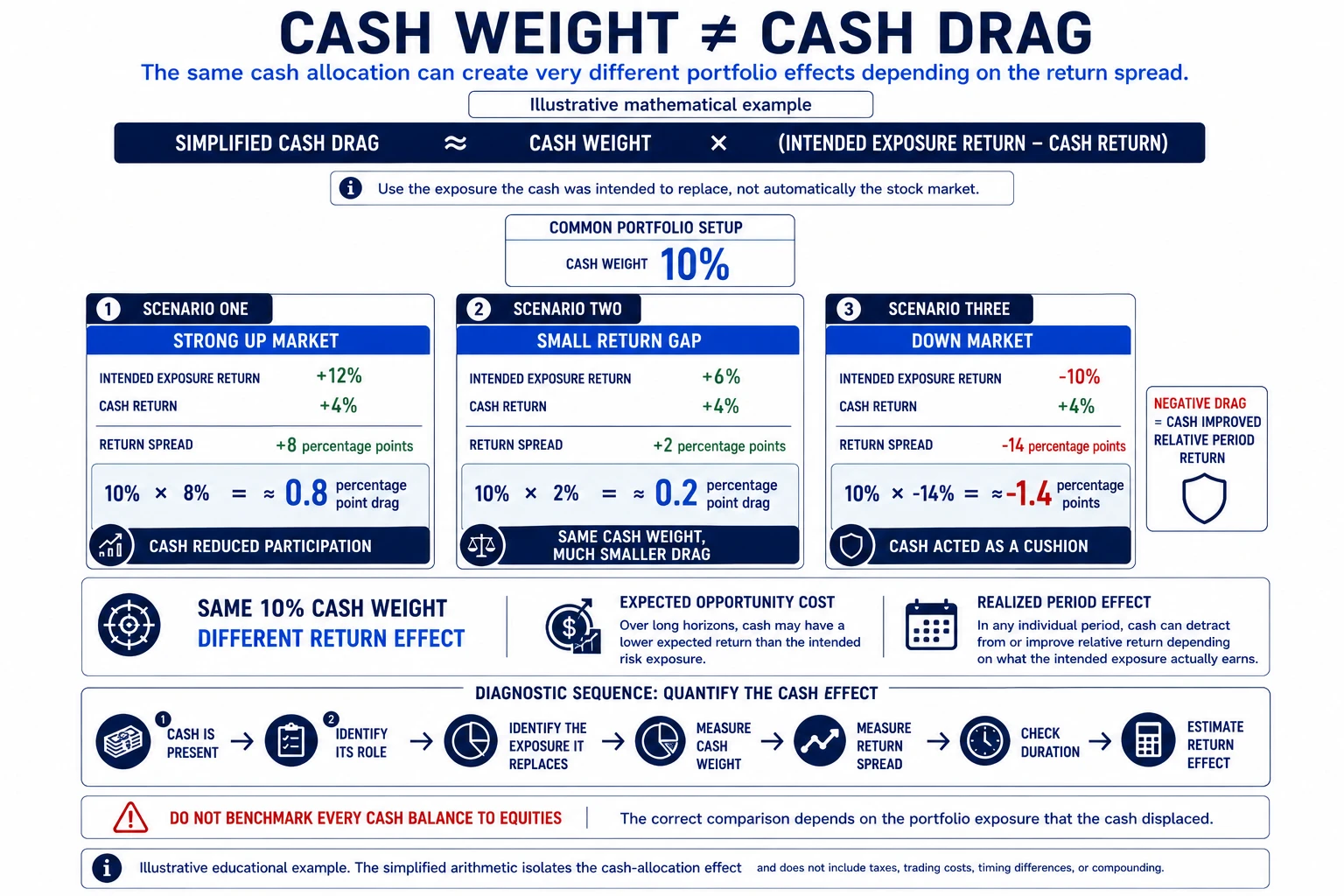
Simplified cash drag ≈ cash weight × (return of intended exposure − return on cash)
This formula is not a complete portfolio model, but it shows the main idea. Cash drag is not determined by cash weight alone. It is driven by cash weight together with the return gap between cash and the exposure that cash displaced.
Suppose 10% of a portfolio remains in cash. If the intended exposure earns 12% and cash earns 4%, the return spread is 8 percentage points. In that case, the approximate portfolio drag from the cash allocation is:
10% × 8% = about 0.8 percentage point of drag
If the intended exposure earns 6% while cash earns 4%, the same 10% cash weight creates a much smaller effect:
10% × 2% = about 0.2 percentage point of drag
And if the intended exposure loses 10% while cash earns 4%, the effect reverses for that period:
10% × (-10% − 4%) = about -1.4 percentage points
In that down-market example, the cash position helped relative return for the period rather than hurting it.
Core insight: the same 10% cash weight can produce different results because cash drag depends on the return spread, not on cash weight by itself.
Expected Cash Drag vs Realized Cash Effect
It helps to separate the long-term opportunity-cost idea from the realized effect in a specific period.
| Perspective | Main question | What it means |
|---|---|---|
| Expected cash drag | Over time, is cash likely to earn less than the intended risk exposure? | This is the long-term opportunity-cost view. It matters when cash sits idle beyond its role and prevents the portfolio from holding its intended exposure. |
| Realized cash effect | During the period reviewed, did cash underperform or outperform the exposure it replaced? | This is the period-specific result. In rising markets, cash often reduces participation. In weak markets, cash can cushion relative performance. |
This distinction matters because a cash position can be a long-term drag expectation and still improve relative performance in a short negative period. A clean review keeps both ideas separate.
Measurement caution: cash drag should be compared with the exposure the cash was intended to replace, not automatically with the stock market. If the cash displaced short-term bond exposure, the relevant comparison is different from a case where the cash displaced equities.
How to Interpret Cash Drag in Portfolio Maintenance
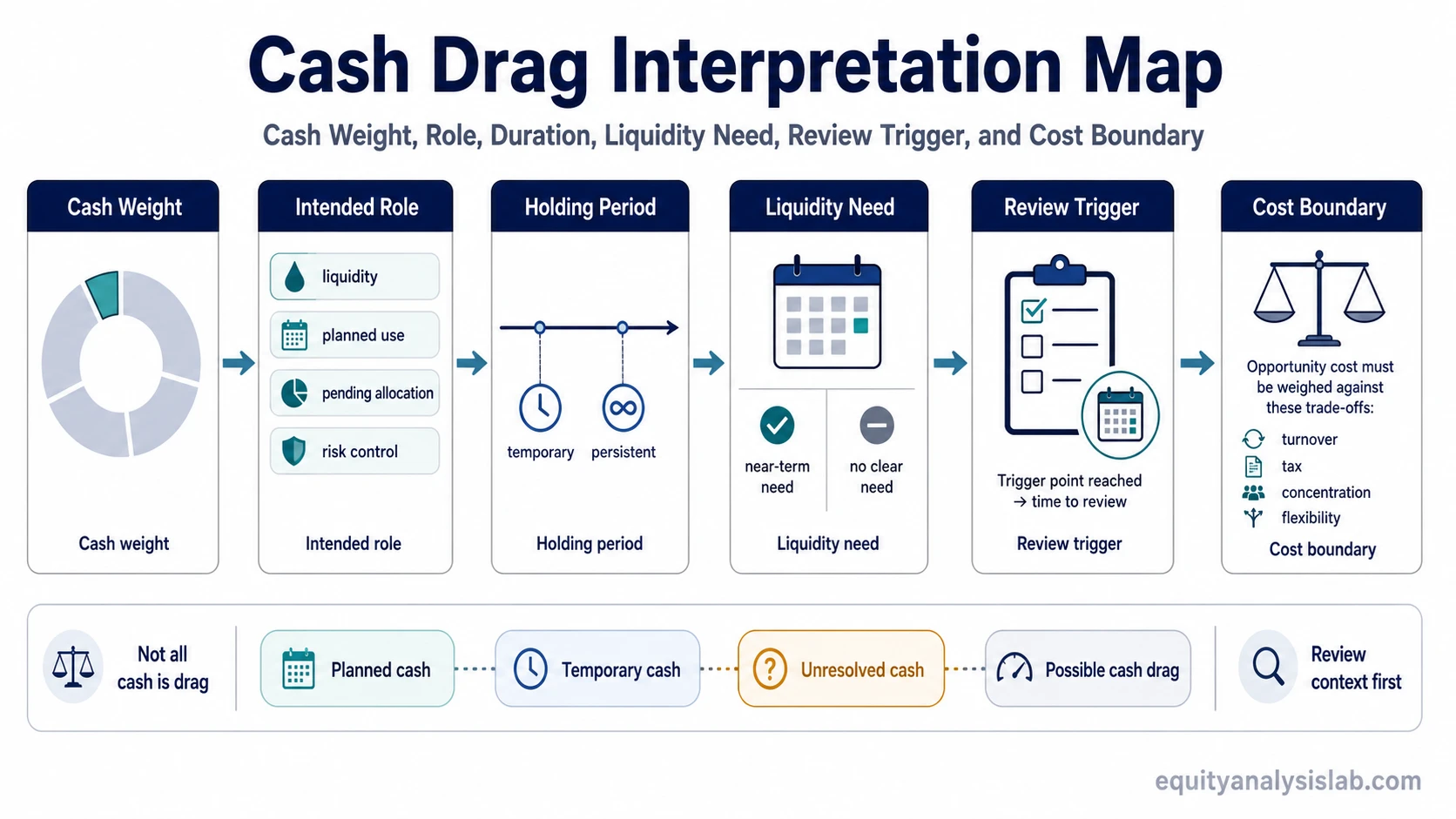
The most useful review starts with a sequence. First, identify the cash weight. Then identify the role of the cash. After that, check what exposure the cash replaced, how long the cash has remained in place, and whether a review trigger still exists.
Cash drag sequence: cash weight → intended role → replaced exposure → holding period → return spread → liquidity need → review trigger → action-cost boundary.
Cash can also contribute to portfolio drift when the cash weight moves the portfolio away from its intended exposure mix. The two concepts are related, but they answer different questions. Drift measures deviation from intended allocation. Cash drag measures the return effect of money sitting outside the intended exposure.
A structured portfolio review helps separate temporary operational cash from cash that has become idle because no rule, deadline, or review point was set.
Cash Drag vs Nearby Portfolio Concepts
Cash drag overlaps with several portfolio-maintenance ideas, but each concept has a different role.
| Concept | Main question | Boundary |
|---|---|---|
| Cash drag | What return effect is created because cash remains outside intended exposure? | Focuses on the performance or opportunity-cost impact of the cash balance. |
| cash position | How much cash is held and why is it held? | Describes the size and purpose of cash, not the return effect by itself. |
| Portfolio drift | Has the portfolio moved away from its intended allocation? | Can include cash-weight drift, but is broader than cash drag. |
| Portfolio review | When should exposures, cash, and holdings be checked? | Defines the review process rather than the drag itself. |
| Portfolio turnover | What trading activity and friction appear after the investor acts? | Describes the activity and friction created by decisions, not the original cash effect. |
When Cash Drag Matters Most
Cash drag has a stronger reading when the cash balance is meaningful, persistent, outside the intended exposure, and no longer tied to a clear liquidity or risk-control purpose. The case is stronger again when the return spread between cash and the intended exposure is wide.
The reading is weaker when the cash is temporary, operational, tied to a near-term need, or part of a deliberate design. In those cases, cash may still have an opportunity cost, but the cost may be accepted as part of flexibility, liquidity management, or a risk-control decision.
Important limit: cash drag is not proof that cash is wrong. It is the cost side of holding money outside intended exposure. The conclusion remains incomplete without role, duration, liquidity need, risk tolerance, and the relevant comparison exposure.
Common Mistakes When Reading Cash Drag
Mistake: treating every cash balance as a drag before checking its purpose. Cash may be emergency liquidity, planned spending capacity, pending allocation, a rebalancing buffer, or truly idle cash. The label changes only after the role is identified.
Another mistake is measuring the cash balance against the wrong benchmark. Cash held instead of equities should not be interpreted in the same way as cash held instead of short-duration bond exposure.
A third mistake is ignoring the cost of acting. Moving cash back into exposure can create trading activity, tax friction, timing issues, or concentration effects. Those consequences belong to broader portfolio activity and turnover friction.
FAQ
Is cash drag always bad?
No. Cash can serve liquidity, flexibility, spending, or risk-control purposes. Cash drag becomes more relevant when cash remains outside intended exposure after that role no longer justifies the balance.
How is cash drag different from a cash position?
A cash position describes the amount and purpose of cash in the portfolio. Cash drag describes the return effect or opportunity cost created when that cash remains outside intended exposure.
What determines the size of cash drag?
The main drivers are the cash weight, the exposure the cash replaced, and the return spread between cash and that intended exposure over the period being reviewed.
Can cash ever help portfolio performance?
Yes. In a weak market, cash can improve relative period performance if the exposure it replaced falls more than cash. That does not remove the long-term opportunity-cost question, but it changes the realized effect in that specific period.