
A cash position in a portfolio is the share of an investment portfolio held in cash or cash equivalents instead of stocks, funds, bonds, or other investment assets.
It is measured as a portfolio weight. The same dollar amount of cash can mean a small reserve in a large portfolio or a major exposure change in a smaller one.
Definition: Cash position means the cash and cash-equivalent portion of an investment portfolio, usually expressed as a percentage of total portfolio value.
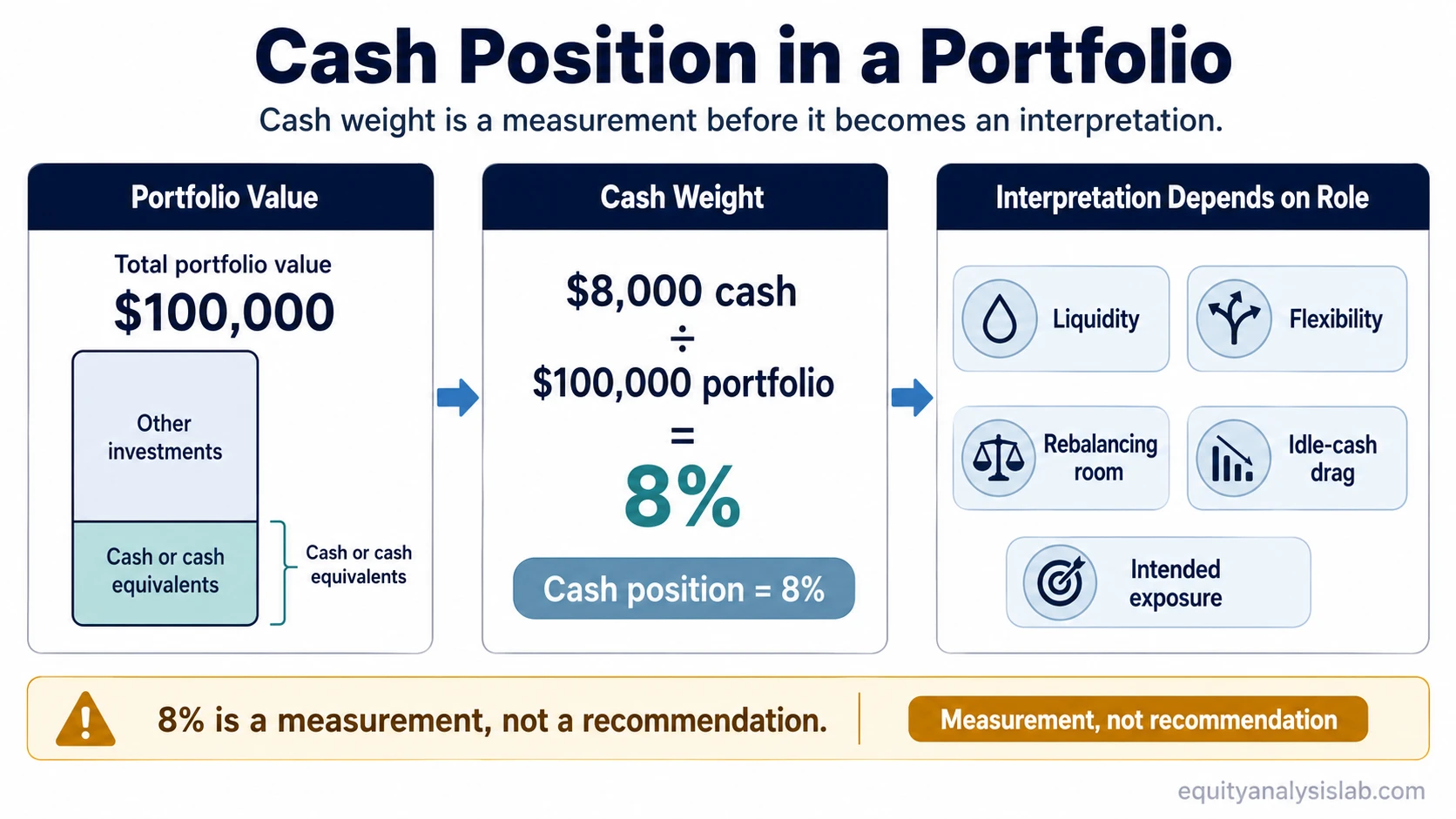
Formula: cash amount ÷ total portfolio value = cash position weight.
Key Points
- A cash position is a portfolio weight, not a universal recommendation.
- Cash can support liquidity, flexibility, and rebalancing room.
- Idle cash can create drag when it remains large without a clear role.
- Too little cash can reduce flexibility if the portfolio needs liquidity or rebalancing capacity.
What a Cash Position Means in a Portfolio
Portfolio cash usually includes immediately available cash and cash-equivalent holdings that are treated as the liquid reserve inside the investment portfolio. Depending on account structure, cash-equivalent holdings can include settlement cash, money market holdings, Treasury bills, or short-term certificates of deposit, but liquidity, maturity, and account treatment can differ.
The key distinction is portfolio role. Cash is not only a dollar balance. It changes how much of the portfolio is exposed to investment assets, how much liquidity is available, and how much room exists for rebalancing without selling another holding.
A separate emergency reserve is usually a personal liquidity bucket outside the investable portfolio. Portfolio cash sits inside the investment portfolio and affects allocation, exposure, and maintenance decisions.
How to Measure a Cash Position
The basic measurement is simple: divide the cash amount by total portfolio value.
Simple cash position example: If a $100,000 portfolio holds $8,000 in cash or cash equivalents, the cash position is 8%.
Calculation: $8,000 ÷ $100,000 = 0.08, or 8%.
That number describes portfolio exposure. It does not say whether 8% is too high, too low, or appropriate for a particular investor.
A cash position becomes more meaningful when it is compared with the portfolio’s intended exposure. An 8% cash position may be a planned reserve, a temporary result of recent selling, or an idle balance that has not been assigned a clear role.
What Changes the Meaning of a Cash Position
The cash percentage is only the first measurement. Its interpretation depends on why the cash exists, how large the portfolio is, and whether the portfolio has a defined review rule.
| Input | What it changes | Interpretation risk |
|---|---|---|
| Portfolio value | Sets the denominator for the cash weight | The same cash amount can be small in one portfolio and large in another |
| Cash amount | Shows how much capital is not currently allocated to investment assets | A dollar balance alone can hide the real exposure effect |
| Cash-equivalent category | Clarifies liquidity, maturity, and account treatment | Not every cash-like holding behaves like instant cash in every situation |
| Liquidity needs | Changes how much flexibility the portfolio may need | A low cash position may create forced-selling pressure if liquidity is needed |
| Time horizon | Changes how much idle cash may affect long-term exposure | A cash balance can be reasonable for short-term needs but costly if left idle without purpose |
| Rebalancing rule | Determines whether cash is used for maintenance or remains unused | Cash without a review rule can become accidental allocation drift |
| Intended exposure | Shows whether cash is part of the plan or a departure from it | A high cash percentage is not automatically defensive if the rest of the portfolio is concentrated |
| Overlap with defensive assets | Changes how much total portfolio stability is already present elsewhere | Cash can be double-counted as safety if other defensive holdings already serve that role |
How Cash Position Affects Portfolio Maintenance
A cash position can support liquidity because it gives the portfolio a liquid buffer. It can also reduce investment exposure because part of the portfolio is not allocated to investment assets.
Cash can preserve flexibility when the portfolio needs room for rebalancing, new contributions, withdrawals, or planned allocation changes. That flexibility is not automatically better than being fully invested. It depends on whether the cash has a defined role.
Cash can also change allocation weights over time. If a target allocation assumes a certain exposure to stocks or funds, a larger-than-planned cash balance may contribute to portfolio drift.
A scheduled portfolio review process can separate planned cash from accidental idle cash by checking whether the cash balance still matches the portfolio’s intended role.
Cash Position vs Nearby Portfolio Concepts
Cash position is the measured cash weight. Nearby concepts explain what that weight may do to the portfolio.
| Concept | Main question | How it differs from cash position |
|---|---|---|
| Cash position | How much of the portfolio is held in cash or cash equivalents? | It measures the cash share of total portfolio value. |
| Cash drag | What cost can appear when cash remains idle? | Cash drag describes the return or exposure cost that can come from holding a large idle cash balance. |
| Portfolio drift | Has the portfolio moved away from intended weights? | Drift compares actual allocation with intended allocation, while cash position measures one part of that allocation. |
| Portfolio review | When should the cash balance be checked? | A review process decides whether the cash level still fits the portfolio plan. |
| Portfolio turnover | How often are holdings being bought, sold, or replaced? | Cash can change trading frequency if it is repeatedly raised, deployed, or rebuilt during maintenance. |
Cash can reduce forced decisions, but repeated cash raises and redeployments may increase portfolio turnover if the process becomes too active.
Common Mistakes and Limitations
Common mistake: treating cash as automatically safe, automatically inefficient, or automatically defensive.
Cash changes exposure, liquidity, and flexibility, but the meaning depends on portfolio context. A high cash position can reduce market exposure while creating cash drag if the balance remains idle without a clear role. A low cash position can keep more capital invested while reducing flexibility if cash is needed for withdrawals or rebalancing.
Limitation: the cash percentage does not identify the correct action by itself.
A cash position becomes useful when it is compared with intended exposure, liquidity needs, time horizon, and review rules. Without that context, the same percentage can be planned reserve cash, temporary unallocated cash, or an accidental allocation gap.
FAQ
What is a cash position in a portfolio?
A cash position is the portion of an investment portfolio held in cash or cash equivalents. It is usually measured as cash amount divided by total portfolio value.
Is a higher cash position always safer?
No. A higher cash position can reduce exposure to investment assets, but it can also create idle-cash drag and may not reduce concentration risk elsewhere in the portfolio.
Is portfolio cash the same as an emergency reserve?
No. Portfolio cash is part of the investment portfolio and affects allocation. An emergency reserve is usually a separate personal liquidity bucket outside the investable portfolio.