
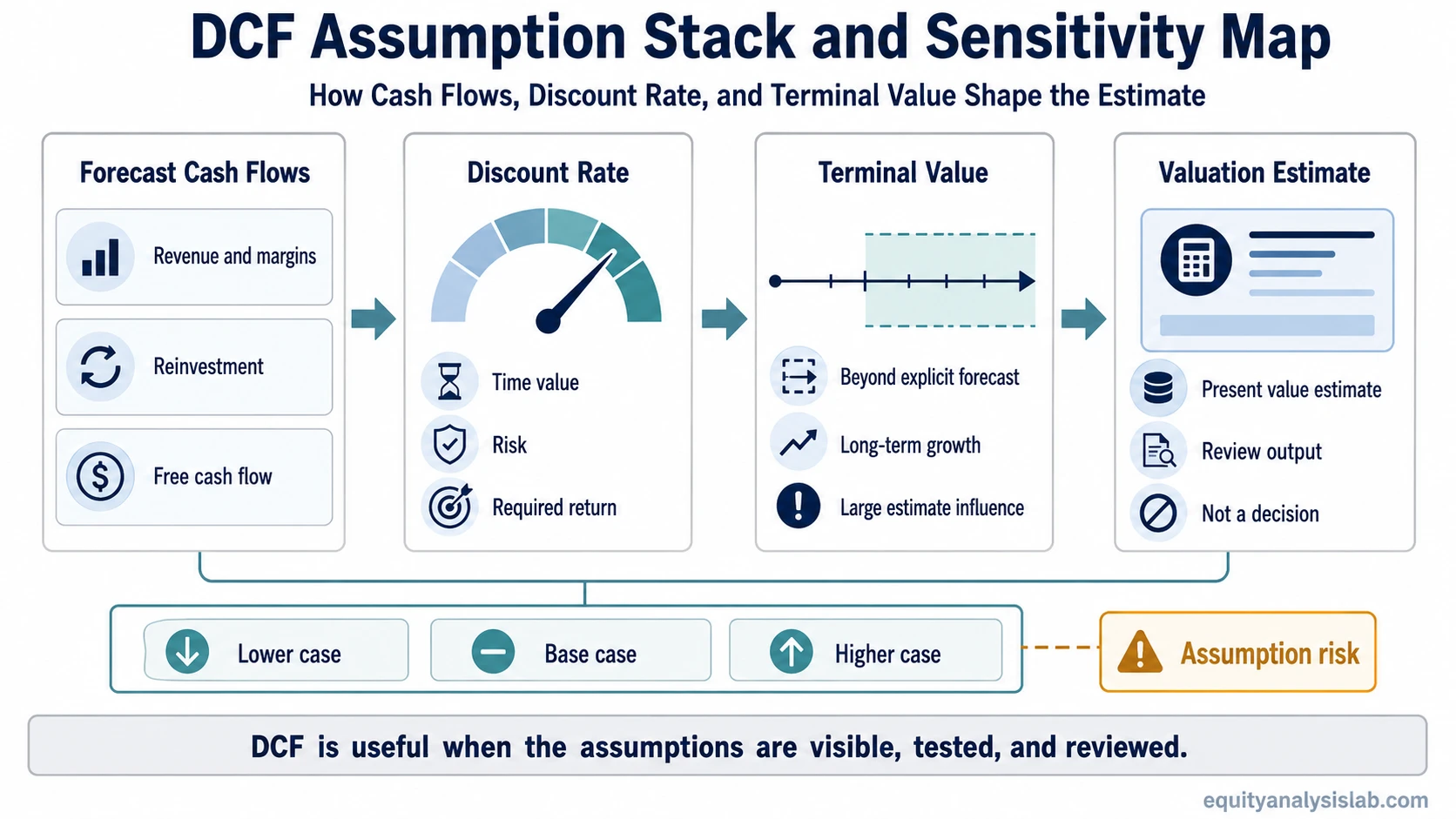
Discounted cash flow is a valuation method that estimates what expected future cash flows may be worth today after discounting them for time, risk, and required return.
A DCF model does not prove the true value of a company. It turns assumptions about cash flow, growth, reinvestment, discount rate, and terminal value into a present-value estimate that can be reviewed against business quality, cash-flow durability, balance-sheet risk, and market price.
Definition: Discounted cash flow, often shortened to DCF, estimates present value by forecasting future cash flows and discounting them back to today. The method is most useful when future cash generation can be estimated with enough discipline to test the assumptions behind the valuation.
Key Points About Discounted Cash Flow
- DCF estimates present value from expected future cash flows.
- The method starts with business assumptions, not with an isolated valuation number.
- The main inputs are cash-flow type, operating forecast, reinvestment, discount rate, terminal value, and the bridge from enterprise value to equity value.
- Growth and free cash flow need to be economically consistent because growth usually requires reinvestment.
- Terminal value often explains a large share of the estimate, so stable-state assumptions matter.
- DCF is a valuation review tool, not an investment decision by itself.
What Is Discounted Cash Flow?
Discounted cash flow is based on the time value of money. A dollar expected several years from now is usually worth less than a dollar available today because the future dollar carries timing risk, business risk, financing risk, and opportunity cost.
In company valuation, a DCF model usually starts with expected future cash flows, discounts each forecast period back to present value, adds a terminal value for cash flows beyond the explicit forecast period, and then adjusts the result to estimate enterprise value, equity value, or implied value per share.
The most useful output is not just the final number. It is the assumption trail behind the number: which cash flows were used, how those cash flows were built, what discount rate was selected, how much reinvestment is required, and how much of the estimate depends on terminal value.
How Discounted Cash Flow Works
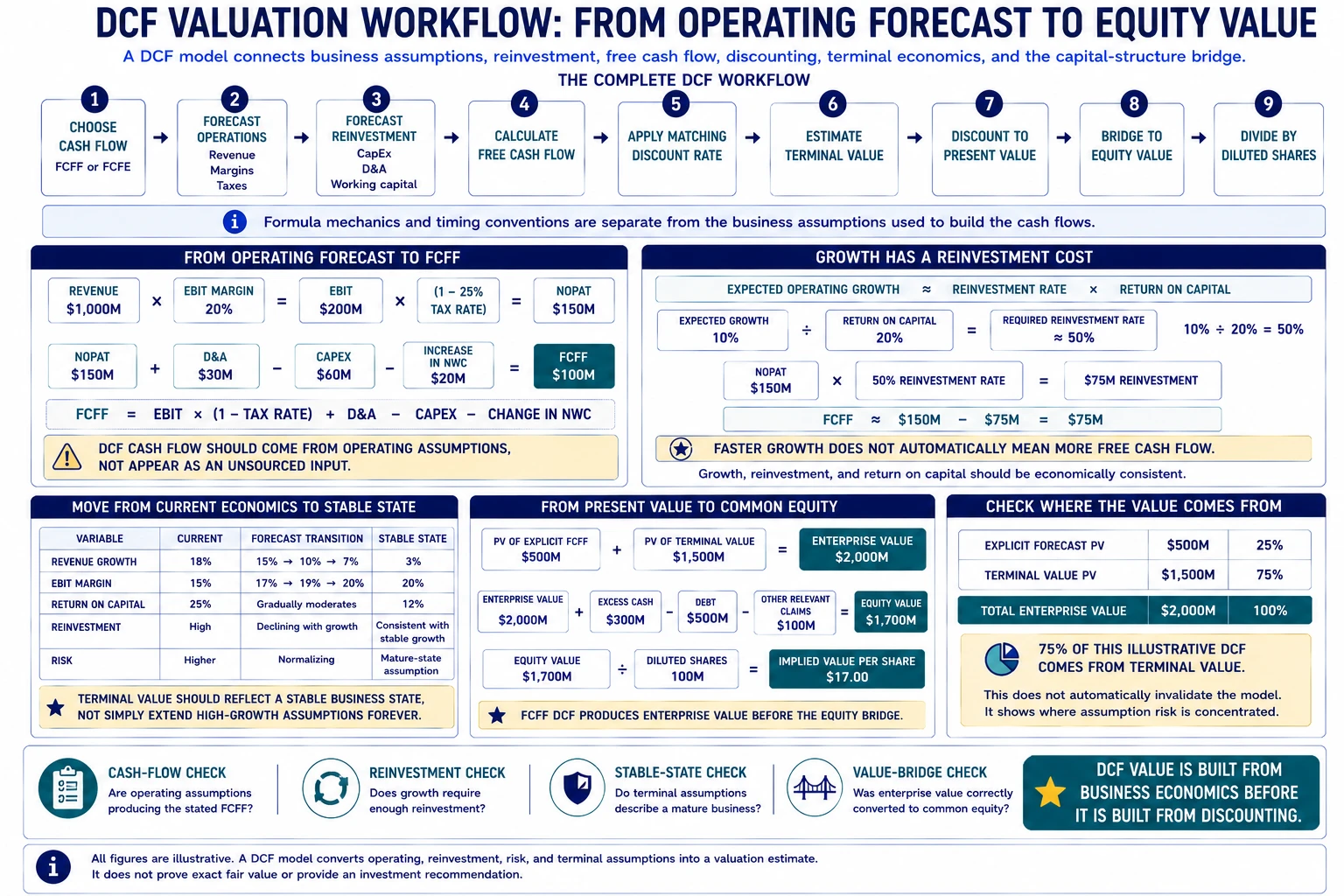
A DCF model is a workflow, not a single equation. It connects operating assumptions, free cash flow, discounting, terminal economics, and the capital-structure bridge.
| Step | What happens | Why it matters |
|---|---|---|
| Choose the cash-flow basis | Select whether the model values the firm or the equity directly. | The cash-flow basis controls the discount rate and the final value output. |
| Build the operating forecast | Forecast revenue, margins, taxes, and operating performance. | Business assumptions create the starting point for free cash flow. |
| Forecast reinvestment | Estimate capital expenditures, depreciation, and working-capital needs. | Growth usually requires reinvestment, which affects free cash flow. |
| Calculate free cash flow | Convert operating assumptions into cash flow available to the firm or equity. | The DCF method discounts free cash flow, not accounting profit alone. |
| Select the discount rate | Apply a required return that matches the cash-flow definition and risk. | A mismatched discount rate can distort the entire estimate. |
| Estimate terminal value | Assign value to cash flows beyond the explicit forecast period. | Terminal value often explains a large share of total present value. |
| Discount to present value | Discount explicit cash flows and terminal value back to today. | This converts future assumptions into a present-value estimate. |
| Bridge to equity value | Adjust for debt, cash, and other relevant claims where needed. | Enterprise value and common-equity value are not the same output. |
| Run sensitivity checks | Test how valuation changes when key assumptions move. | A DCF estimate is more useful when it holds across reasonable scenarios. |
The mathematical discounting mechanics are explained separately in the DCF formula mechanics page. This page stays focused on the full valuation method and the economic logic behind the model.
Choose the cash-flow basis first
A DCF model can value the whole business or directly value common equity. That choice should be made at the beginning because it affects the discount rate and the valuation bridge.
| Cash-flow basis | What is being valued | Typical discount-rate logic | Typical output |
|---|---|---|---|
| Free Cash Flow to the Firm | The operating business before financing effects | Firm-level required return, often WACC | Enterprise value |
| Free Cash Flow to Equity | Cash flow available to common shareholders after financing effects | Equity required return | Equity value |
Matching rule: The cash-flow definition, discount rate, and value bridge should stay on the same capital-provider basis.
Build the operating forecast before the valuation
The most important part of a DCF model often happens before discounting begins. Revenue growth, operating margins, taxes, capital intensity, and working-capital needs determine what cash flow the business may actually generate.
This is why DCF works best when the business can be described with enough operating discipline. A smooth spreadsheet can still hide unrealistic assumptions if growth, margins, or reinvestment are disconnected from how the business actually functions.
| Operating input | What it controls | Why it matters in DCF |
|---|---|---|
| Revenue growth | Top-line expansion or contraction | It shapes the scale of future operating income and free cash flow. |
| Operating margin | Profitability of the business model | Higher or lower margins change the cash-flow base before reinvestment. |
| Tax rate | After-tax operating earnings | DCF values after-tax cash-flow generation rather than pretax profit. |
| Capital expenditures | Investment in long-lived operating assets | Growth often requires new capital, which reduces free cash flow. |
| Depreciation and amortization | Non-cash accounting expense | It affects the bridge from accounting earnings to cash flow. |
| Working capital | Cash tied up in operations | Growing businesses may need more cash to support receivables, inventory, or other operating needs. |
From operating forecast to free cash flow
A DCF model becomes more useful when the reader can see how operating assumptions turn into cash flow. In a firm-level model, that usually means moving from operating income to FCFF.
Illustrative FCFF bridge: FCFF = EBIT × (1 – Tax Rate) + D&A – CapEx – Change in Net Working Capital
Consider this simplified example:
| Illustrative input | Amount |
|---|---|
| Revenue | $1,000 million |
| EBIT margin | 20% |
| EBIT | $200 million |
| Tax rate | 25% |
| NOPAT | $150 million |
| Depreciation and amortization | $30 million |
| Capital expenditures | $60 million |
| Increase in net working capital | $20 million |
| FCFF | $100 million |
This example shows that DCF cash flow does not appear by itself. It is the result of operating assumptions, tax assumptions, and reinvestment assumptions working together.
Growth and reinvestment must be consistent
One of the most common DCF mistakes is to assume strong growth without showing the reinvestment required to support that growth. Faster growth does not automatically create more free cash flow.
Economic link: Expected operating growth is often connected to reinvestment rate and return on capital.
For example, if a company is expected to grow operating income by 10% and it earns a 20% return on capital, the implied reinvestment rate is roughly 50%.
Illustrative calculation:
Expected growth ÷ Return on capital = Implied reinvestment rate
10% ÷ 20% = 50%
If NOPAT is $150 million, a 50% reinvestment rate implies about $75 million of reinvestment. That leaves about $75 million of free cash flow before considering any other modeling details. The main point is that growth, reinvestment, and cash flow need to describe the same business reality.
Forecast period, transition, and stable state
A useful DCF model does not only project a few years and then attach a terminal value. It also needs a transition from current economics to a more stable long-term state.
| Model phase | What usually changes | Why it matters |
|---|---|---|
| Current state | Current growth, margins, returns, and risk | This is the starting point for the forecast. |
| Explicit forecast period | Revenue growth, operating margins, reinvestment needs, and cash flow | This is where business-specific assumptions are made directly. |
| Transition period | Growth, returns, and reinvestment often move toward more normal levels | It helps avoid unrealistic jumps from high-growth assumptions to permanent stable growth. |
| Stable state | Long-run growth, mature margins, and sustainable returns | These assumptions shape terminal value. |
Stable-state assumptions should describe a business that has matured relative to the explicit forecast. Extending high-growth conditions indefinitely can make terminal value look larger than the economics justify.
Discount rate and terminal value
The discount rate is one of the most important judgment points in a DCF model. A firm-level DCF often uses a weighted average cost of capital because the model values cash flows available to all capital providers. An equity-level DCF should use an equity required return that matches the shareholder cash-flow basis.
Terminal value estimates what the business may be worth after the explicit forecast period. That estimate can be based on a long-term growth assumption or an exit multiple. Both approaches require caution because small changes in long-term assumptions can move the valuation materially.
Limitation: A DCF output can look exact even when the most important inputs are judgment calls. The model is usually more useful as a valuation range than as one fixed answer.
From enterprise value to equity value
Many DCF models based on FCFF produce enterprise value first. That is not yet the amount attributable to common shareholders. The estimate still needs a capital-structure bridge.
| Step | Illustrative amount |
|---|---|
| Present value of explicit FCFF | $500 million |
| Present value of terminal value | $1,500 million |
| Enterprise value | $2,000 million |
| Plus excess cash | $300 million |
| Less debt | ($500 million) |
| Less other relevant claims | ($100 million) |
| Equity value | $1,700 million |
| Diluted shares outstanding | 100 million |
| Implied value per share | $17.00 |
This bridge is important because enterprise value and common-equity value answer different questions. A DCF estimate can look attractive at the enterprise-value level while the equity outcome changes meaningfully after debt and other claims are considered.
How much of the estimate comes from terminal value?
Terminal value often explains a large share of total DCF value. That is not automatically a problem, but it tells the reader where assumption risk is concentrated.
Illustrative example:
Present value of explicit forecast cash flows = $500 million
Present value of terminal value = $1,500 million
Total enterprise value = $2,000 million
Terminal value share of enterprise value = 75%
If most of the estimate comes from terminal value, the model becomes highly dependent on long-term growth, stable-state profitability, reinvestment assumptions, and the selected discount rate.
Discounted cash flow sensitivity
Sensitivity analysis shows how much the valuation changes when key assumptions move. This matters because a DCF estimate can be highly dependent on a small number of inputs, especially the discount rate, terminal growth rate, margin path, and reinvestment assumptions.
| WACC \\ Terminal growth | 2% | 3% | 4% |
|---|---|---|---|
| 8% | $2,450 million | $2,700 million | $3,010 million |
| 9% | $2,150 million | $2,350 million | $2,590 million |
| 10% | $1,900 million | $2,050 million | $2,230 million |
The table is illustrative, but the direction is important. Higher discount rates usually reduce value, while higher terminal-growth assumptions usually raise value. If a small assumption change creates a large valuation swing, the model is fragile.
DCF and intrinsic value
DCF is often used to estimate intrinsic value, but the two terms are not identical. Intrinsic value is the estimated economic worth of an asset. DCF is one method that can be used to estimate that worth.
The distinction matters because a polished DCF model can still be weak if cash-flow forecasts are unrealistic, the discount rate is too low, terminal value is aggressive, or the bridge to equity value is incomplete.
When discounted cash flow is useful
DCF is most useful when the business has reasonably visible cash flows, an understandable reinvestment profile, and assumptions that can be tested. It often works well for mature companies, stable cash-generating businesses, and companies where the link between growth, returns, and reinvestment can be estimated with some discipline.
DCF can also help separate business analysis from market pricing. Instead of only asking what peers trade for, the model asks what the business may be worth under a set of cash-flow assumptions.
When DCF is less reliable
DCF becomes less reliable when future cash flows are highly uncertain, the business model is changing quickly, profitability is not yet visible, reinvestment needs are hard to estimate, or terminal value explains most of the output. In those cases, the model may still be useful for scenario analysis, but the final number should not be treated as precise.
Common mistake: Treating the DCF output as “the value” instead of asking which assumptions caused the output. A better review starts with the cash-flow path, reinvestment needs, discount rate, terminal value, and sensitivity range.
Discounted cash flow vs other valuation methods
DCF is one valuation method, not the entire valuation process. It is often used alongside market-based methods, accounting checks, and business-quality review.
Comparable Company Analysis looks at how similar companies are priced in the market.
A market-relative cross-check can show whether a DCF estimate is far away from peer valuation levels, but peer multiples can also reflect market mood, accounting differences, or business-quality gaps.
A dividend-focused valuation approach is narrower because it values expected dividends rather than broader free cash-flow generation.
DCF and NPV share the idea of discounting future cash flows, but they are often used in different contexts. DCF is commonly used to value companies or securities, while NPV is often used to evaluate a project, investment, or capital-allocation decision.
How to read a DCF estimate
A useful DCF review starts with a few simple questions. Are the operating assumptions realistic? Does the free cash flow reflect the reinvestment needed to support the forecast? Is the discount rate appropriate for the risk and the cash-flow basis? Does terminal value explain too much of the result?
If the answer depends mainly on one optimistic assumption, the valuation range is fragile. If the estimate holds across several reasonable scenarios, the model gives a more useful view of valuation context, although it still does not make the investment decision by itself.
FAQ
What does a discounted cash flow model do?
A discounted cash flow model estimates present value by forecasting future cash flows, discounting them back to today, and combining those present values with a terminal-value estimate.
Why does free cash flow matter in DCF?
DCF values cash generation, not accounting profit alone. Free cash flow reflects how much cash remains after operating needs and reinvestment are considered.
Why does growth not automatically increase DCF value?
Because growth usually requires reinvestment. If a business needs more capital to support growth, free cash flow may not rise as much as revenue or operating income.
Why can terminal value make a DCF fragile?
Terminal value often represents a large share of the total estimate. If the long-term growth, exit multiple, or stable-state assumptions are too optimistic, the final valuation can look more precise than it is.
Is DCF the same as intrinsic value?
No. DCF can be used to estimate intrinsic value, but the result depends on the assumptions used in the model. It is an estimate, not proof of exact value.
Can DCF tell whether a stock should be bought?
No. DCF can support valuation review, but it does not make a buy or sell decision by itself. Business quality, risk, portfolio context, market price, and assumption sensitivity still need review.