
Investing guides at Equity Analysis Lab help readers choose the right path for stock basics, company analysis, valuation, portfolio construction, and annual-report review.
The best starting point depends on the question being solved. A reader learning stock-market basics does not need the same path as a reader trying to analyze a company, estimate value, build a portfolio, or read an annual report. This hub separates those routes so each guide leads into the right investor decision process.
Start With the Right Investing Guide
Use the table below to choose the guide that matches the current task. The goal is not to replace deeper research, but to route the reader toward the next useful step.
| Current need | Best guide | What it helps organize | Boundary |
|---|---|---|---|
| Learn stock-investing basics | Investing in Stocks for Beginners | Basic stock ownership, risk context, diversification, time horizon, and beginner orientation. | It does not replace company analysis, valuation work, or personal suitability review. |
| Analyze an individual company | How to Analyze a Stock | Business model, financial statements, quality, valuation context, and risk review. | It should not become a shortcut for choosing stocks without evidence. |
| Estimate what a stock may be worth | How to Value a Stock | Intrinsic value, valuation methods, assumptions, financial evidence, and margin-of-safety context. | It does not produce certainty, a price target, or a buy/sell decision. |
| Build a portfolio process | How to Build a Stock Portfolio | Position roles, diversification, concentration, allocation logic, and rebalancing discipline. | It does not decide the right allocation for a specific investor. |
| Read company reports more effectively | How to Read an Annual Report | Business description, financial statements, management discussion, risk factors, and footnotes. | It does not replace deeper accounting, valuation, or business-quality analysis. |
Key Points
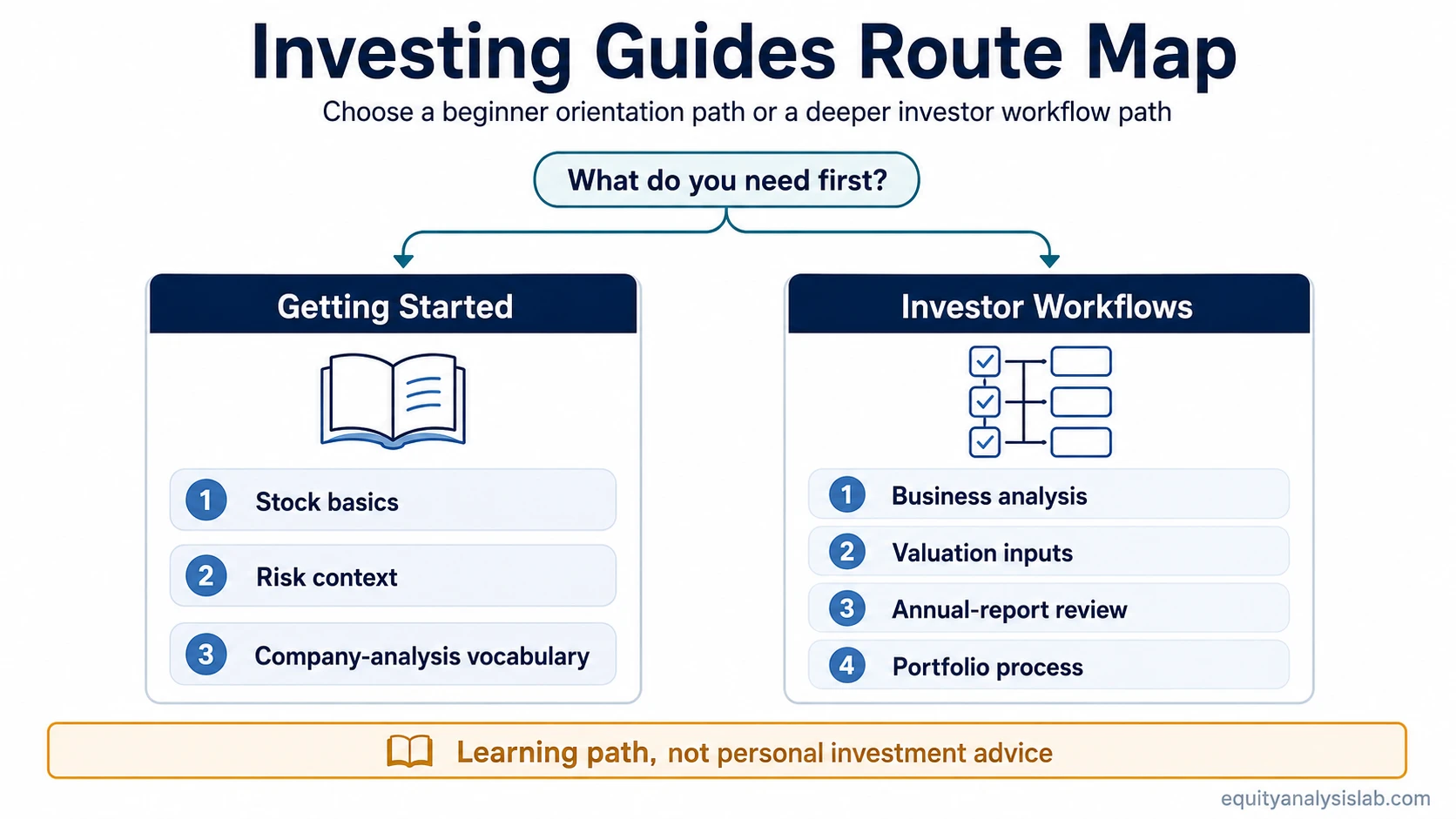
- Start with beginner stock-investing orientation if basic market terms, risk context, diversification, or company-analysis vocabulary are still unclear.
- Use the stock analysis and valuation guides when the task is understanding a business, reviewing evidence, and connecting assumptions to value.
- Use the portfolio and annual-report guides when the task is organizing holdings or reading company disclosures more systematically.
- These guides are educational routing tools, not personal investment advice, product selection, allocation guidance, or buy/sell recommendations.
Beginner Stock Investing Path
The beginner path is the better first stop when the main problem is orientation. It keeps the focus on what stock ownership means, how risk and return should be understood, why diversification matters, and how a beginner can move from broad investing concepts into company-level research.
This path is most useful before deeper analysis if terms like equity investing, time horizon, risk tolerance, valuation, financial statements, or portfolio construction still feel disconnected.
Stock Analysis and Valuation Paths
The stock analysis path is for readers who are ready to evaluate a company rather than only understand the stock market in general. It points toward business model review, financial statements, margins, cash flow, balance-sheet risk, management quality, and the evidence that supports or weakens an investment thesis.
The valuation path comes after the evidence is clearer. Valuation depends on assumptions about cash flow, growth, margins, risk, and future business quality. A stock can look cheap on a simple multiple while the underlying assumptions remain weak, uncertain, or unsupported.
Portfolio and Annual Report Paths
The portfolio path is useful when the question is how holdings fit together. It focuses on portfolio structure, diversification, concentration, position roles, review discipline, and the difference between analyzing one stock and managing a group of exposures.
The annual-report path is useful when the question is what the company actually discloses. Annual reports can help connect the business model, financial statements, management discussion, risk factors, footnotes, and long-term evidence before the reader moves deeper into valuation or portfolio decisions.
What These Investing Guides Do Not Replace
Educational boundary: These investing guides organize learning paths for stock basics, company analysis, valuation, portfolio construction, and annual-report review. They do not determine which security to buy, what account to use, how much to allocate, or whether an investment is suitable for a specific person.
The value is structure. A clean route can make investor research less scattered, but final decisions still depend on objectives, risk capacity, time horizon, tax context, available evidence, and independent judgment.
FAQ
Which investing guide should come first?
Start with the beginner stock-investing guide if basic market terms, risk context, or company-analysis vocabulary are still unclear. Move into stock analysis, valuation, portfolio construction, or annual-report review when the next task is more specific.
Are these investing guides personal investment advice?
No. The material is educational and process-oriented. It does not recommend securities, products, accounts, allocations, or investment actions for a specific person.
Do these guides replace valuation or portfolio research?
No. They help organize the learning path. Valuation, portfolio construction, annual-report review, and company analysis still require deeper research, assumptions, evidence review, and investor-specific context.