
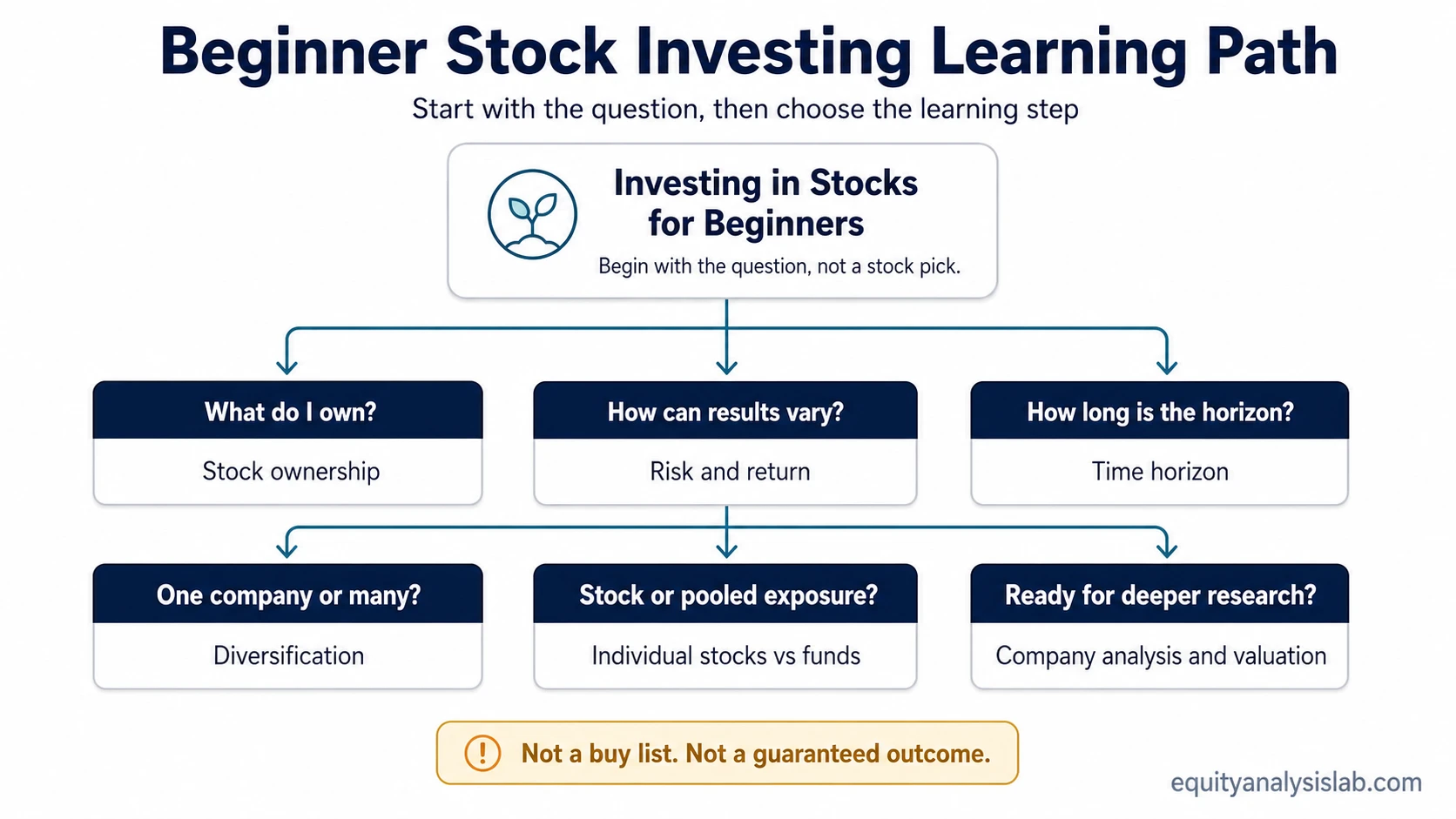
Investing in stocks for beginners starts with a simple sequence: understand what stock ownership means, decide whether individual companies or pooled exposure fits the starting point, set goals and time horizon first, and learn how risk, return, and diversification shape every stock decision.
A stock represents ownership in a business. That ownership can rise or fall in market value, and it does not guarantee a positive result. The beginner mistake is treating the first stock idea as the whole plan. The stronger starting point is to understand the decision structure before focusing on any single company.
Beginner stock investing: a first learning path for understanding equity ownership, risk, time horizon, diversification, and the difference between owning individual businesses and gaining broader stock-market exposure.
Key Points
- Stock investing begins with ownership and risk, not with a search for the “best” stock.
- Individual stocks require company-specific research; pooled exposure spreads ownership across many securities.
- Goals, risk tolerance, risk capacity, and time horizon should come before stock selection.
- Diversification helps prevent one company from becoming the entire investment plan.
- Company analysis and valuation are later steps after the beginner understands the investing framework.
What investing in stocks means for a beginner
Investing in stocks means accepting ownership exposure to businesses. A shareholder participates in the changing market value of that ownership, but the result depends on business performance, valuation, investor expectations, market conditions, and the price paid.
The first useful distinction is between the equity-investing concept and the act of choosing one stock. Equity investing explains the ownership category. A stock purchase is only one possible expression inside that category.
There is no need to master every valuation method immediately. The priority is to understand the structure of the decision: what is being owned, how much uncertainty is involved, how long the money may be invested, and whether the exposure depends on one company or many.
The first decision is the learning path
Stock investing becomes clearer when the first question is not “Which stock should I buy?” but “Which part of the process do I need to understand next?” That question separates ownership basics, risk, time horizon, diversification, company research, and valuation into different learning steps.
| Starting question | What it means | Learn next | Mistake to avoid |
|---|---|---|---|
| What do I own when I buy a stock? | The starting point needs the ownership concept before thinking about a specific company. | Equity ownership and shareholder exposure | Treating a stock ticker as just a moving price |
| How much can the result vary? | The starting point needs to understand uncertainty before choosing a security. | Risk, return, and loss tolerance | Assuming stock investing is guaranteed |
| How long can the money stay invested? | The investment period changes how price swings and business outcomes are interpreted. | Time horizon and investment objectives | Using short-term emotions to judge a long-term decision |
| Should I start with one company or broader exposure? | The question is choosing between company-specific risk and diversified stock exposure. | Diversification and stock funds versus individual stocks | Believing one stock is a complete plan |
| How do I judge a specific company? | The question is moving from general investing into company analysis. | Business model, financial statements, and valuation basics | Reading a story without checking the numbers |
Individual stocks and pooled exposure are not the same starting point
An individual stock concentrates the decision in one company. The investor must understand the business, financial condition, competitive position, valuation, and risks specific to that company. A pooled vehicle, such as a broad stock fund, spreads exposure across many holdings and reduces dependence on a single business.
That difference does not make one path automatically better for every beginner. It changes the learning requirement. Individual stocks demand more company-level judgment. Pooled exposure still involves market risk, but it reduces the need to make every decision company by company.
Useful distinction: individual stocks create company-specific exposure; pooled stock exposure creates broader market or category exposure. Both can lose value, but they ask different questions from the investor.
Risk, return, and time horizon come before stock selection
Stock investing involves uncertainty. Prices can move against the investor even when the original idea sounded reasonable. The relationship between risk and return should be understood before any beginner treats a stock idea as safe or obvious.
A working investment time horizon is also necessary. Money needed soon cannot be interpreted the same way as money intended for a longer investment period. A short horizon can make ordinary stock volatility harder to tolerate, while a longer horizon still does not remove business or valuation risk.
Goals shape the decision as well. Someone trying to learn company analysis has a different task from someone trying to build broad stock-market exposure. Mixing those goals can lead to shallow research, accidental concentration, or emotional decisions after normal price changes.
Diversification prevents one idea from becoming the whole plan
Owning one stock means the outcome depends heavily on one company. That company may face weak earnings, management mistakes, competitive pressure, regulatory issues, valuation compression, or a market environment that changes investor appetite for its shares.
Diversification spreads exposure so that one position does not dominate the entire plan. It does not eliminate risk and it does not guarantee a positive return. It changes how dependent the investor is on a single company, sector, or thesis.
Risk boundary: diversification can reduce concentration risk, but it cannot remove market risk, valuation risk, or the possibility of loss. A diversified portfolio can still decline when broad equity markets fall.
When company research becomes the next step
After the beginner understands ownership, risk, time horizon, and diversification, individual company research becomes more useful. Company research asks whether the business itself is understandable, financially durable, competitively positioned, and valued in a way that leaves room for uncertainty.
At that point, the learning path can move into business model analysis, financial statements, earnings quality, cash flow, and valuation. That is a later step, not the opening move. A stock idea is weaker when the investor knows the story but has not checked how the business earns money, how much cash it produces, or what assumptions are already reflected in the price.
One possible stock-selection style is value investing, which focuses on the relationship between price and underlying business value. That style still requires judgment; a low share price or low valuation multiple is not enough by itself.
A beginner path map for stock investing
The stock-investing path works best when each question points to the right concept. Broad beginner orientation should not replace deeper pages on equity ownership, risk, time horizon, diversification, company analysis, or valuation.
| Learning need | Beginner interpretation | Best next concept |
|---|---|---|
| Understand what stocks are | Stocks are ownership interests, not just price charts. | equity investing |
| Understand uncertainty | Potential return and possible loss must be considered together. | risk and return |
| Frame the investment period | The time available affects how volatility and business outcomes are judged. | time horizon |
| Control concentration | One company should not accidentally become the whole plan. | diversification |
| Learn a stock-selection style | Price should be compared with business value, quality, and uncertainty. | value investing framework |
Common beginner mistakes with stocks
Many beginner mistakes come from skipping the decision structure. The same mistake can appear in different forms: chasing a popular idea, assuming a low price is automatically cheap, or buying a company before knowing what would make the thesis weaker.
| Mistake | Why it is incomplete | Safer learning response |
|---|---|---|
| Following hot tips | A tip does not explain ownership, risk, valuation, or what could go wrong. | Translate the idea into a research question before treating it as investable. |
| Treating one stock as a plan | One company can dominate the outcome more than the beginner expects. | Check whether the exposure is concentrated or diversified. |
| Thinking low price means good value | A low share price can reflect weak fundamentals, dilution, business risk, or poor expectations. | Separate price from value and value from quality. |
| Skipping time horizon | A decision with no time frame is hard to evaluate when price moves sharply. | Define the investment period before judging normal volatility. |
| Confusing account setup with investing process | Opening an account gives access to markets, but it does not create an investment framework. | Build the reasoning process before focusing on platform mechanics. |
A simple orientation example
A beginner may start with the question, “Should I learn individual stocks first or understand broad equity exposure first?” If the goal is to understand what stock ownership means, the first path is equity investing. If the concern is loss, uncertainty, or emotional reaction to price movement, the next path is risk and return. If the money may be needed soon, time horizon becomes the first filter. If the beginner is worried about relying on one company, diversification becomes the next concept. Only after those questions are clear does company analysis or valuation become a stronger next step.
This is an orientation scenario, not an investment instruction. It shows how the same beginner topic can lead to different learning paths depending on the question being asked.
Where brokerage accounts fit in the sequence
A brokerage account may be needed to buy stocks, but account access is not the same as investment reasoning. Platform setup, order entry, and account features are implementation details after the beginner understands the decision being implemented.
The educational sequence should stay clear: first understand ownership, risk, time horizon, and diversification; then decide whether the next step is broad exposure, company analysis, valuation, or portfolio construction. The account should serve the investment process, not replace it.
What to learn before analyzing one company
Company analysis becomes more useful after the beginner understands why one business should not be judged in isolation from risk, time horizon, portfolio role, and valuation. A company can have a strong story and still be a poor investment if the price already assumes too much, if the balance sheet is weak, or if the thesis depends on assumptions the investor has not examined.
Later company analysis should answer questions such as how the business earns money, how durable earnings appear, how cash flow supports the story, what risks could weaken the thesis, and what valuation assumptions are being made. Those questions belong after the beginner has a basic investing framework.
FAQ
Should beginners start with individual stocks?
Beginners can study individual stocks, but the first step is understanding stock ownership, risk, time horizon, and diversification. Individual stocks require company-specific research, so they should not be treated as the simplest path by default.
Is investing in stocks guaranteed?
No. Stocks can decline in value, and positive returns are not guaranteed. Risk, valuation, business quality, diversification, and time horizon all affect how stock investing should be interpreted.
Are stocks and stock funds the same thing?
No. An individual stock is ownership in one company, while a stock fund usually holds many securities. Both involve equity-market risk, but they create different levels of company-specific exposure.