
Network effects describe a business model feature where additional users or participants can make a product, service, or platform more valuable to other users. For investors, the important question is not whether a company has a large user base, but whether participation actually improves activity, retention, pricing power, unit economics, margins, or cash conversion.
Key Points
- Network effects depend on useful participation, not just user count or brand visibility.
- Direct network effects and indirect network effects create value through different channels.
- Investor evidence should include engagement, retention, transaction quality, unit economics, margins, and cash conversion.
- Network effects can weaken when congestion, multihoming, low switching costs, poor activity quality, or cost inflation offset user growth.
What Are Network Effects?
Network effects occur when the value of a product, service, or platform increases as more relevant users, participants, sellers, buyers, developers, or contributors join and use it.
The core idea is value improvement through participation. A communication service becomes more useful when more people can be reached. A marketplace can become more useful when buyers attract sellers and sellers attract buyers. A software platform can become more useful when more developers, integrations, or data contributors improve the user experience.
A network effect is not the same as popularity. A product can grow quickly without making each user’s experience better. The stronger claim is that new participation improves the system for existing or complementary users, and that improvement becomes visible in business evidence rather than only in a growth narrative.
How Network Effects Work in a Business Model
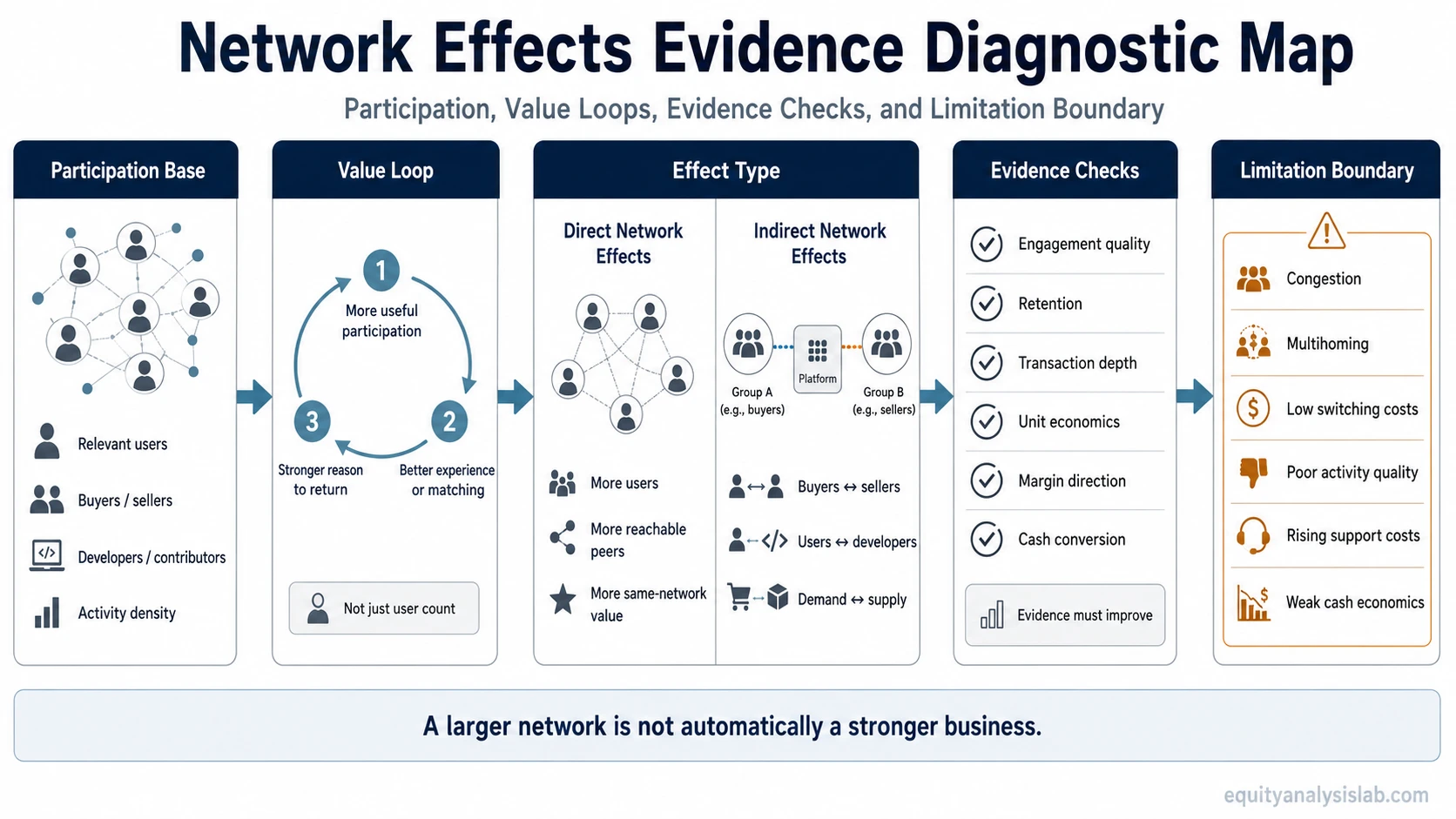
Network effects usually begin with a participation loop. More users or participants improve the value of the service, that added value attracts more participation, and the larger network can make the service harder to replace. The loop can become more powerful after the business reaches enough activity density for users to notice the improved value.
That threshold is often described as critical mass. Before that point, the product may still require heavy spending, incentives, or discounts to attract users. After that point, the network can begin to support stronger retention, better liquidity, more relevant matches, more useful data, or a better ecosystem of complementary services.
The economic value is still conditional. A network may be large but expensive to maintain. Participation may increase while margins stay weak. A company may report user growth while the quality of activity deteriorates. For equity analysis, the network-effect claim becomes more useful when participation produces measurable business improvement, not only a larger audience.
Illustrative scenario: A marketplace may add many registered users, but the network-effect claim is weak if transaction frequency falls, sellers leave, customer acquisition costs rise, and cash conversion does not improve. The claim becomes more credible when participation improves the experience for other participants and that improvement appears in retention, engagement, pricing, or unit economics.
Direct vs Indirect Network Effects
Direct network effects occur when users benefit directly from more users of the same product or network. A communication network is the simplest example: the service becomes more useful when more relevant people can be contacted through it.
Indirect network effects occur when one group of participants attracts or improves the experience for another group. A two-sided platform can show this pattern when more buyers attract more sellers, and more sellers improve buyer choice, availability, or price discovery.
Platform network effects often combine several channels. More users can attract more developers, creators, merchants, advertisers, data contributors, or service providers. The analytical risk is that the label can become too broad. A platform is not automatically protected by network effects simply because it connects groups of users.
| Type | How value is created | Investor evidence to check |
|---|---|---|
| Direct network effects | More users increase value for users in the same network. | Activity, retention, engagement, switching behavior, and user-to-user utility. |
| Indirect network effects | One participant group improves value for another participant group. | Marketplace liquidity, seller quality, buyer demand, creator supply, developer activity, or ecosystem depth. |
| Data network effects | More usage improves data, recommendations, matching, or product quality. | Model quality, relevance, repeat usage, measurable user outcomes, and whether competitors can access similar data. |
Network Effects vs Economic Moats
Network effects can contribute to an economic moat, but they are not the same thing. An economic moat is a broader durability concept. Network effects describe one possible mechanism that can make a business harder to displace.
The distinction matters because a network can be large without being durable. If users can easily multihome, switch between services, or recreate their connections elsewhere, the network may offer less protection than the headline user count suggests. If participation adds cost faster than value, the network can grow while business quality stays weak.
Limitation: A network-effect claim should not be treated as proof of pricing power, margin expansion, valuation upside, or investment safety. The claim has to survive evidence checks around user behavior, competitive alternatives, unit economics, and cash generation.
How Investors Can Test Network Effects
For investors, the most useful network-effect analysis connects user participation to observable business outcomes. A company’s narrative may emphasize users, creators, merchants, developers, or ecosystem scale, but the investor still has to ask whether the larger network improves business economics.
Useful evidence can include retention, engagement, transaction frequency, take rates, gross margin behavior, customer acquisition costs, contribution margin, and cash conversion. The evidence should show that additional participation improves the quality or economics of the network rather than only increasing reported scale.
| Claim | Evidence that strengthens it | Evidence that weakens it |
|---|---|---|
| More participation improves value | Higher activity, better matching, improved retention, or stronger repeat usage. | Inactive users, low engagement, poor matching, or declining transaction quality. |
| The network is hard to leave | High switching costs, durable relationships, embedded workflows, or unique ecosystem data. | Easy account switching, multihoming, low loyalty, or weak user dependence. |
| The network improves economics | Better unit economics, lower acquisition burden, stronger margins, or better cash conversion. | Heavy incentives, rising support costs, weak margins, or persistent cash burn. |
| The network supports pricing power | Stable retention after pricing changes and limited customer churn. | High churn, discounting pressure, or rapid movement to lower-cost alternatives. |
The test should also connect to unit economics. If each additional participant improves activity but requires heavy subsidies, the network may not create attractive economics. If participation increases retention and lowers acquisition intensity, the network-effect claim becomes more credible.
Common Mistakes When Analyzing Network Effects
Mistake 1: Treating user count as proof. A large user base is only a starting point. The stronger test is whether more relevant users improve the experience and economics for other users.
Mistake 2: Ignoring activity quality. Registered users, downloads, or accounts can overstate network strength if active usage, retention, or transaction quality is weak.
Mistake 3: Assuming network effects always create pricing power. Pricing power depends on user dependence, alternatives, switching behavior, and competitive pressure. A network can be valuable but still face limits on monetization.
Mistake 4: Missing cost inflation. Some networks require spending on incentives, moderation, infrastructure, support, fraud prevention, or partner economics. Growth can become less attractive if those costs rise faster than value.
When Network Effects Can Weaken
Network effects weaken when more participation no longer improves the user experience. Congestion, spam, low-quality supply, weak matching, fraud, or excessive monetization can reduce the value of a network even while the participant count grows.
They can also weaken when users can maintain accounts across several competing services. Multihoming reduces exclusivity. If buyers, sellers, creators, developers, or users can participate across multiple networks with little friction, the network may be less defensible than it appears.
Another risk is that the network depends on incentives rather than organic value. If users stay only because of discounts, subsidies, or promotional economics, the business may struggle when those incentives are reduced. In that case, growth may not translate into durable retention or cash generation.
Investor boundary: Network effects are useful only when they survive both customer-behavior tests and financial-statement tests. Retention, engagement, margins, and cash conversion matter more than the label itself.
Relationship to Pricing Power and Margins
Network effects can support pricing power when the network creates value that users cannot easily replace. If the service becomes embedded in workflows, relationships, data, or access to counterparties, customers may tolerate price increases better than they would for a more interchangeable product.
The margin impact depends on the operating model. Some networks can scale with relatively low incremental cost after the infrastructure is built. Others require ongoing incentives, moderation, partner payouts, sales support, or infrastructure spending. That is why margin evidence matters alongside network evidence.
The claim becomes stronger when participation improves value, retention stays resilient, monetization does not damage activity, and margins or cash conversion improve over time. It becomes weaker when users resist pricing, churn rises, or the cost of maintaining the network offsets the benefit of scale.
How Network Effects Connect to Business Model Analysis
Network effects are one part of business model analysis. They help explain how a company may create or reinforce value, but they do not replace analysis of revenue quality, cost structure, customer concentration, margins, balance-sheet risk, or capital requirements.
A company with network effects may still have weak profitability if monetization is difficult or costs scale with usage. A company without strong network effects may still have a high-quality business model if it has other strengths, such as customer switching costs, efficient distribution, strong cash generation, or disciplined capital allocation.
Related business model checks: Compare network effects with economies of scale, asset-light business model structure, and the company’s capital intensity profile.
The clean distinction is that network effects ask whether more participation increases value for other participants. Scale economics ask whether higher volume changes cost behavior. Asset-light structure and capital needs ask how much investment is required to operate and grow the model.
FAQ
Are network effects the same as economies of scale?
No. Network effects are mainly about value increasing as participation grows. Economies of scale are mainly about cost per unit declining as volume grows. They can appear together, but they describe different business model mechanics.
Do network effects guarantee a durable moat?
No. Network effects can support a moat, but only if the network remains useful, difficult to replicate, and economically valuable. Weak retention, multihoming, congestion, poor activity quality, or weak cash economics can reduce the durability of the effect.
What is the difference between direct and indirect network effects?
Direct network effects occur when more users of the same network increase value for each other. Indirect network effects occur when one participant group increases value for another group, such as buyers attracting sellers or developers improving a software ecosystem.
Can a company have many users but weak network effects?
Yes. A large user base is weak evidence if participation is inactive, retention is poor, engagement is falling, acquisition costs are rising, or cash conversion remains weak. The key test is whether more users improve the experience and the economics of the business.