
Switching costs are the financial, operational, technical, or behavioral frictions that make it costly, slow, risky, or disruptive for a customer to move from one provider to another.
For investors, the important question is not whether a company claims to have customer lock-in. The useful question is whether that friction appears in observable business evidence, such as retention, renewals, price realization, margins, unit economics, cash conversion, and customer behavior when competitors offer alternatives.
Simple definition: switching costs are the burdens a customer faces when changing suppliers, products, platforms, systems, or service providers.
Investor interpretation: switching costs can support revenue durability and pricing resilience when customers stay because leaving would create real cost or disruption. They do not prove a moat, business quality, valuation upside, or stock attractiveness by themselves.
Key points about switching costs
- Switching costs can be financial, technical, procedural, contractual, data-related, compliance-related, or behavioral.
- They matter most when they show up in customer behavior, not only in management language or product complexity.
- Strong switching friction can support retention, renewal behavior, and pricing durability, but the evidence must be checked.
- High switching costs can be overstated when substitutes improve, regulation reduces lock-in, customer dissatisfaction rises, or technology makes migration easier.
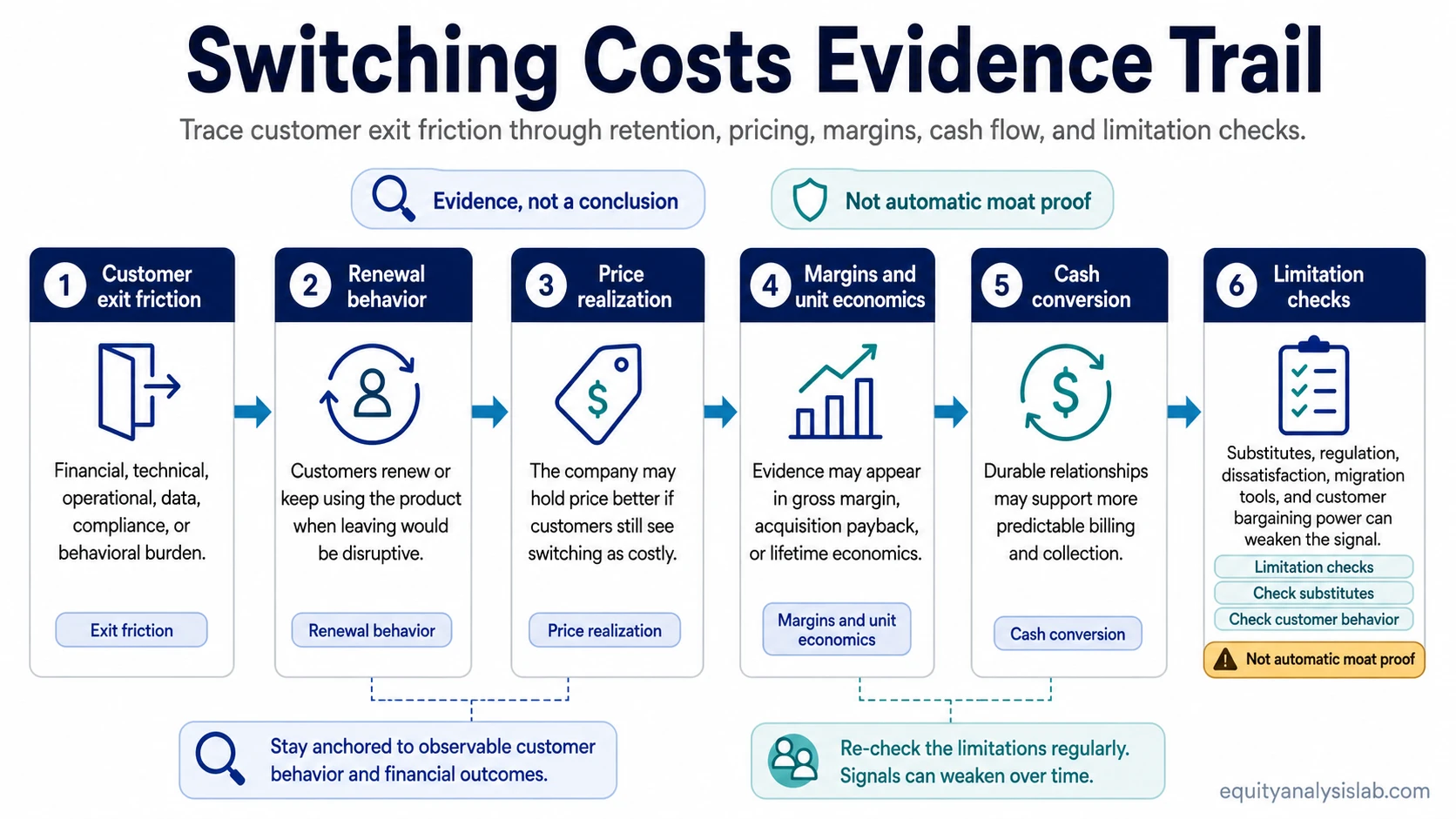
How switching costs work in a business model
Switching costs work by increasing the total burden of leaving. A customer may need to pay termination fees, retrain staff, migrate data, rebuild workflows, pass a compliance review, accept temporary disruption, or risk mistakes during the transition. The stated price of the new provider is only one part of the decision.
This is why switching costs can matter in business model analysis. If leaving is disruptive, customers may renew even when a competitor offers a lower headline price. That can help a company defend revenue, sustain better unit economics, and sometimes hold price more effectively. The relationship is conditional, not automatic. A customer can tolerate friction for a while and still leave if the product becomes too expensive, too weak, or too hard to justify.
Switching costs are also different from recurring revenue. Recurring revenue describes how revenue is contracted or repeated. Switching costs explain why a customer may hesitate to stop, replace, or migrate away from that relationship.
Observable evidence for switching costs
The strongest analysis separates claimed switching costs from observed customer behavior. A company may describe its product as sticky, mission-critical, or deeply embedded, but investors still need evidence that customers actually behave as if leaving is costly.
| Observable signal | What it can suggest | What can make it misleading |
|---|---|---|
| Churn / retention | Customers may face real friction when leaving. | Retention may reflect contracts, discounts, weak alternatives, or measurement choices. |
| Contract renewal or repeat purchase behavior | Customers may keep using the product after the initial sale. | Renewals can be driven by promotion, bundle pressure, or lack of near-term alternatives. |
| Gross margin and price realization | The company may hold price without immediate customer loss. | Margin strength may come from mix, cost cuts, accounting, or temporary demand. |
| Customer acquisition cost and payback | Switching friction may improve customer lifetime economics. | Customer acquisition cost may be low for unrelated reasons, or payback may depend on aggressive assumptions. |
| Integration / migration burden | Moving providers may require time, retraining, data transfer, or process change. | The burden can fall quickly if new tools make migration easier. |
| Customer concentration | Large customers may have deep integration with the product or service. | A few customers can also create bargaining power against the company. |
| Cash conversion | Durable relationships may support more predictable cash collection. | Cash conversion can be distorted by billing timing, working capital, or contract terms. |
| Cycle behavior | Retention through downturns can show durability. | Downturn behavior may reflect contract timing rather than true loyalty. |
| Competitive response to rival discounting | Customers staying despite discounts can indicate friction. | Rivals may not be comparable, or discounts may target different customer segments. |
The table is not a scorecard. It is a way to test whether the claimed friction is visible in the business. A single metric rarely proves switching costs. The evidence becomes stronger when several signals point in the same direction and the alternative explanations are weaker.
Types of switching costs
Switching costs can appear in several forms. The most obvious is direct financial cost, such as termination fees, setup costs, parallel-system costs, or the expense of implementation. Financial friction is easy to identify, but it is not always the strongest form of lock-in.
Operational and procedural costs can matter just as much. A customer may need to change internal processes, retrain employees, redesign workflows, or coordinate a migration across departments. These frictions can be especially important when the product touches daily operations rather than a narrow optional task.
Technical and data-related costs can also create friction. Data migration, system integrations, custom configurations, compliance checks, security reviews, and workflow dependencies can make a replacement project difficult even when a cheaper provider exists.
There can also be softer forms of switching cost. Habit, relationship familiarity, user training, internal approvals, and fear of disruption can slow customer movement. These forms are harder to measure, so they should be tested against renewal behavior, retention, price realization, and customer satisfaction rather than assumed from the product story alone.
Illustrative scenario
A business customer may hesitate to replace a software provider if the switch requires data migration, employee retraining, workflow redesign, security approval, compliance review, and temporary operational disruption. A competitor might offer a lower subscription price, but the real cost of switching includes the risk and disruption of the transition.
That scenario can indicate switching friction, but it is still only a starting point for analysis. The stronger case would show up in renewal behavior, stable retention, price realization, durable margins, and cash collection. The weaker case would appear if customers leave quickly once contracts expire, rivals win accounts with modest discounts, or new tools reduce migration pain.
When switching costs are overstated
Switching costs can be overstated when the friction exists mainly on paper. A long contract may delay churn without proving customer satisfaction. A complex implementation may slow replacement without creating durable advantage. A customer may stay because alternatives are weak today, not because the company has lasting protection.
The risk rises when customer dissatisfaction is high, substitutes are improving, regulation reduces lock-in, technology simplifies migration, or a large customer has enough bargaining power to demand concessions. In those cases, switching friction can protect revenue temporarily while weakening brand trust or future pricing flexibility.
Investors should also avoid treating switching costs as the same thing as economic moat. Switching costs can contribute to a moat when they are durable, hard to bypass, and economically visible. They do not prove one on their own.
Switching costs vs related business model features
Switching costs often overlap with other business model features, but they answer a different question. The core question is: what makes leaving costly or disruptive for the customer?
| Concept | Main question it answers | How it differs from switching costs |
|---|---|---|
| Recurring revenue | How does revenue repeat over time? | Recurring revenue describes the revenue pattern. Switching costs explain why the customer may not leave. |
| Network effects | Does the product become more valuable as more users or participants join? | Network effects come from growing participation value. Switching costs come from the burden of moving away. |
| Pricing power | Can the company raise or hold price without losing too much demand? | Switching costs may support pricing power, but price durability must still appear in customer behavior and margins. |
| Economic moat | Does the company have a durable competitive advantage? | Switching costs can be one source of moat, but only if the friction is durable and economically meaningful. |
| Economies of scale | Does scale lower cost or improve efficiency? | Scale is about cost structure and operating leverage. Switching costs are about customer exit friction. |
| Capital intensity | How much capital is needed to support growth? | Capital intensity describes the asset and reinvestment burden. Switching costs describe the customer migration burden. |
Investor-use boundary
Switching costs can help explain retention, renewal behavior, revenue durability, and price resilience. They can also help investors ask better questions about customer behavior and competitive pressure.
They should not be used as a stand-alone investment conclusion. High switching costs do not automatically make a company high quality, prove valuation upside, justify a target price, or create a buy or sell decision. The useful role of the concept is diagnostic: it helps test whether customer friction is real, durable, and visible in the economics of the business.
FAQ
Are switching costs the same as customer loyalty?
No. Customer loyalty means a customer wants to stay. Switching costs mean leaving is costly, slow, risky, or disruptive. A company can have high switching costs without strong customer loyalty, which is why satisfaction and competitive response still matter.
Are switching costs always an economic moat?
No. Switching costs can contribute to an economic moat when they are durable, difficult to bypass, and visible in retention, pricing, margins, and cash conversion. Weak or temporary switching friction does not prove durable advantage.
How can investors tell if switching costs are real?
Investors can look for evidence in churn, renewal behavior, price realization, customer acquisition economics, integration burden, cash conversion, cycle performance, and customer response to rival discounts. The evidence is stronger when multiple signals support the same interpretation.