
Annual recurring revenue is the annualized value of the active recurring subscription or contract base at a measurement date. ARR is a diagnostic metric, not proof that a SaaS company has strong retention, high margins, pricing power, or attractive valuation.
Annual recurring revenue, or ARR, measures the annualized recurring revenue base of a subscription business at a given point in time. It usually excludes one-time setup fees, non-recurring services, temporary usage spikes, and revenue that is not tied to an active recurring contract or subscription.
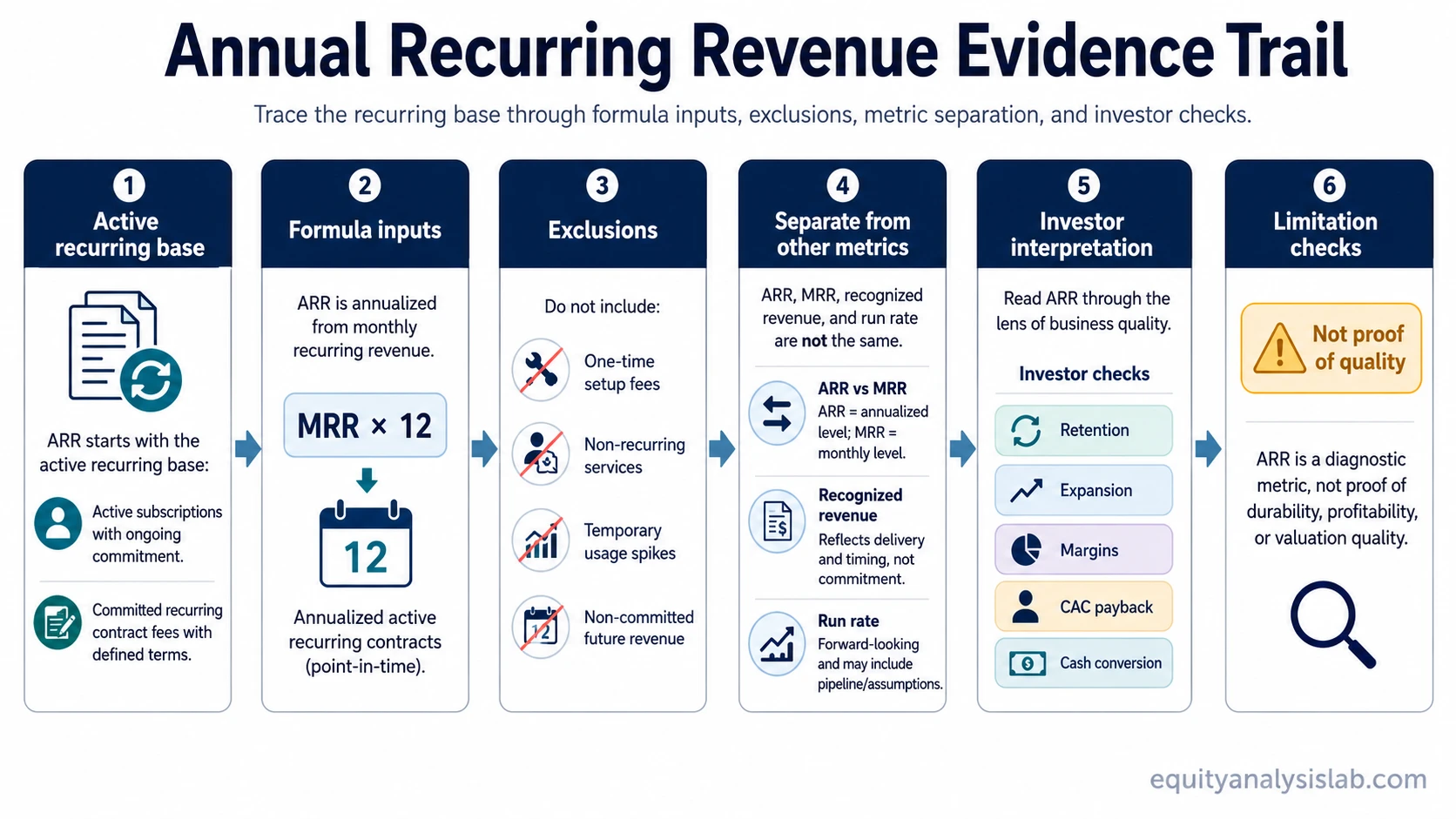
Key points about annual recurring revenue
- ARR annualizes recurring subscription or contract revenue at a measurement date.
- ARR is not the same as recognized revenue under accounting rules.
- ARR can grow even when churn, discounts, weak cash conversion, or margin pressure reduce business quality.
- Contract metrics such as ACV, RPO, and cRPO should not automatically be treated as ARR.
- Investors should read ARR alongside retention, expansion, gross margin, acquisition payback, and cash flow.
What annual recurring revenue means
Annual recurring revenue represents the annualized recurring revenue base that is active at a measurement date. For a SaaS company, that base usually comes from subscriptions, recurring licenses, committed recurring fees, or other repeatable customer payments that meet the company’s ARR definition.
The important boundary is recurrence. A customer payment belongs in ARR only when it reflects an ongoing revenue relationship. A one-time implementation fee may increase reported revenue, but it does not usually increase ARR because it does not repeat each year by itself.
ARR helps investors separate the recurring part of a business from revenue that may be temporary, transactional, or service-heavy. That separation can make the revenue base easier to analyze, but ARR definitions are not fully standardized across companies. The included products, contract structures, usage components, and measurement rules need to be checked before comparing one company with another.
How annual recurring revenue is calculated
The basic ARR formula annualizes recurring revenue. The simplest version is:
ARR = monthly recurring revenue × 12
For contract-based businesses, ARR can also be built from the active recurring contract base:
ARR = annualized value of active recurring subscriptions and committed recurring contract fees
| Formula part | What it means | Investor interpretation |
|---|---|---|
| Active recurring subscriptions | Current customers paying for repeat access to a product or service | Shows the current recurring base, but not whether the customer base is improving in quality |
| Committed recurring contract fees | Recurring payments associated with active customer contracts | Useful only when the company’s ARR definition shows how contract duration, billing, and non-recurring elements are treated |
| Expansion revenue | Recurring upgrades, seat additions, or plan expansions from existing customers | Can improve ARR quality when it comes from durable customer expansion |
| Churned or downgraded revenue | Recurring revenue lost when customers cancel, reduce seats, or move to lower plans | Must leave the active base or be analyzed separately because new ARR can hide weakening retention |
What counts and what does not count in ARR
ARR quality depends on what the company includes. The same headline number can mean different things if one company includes only committed recurring subscriptions while another includes more variable or service-heavy revenue.
| Revenue item | Usually included in ARR? | Why the boundary matters |
|---|---|---|
| Active subscription fees | Yes | They represent recurring customer payments tied to the product or service. |
| Recurring contract fees | Yes | They can form part of the recurring base when they meet the company’s ARR definition. |
| Recurring upgrades or seat additions | Often yes | They can increase ARR if they are recurring and not one-time usage or temporary service work. |
| One-time setup or implementation fees | Usually no | They may increase reported revenue, but they do not usually repeat each year. |
| Professional services revenue | Usually no | Service-heavy revenue may not have the same recurrence, margin profile, or scalability as subscription revenue. |
| Temporary usage spikes | Usually no | Short-term usage can inflate a period without proving that the recurring base has permanently expanded. |
| Churned contracts | No | Revenue from customers who have cancelled should not remain in the active recurring base. |
Simple ARR example
If a SaaS company has $500,000 of monthly recurring revenue from active subscriptions, the simple annualized ARR calculation is:
$500,000 × 12 = $6,000,000 ARR
That number describes the annualized recurring base, not the full income statement. If the company also earns one-time implementation fees, custom service revenue, or temporary usage revenue, those items may affect reported revenue without changing ARR in the same way.
ARR vs MRR vs recognized revenue
ARR, MRR, and recognized revenue answer different questions. Treating them as interchangeable can lead to weak analysis because each metric uses a different time frame and measurement basis.
| Metric | What it measures | Common investor mistake |
|---|---|---|
| ARR | Annualized recurring subscription or contract revenue base | Assuming it is the same as accounting revenue or future cash collection |
| Monthly recurring revenue | Recurring revenue measured monthly | Annualizing a volatile monthly base without checking churn, discounts, or seasonality |
| Recognized revenue | Revenue recorded under accounting rules during a reporting period | Confusing accounting recognition with the current recurring revenue base |
| Billings or cash collections | Amounts invoiced or collected from customers | Assuming cash timing and revenue recognition move together |
ARR is useful because it highlights the recurring base, but recognized revenue and cash flow still matter. A company can show strong ARR growth while cash conversion is weak if commissions, discounts, deferred revenue timing, or implementation costs absorb the benefit.
ServiceNow Example: ACV, RPO, cRPO, and Revenue Are Different Metrics
ServiceNow’s second-quarter 2026 disclosures show why recurring-sounding software metrics need to be separated before they are compared. The company reported $3.877 billion of subscription revenue for the quarter, $29.0 billion of remaining performance obligations, or RPO, and $13.20 billion of current remaining performance obligations, or cRPO.
| ServiceNow metric | Q2 2026 disclosure | What it represents |
|---|---|---|
| Subscription revenue | $3.877 billion | Subscription revenue recognized during the quarter. |
| RPO | $29.0 billion | Contracted revenue that had not yet been recognized. |
| cRPO | $13.20 billion | The portion of RPO expected to be recognized as revenue during the next 12 months. |
| ACV | Used in customer and transaction disclosures | Annual contract value used by ServiceNow to describe contract and customer scale. It is a separate company-reported metric and should not be relabeled as ARR. |
ServiceNow also reported 123 transactions above $1 million in net new ACV and 658 customers with more than $5 million in ACV. Those figures provide information about contract activity and customer scale. They do not make ACV, RPO, cRPO, recognized subscription revenue, and ARR interchangeable.
The distinction changes the analysis. RPO can include multi-year contracted revenue that has not yet been recognized, while cRPO narrows that amount to the next 12 months. Recognized revenue belongs to the accounting period in which it is reported. ARR, when a company reports it, is intended to annualize an active recurring revenue base under that company’s definition.
How investors should interpret ARR
ARR is most useful when it becomes the starting point for better questions. A high ARR number may show scale, but the quality of that scale depends on customer behavior, pricing, margins, and cash economics.
| Investor check | Question to ask | Why it matters |
|---|---|---|
| Retention | Are customers staying? | Gross revenue retention helps show whether the existing base is leaking before expansion is added. |
| Expansion | Are existing customers spending more? | Net revenue retention helps separate customer expansion from pure new-logo growth. |
| Acquisition efficiency | How expensive is new ARR? | CAC payback period helps connect recurring revenue growth with the cost of acquiring it. |
| Profitability balance | Does growth come with improving economics? | The Rule of 40 can help frame growth and profitability together, but it should not replace margin, cash flow, and retention analysis. |
| Cash conversion | Does ARR turn into cash? | Recurring revenue visibility is less valuable if working capital, discounts, commissions, or implementation costs absorb the cash benefit. |
When ARR can mislead
ARR can overstate business quality when it is read without churn, margin, cash flow, and revenue recognition context. A larger recurring revenue base is helpful information, but it is not a complete quality signal.
- New ARR can hide churn. A company may add enough new customers to grow ARR while losing older customers at an unhealthy rate.
- Expansion can mask weakness in the core base. Upsells can lift ARR even if many customers are downgrading or using the product less.
- Contract value is not automatically ARR. ACV, bookings, RPO, and other contract metrics can use different measurement rules and should be interpreted from the company’s own definition.
- Booked contract value is not the same as recognized revenue. A contract may increase visibility, but revenue recognition and billing timing can differ.
- ARR can grow while margins weaken. Heavy discounts, high support costs, implementation work, or high sales commissions can reduce the economic value of ARR growth.
- Definitions can differ by company. ARR comparisons are stronger when the included and excluded revenue items are consistent.
- ARR does not prove product quality or valuation upside. The number needs support from retention, expansion, unit economics, and cash conversion.
Related SaaS metrics to check next
ARR becomes more useful when it is compared with the metrics that explain customer behavior and business economics. MRR clarifies the monthly base. GRR and NRR separate customer retention from expansion. CAC payback connects growth with acquisition cost. The Rule of 40 frames growth and profitability together without treating ARR as a standalone quality score.
| Metric | Use it to understand | Best next question |
|---|---|---|
| Monthly recurring revenue | The recurring base measured monthly | Is the monthly base stable enough to annualize? |
| ARR vs MRR | The difference between annual and monthly recurring revenue views | Which time scale fits the analysis? |
| Gross revenue retention | Revenue kept from existing customers before expansion | How much of the base survives without upsells? |
| Net revenue retention | Existing-customer revenue after churn, downgrades, and expansion | Are retained customers expanding enough to offset losses? |
| CAC payback period | How long acquisition spend takes to pay back | Is new ARR being bought efficiently? |
| Rule of 40 | Growth and profitability balance | Does recurring revenue growth come with acceptable economics? |
FAQ
Is ARR the same as revenue?
No. ARR is an annualized measure of the active recurring subscription or contract revenue base. Revenue is the amount recognized during an accounting period, and it can include recurring revenue, services revenue, one-time fees, and other items depending on the business.
Is ARR the same as MRR?
No. MRR measures recurring revenue on a monthly basis, while ARR annualizes recurring revenue over a year. A simple conversion is ARR equals MRR multiplied by 12, but contract timing, churn, expansion, and company-specific definitions can make the interpretation more complex.
Is ARR the same as ACV or RPO?
No. ACV describes annual contract value, while RPO represents contracted revenue that has not yet been recognized. ARR annualizes an active recurring revenue base under the company’s ARR definition. The metrics can be related, but they are not interchangeable.
Does high ARR mean a SaaS company is high quality?
No. High ARR shows a large recurring revenue base, but business quality depends on what supports that base. Retention, expansion, gross margin, acquisition cost, cash conversion, and revenue recognition all affect how useful the ARR figure is for investors.