
The Rule of 40 adds a SaaS company’s annual growth rate to a profitability margin. A score of 40% or more is a common benchmark, but the number is only comparable when the growth base, margin base, and reporting period are defined consistently.
Rule of 40 = Growth rate + Profitability margin
If recurring revenue grows 28% and free cash flow margin is 14%, the Rule of 40 score is 42%.
Which Inputs Should You Use?
The SaaS Metrics Standards Board recommends annual ARR growth plus free cash flow margin as its reference convention. It also documents a GAAP revenue growth version for companies that do not report ARR. The same growth base, profitability base, and reporting period should be used when scores are compared. SaaS Metrics Standards Board
| Input | Reference convention | Comparison check |
|---|---|---|
| Growth rate | Annual ARR growth; GAAP revenue growth is also used when ARR is not disclosed | Do not mix different growth bases without stating the difference. |
| Profitability margin | Free cash flow margin in the standards-board reference convention | EBITDA, operating, net income, and adjusted margins can produce a different score. |
| Reporting period | Annual measurement aligned to a consistent fiscal period | Short or mismatched periods can make two scores look more comparable than they are. |
| Input-quality check | What to examine | Why it changes the reading |
|---|---|---|
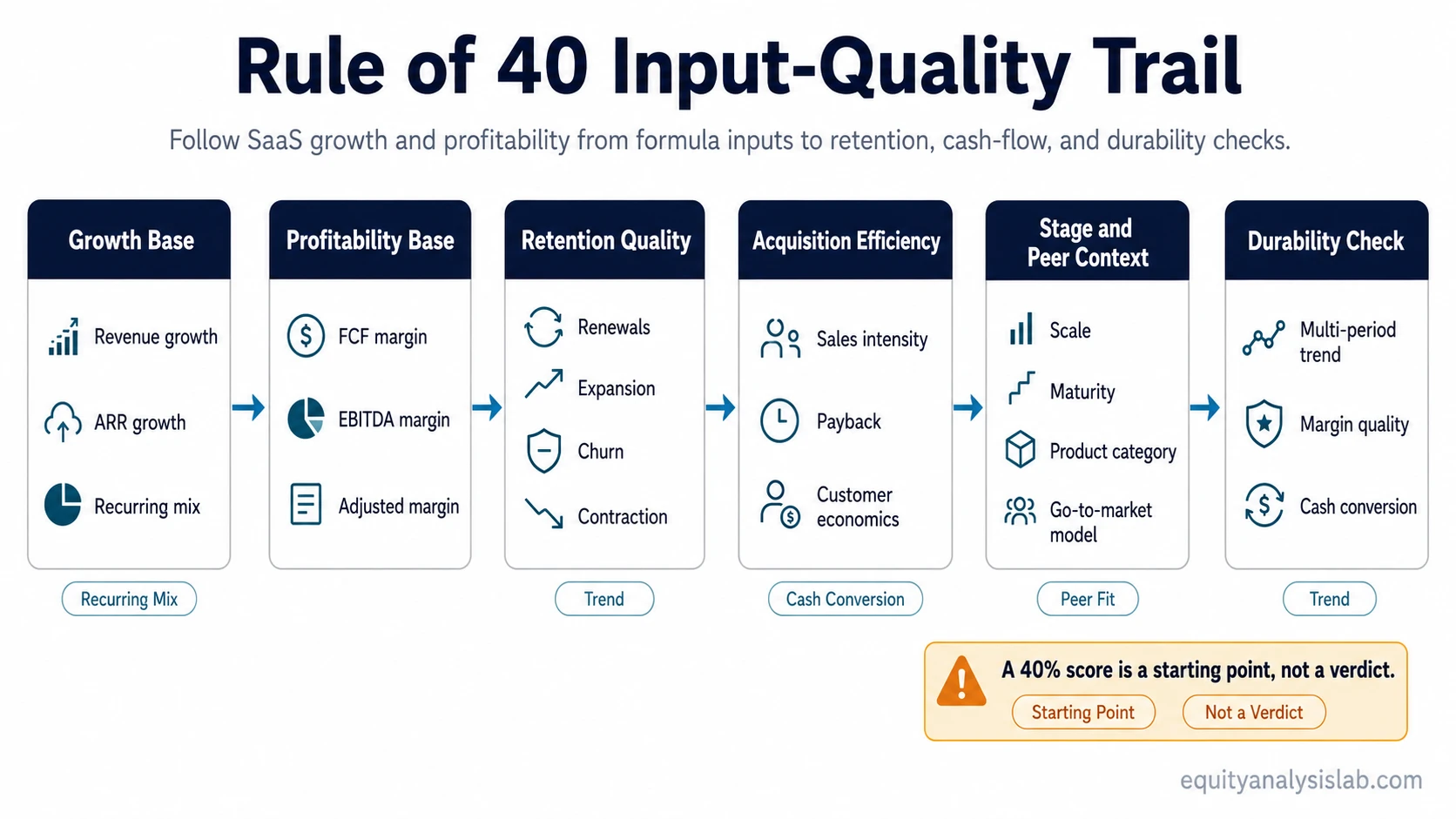
| Retention quality | Renewals, contraction, churn, and customer expansion | Weak retention can force a company to replace more revenue before new sales create net growth. |
| Acquisition efficiency | Sales and marketing intensity, payback period, and new-customer economics | Fast growth can still be expensive to sustain when acquisition efficiency deteriorates. |
| Company stage | Early scaling, growth stage, mature, or post-hypergrowth profile | Early-stage companies may reach the score mainly through growth, while mature companies may rely more on margin. |
| Peer set | Size, product category, gross margin profile, and go-to-market model | Companies with different economics can produce similar scores for different reasons. |
| Trend durability | Growth, margin, and cash-flow trends across multiple periods | A single strong period can reflect spending timing or temporary margin changes rather than a durable shift. |
How to Read the Same Score
Two companies can reach the same Rule of 40 score through very different operating profiles. The total is useful, but the growth-margin mix changes what the number says about the business.
| Rule of 40 mix | Possible reading | What still needs to be checked |
|---|---|---|
| High growth, low margin | The company may still be prioritizing expansion over current profitability. | Retention, gross margin, acquisition efficiency, and whether losses narrow as the business scales. |
| Moderate growth, moderate margin | The profile can be balanced when both inputs are stable. | Whether growth and profitability persist across several reporting periods. |
| Low growth, high margin | The company may be more mature and focused on cash generation. | Whether slower growth reflects maturity, weaker demand, or a deliberate shift in spending. |
| High score after a sharp margin improvement | The formula can improve before the underlying economics are clearly better. | Cost cuts, working-capital timing, adjusted metrics, retention, and the durability of cash conversion. |
What to Check After the Score
The growth side is easier to interpret when the recurring base is clear. annual recurring revenue helps separate recurring scale from revenue that may be more affected by services, contract timing, or other non-recurring items.
Growth can also be expensive. CAC payback period helps test how quickly acquisition spending is recovered through recurring gross profit.
Retention shows how much of the existing base survives before expansion is added. Gross revenue retention helps separate durable customer revenue from growth that has to be replaced through new sales or upsells.
When the Rule of 40 Can Mislead
The Rule of 40 score improves.
Margin rises after temporary cost cuts, working-capital timing, or a broader adjusted measure, while the growth base or reporting period also changes.
Recalculate with consistent inputs, then check retention, acquisition efficiency, and cash conversion before treating the improvement as durable.
The metric combines growth and profitability. It does not by itself establish earnings quality, retention durability, cash-flow quality, valuation attractiveness, or future returns. The threshold is a screening and comparison tool, not a final verdict.