
The price-to-earnings ratio, or P/E ratio, compares a company’s share price with its earnings per share. It shows how much investors are paying for one unit of earnings, but the ratio becomes useful only when the earnings base, business quality, growth outlook, and durability of those earnings are understood together.
A high P/E does not automatically mean a stock is overvalued, and a low P/E does not automatically mean it is undervalued. The first step is to identify what happened to price, what happened to earnings, and which earnings denominator the ratio is actually using.
Definition: The price-to-earnings ratio measures share price relative to earnings per share. It is a valuation context tool, not a standalone verdict, because the same multiple can reflect very different earnings bases, business conditions, and expectations.
Key Points
- P/E ratio equals share price divided by earnings per share.
- The same P/E multiple can come from very different price and earnings paths.
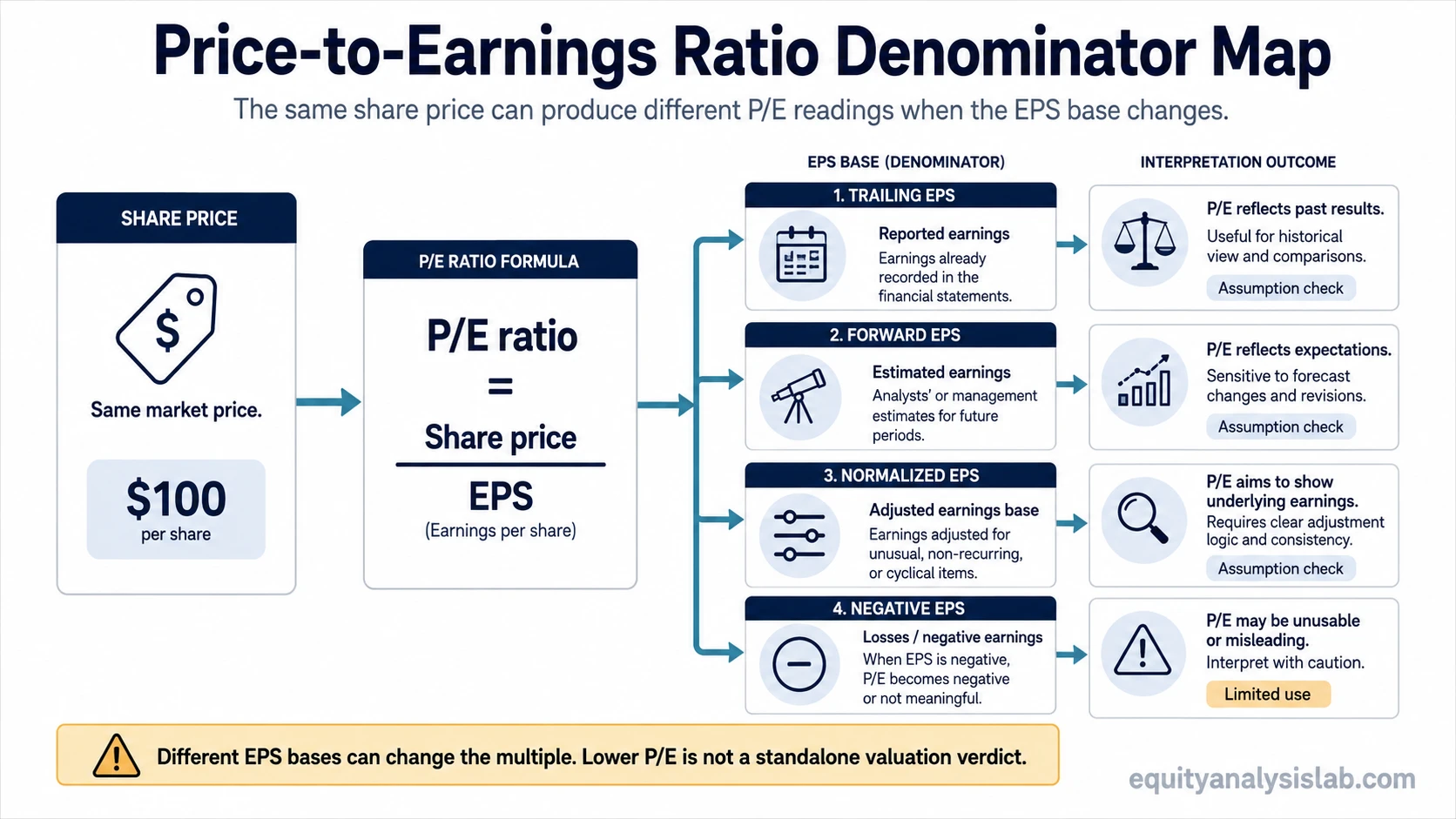
- The meaning changes depending on whether the EPS denominator is trailing, forward, normalized, or temporarily distorted.
- A high P/E can be justified by strong and durable growth, while a low P/E can reflect weak growth, cyclic risk, or business deterioration.
- P/E is most useful when tested against earnings quality, growth durability, cash flow, margins, share count, and peer context.
Price-to-Earnings Ratio Formula
P/E ratio = Share price ÷ Earnings per share
The formula is simple, but the denominator is not. The same company can have different P/E ratios depending on whether the denominator is trailing EPS, forward EPS, normalized EPS, or a temporarily distorted earnings figure.
| Formula input | What it represents | Main interpretation risk |
|---|---|---|
| Share price | The current market price of one share | Price can reflect expectations, sentiment, liquidity, risk appetite, and changing market conditions. |
| Reported EPS | Earnings already produced by the company | The period may contain one-time gains, losses, cyclic peaks, or temporarily weak earnings. |
| Forward EPS | Estimated future earnings per share | The estimate can change if revenue, margins, costs, taxes, demand, or share count develop differently than expected. |
| Normalized EPS | An adjusted earnings base intended to represent more sustainable earning power | The normalization itself requires judgment about what should or should not be excluded. |
The Same P/E Can Come From Very Different Price and Earnings Paths
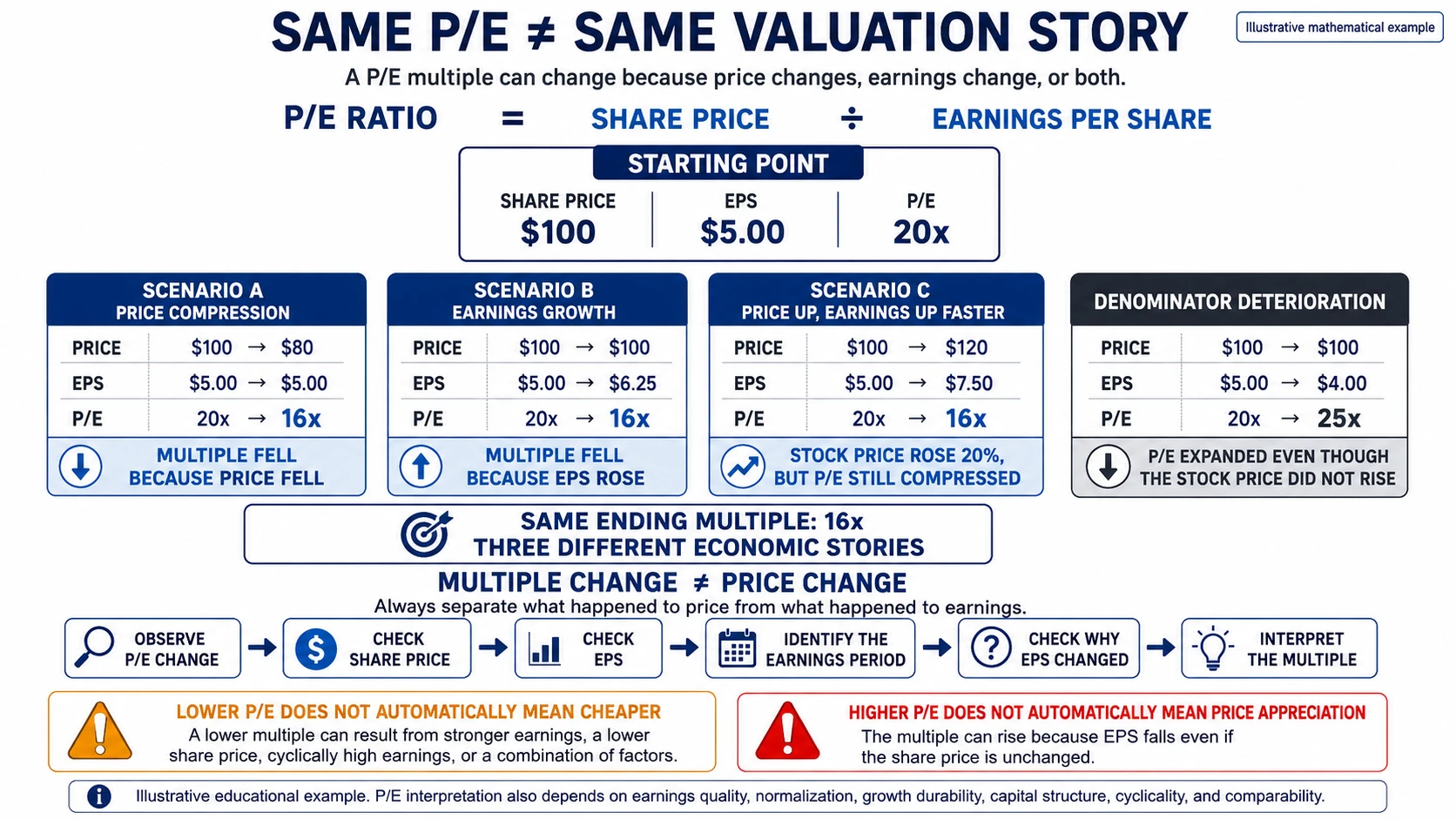
A P/E multiple does not move for one reason only. Because the ratio compares two changing numbers, price and EPS, the same ending multiple can reflect very different valuation stories.
Starting point: Share price = $100, EPS = $5.00, P/E = 20x.
| Scenario | Share price | EPS | Ending P/E | Main interpretation |
|---|---|---|---|---|
| Price compression | $100 → $80 | $5.00 → $5.00 | 16x | The multiple fell because price fell. |
| Earnings growth | $100 → $100 | $5.00 → $6.25 | 16x | The multiple fell because EPS rose. |
| Price up, earnings up faster | $100 → $120 | $5.00 → $7.50 | 16x | The stock rose, but the multiple still compressed because earnings grew faster. |
All three cases end at the same 16x P/E, but the economic meaning is different. That is why a lower P/E does not automatically mean a stock simply became cheaper. The change may come from a lower share price, stronger earnings, or both.
Important distinction: multiple change is not the same as price change. Always separate what happened to the share price from what happened to the earnings denominator.
The reverse is also true. If price stays at $100 while EPS falls from $5.00 to $4.00, the P/E rises from 20x to 25x even though the stock price did not rise at all. In that case, the multiple expanded because the denominator weakened.
See Forward P/E and Growth Risk in a Real Valuation Example
This short example looks at a company with a forward P/E around 34 while revenue growth and EPS growth are weak. The purpose is to show why an elevated earnings multiple can become more sensitive when the business is not producing enough growth to support the expectations embedded in the valuation.
Important context: a forward P/E of 34 combined with weak revenue or EPS growth can increase valuation risk, but it does not by itself prove that a company is overvalued or that the share price must correct to a specific historical level. The conclusion still depends on future earnings durability, margins, cash flow, business quality, balance sheet, peer valuation, and whether growth is expected to reaccelerate.
Why the EPS Denominator Changes the P/E Ratio
The denominator determines what valuation question the multiple is answering. A trailing P/E asks what investors are paying for earnings already reported. A forward P/E asks what investors are paying for expected earnings. A normalized P/E asks what investors are paying for a more sustainable estimate of earning power.
| Same share price | EPS used | Resulting P/E | Main question |
|---|---|---|---|
| $60 | $6.00 | 10.0x | Are the reported earnings recurring and durable? |
| $60 | $4.00 | 15.0x | Does the lower earnings base better represent normalized profitability? |
| $60 | $3.00 | 20.0x | Why are expected or sustainable earnings lower, and is the decline temporary or structural? |
The stock did not become more or less expensive because of the formula alone. The interpretation changed because the earnings assumption changed.
Trailing P/E vs Forward P/E
Trailing and forward P/E use the same share price but different earnings periods. Trailing P/E looks backward at reported earnings. Forward P/E looks ahead using estimated earnings.
| Feature | Trailing P/E | Forward P/E |
|---|---|---|
| Earnings source | Reported EPS | Estimated future EPS |
| Main strength | The denominator has already been reported. | The ratio connects valuation with expected future earning power. |
| Main weakness | Past earnings may no longer represent the business. | Future estimates can be revised or prove wrong. |
| Main analytical question | What are investors paying for realized earnings? | What are investors paying for expected earnings? |
The dedicated Forward P/E vs Trailing P/E page covers this denominator difference in more detail.
What a High or Low P/E Ratio Can Mean
A high P/E means the market price is high relative to the earnings denominator being used. A low P/E means the price is low relative to that denominator. Neither conclusion explains the reason by itself.
| Observed reading | Possible explanation | What to test |
|---|---|---|
| High P/E | Strong expected growth, high business quality, temporarily depressed earnings, or optimistic expectations | Revenue growth, EPS growth, margins, cash conversion, business durability, and whether the premium is justified |
| Low P/E | Potential undervaluation, weak growth, cyclic peak earnings, leverage, or business risk | Normalized earnings, balance-sheet strength, cycle position, industry conditions, and whether the low multiple reflects genuine deterioration |
Interpretation rule: a high multiple can be economically defensible, and a low multiple can still be risky. The useful question is what the multiple requires from the future and how believable that future appears.
How Growth Changes the P/E Interpretation
Growth is one of the main reasons two companies can deserve different P/E multiples. A company growing revenue and EPS quickly may support a higher multiple than a mature company with little growth, but the quality and durability of that growth matter as much as the speed.
| Growth evidence | What it adds to the P/E reading | Main risk |
|---|---|---|
| Revenue growth | Shows whether the business is expanding its sales base | Revenue can grow without producing stronger margins, cash flow, or EPS. |
| EPS growth | Shows whether earnings available per share are increasing | EPS can be affected by buybacks, dilution, tax changes, temporary margins, or accounting items. |
| Margin expansion | Can allow earnings to grow faster than revenue | Margins may be temporarily elevated or difficult to sustain. |
| Free cash flow growth | Helps test whether reported earnings are supported by real cash generation | Working capital or temporary capital spending can distort one period. |
| Share-count reduction | Can support EPS by spreading earnings across fewer shares | EPS growth may look stronger than underlying business growth. |
A high forward P/E becomes more fragile when the valuation assumes earnings growth that the operating business is not yet supporting. That fragility is greater when revenue growth is weak, estimates are falling, or cash conversion is poor.
Valuation principle: forward P/E gives context, but EPS quality gives meaning. Revenue growth matters, yet valuation becomes more defensible when growth is durable, reaches earnings, and is supported by cash flow.
P/E Ratio vs PEG Ratio
P/E compares price with earnings. PEG goes one step further by comparing a P/E multiple with an EPS growth rate.
| Metric | Main question | Main limitation |
|---|---|---|
| P/E ratio | How much are investors paying for one unit of earnings? | The ratio does not directly adjust for differences in growth. |
| PEG ratio | How does the P/E multiple compare with the selected EPS growth rate? | The result depends heavily on which growth assumption is used. |
PEG can provide a useful additional lens when growth is the main valuation question, but it does not remove the need to check growth durability, earnings quality, margins, cash flow, and peer comparability.
How to Evaluate a P/E Ratio Responsibly
- Identify the earnings denominator. Determine whether the multiple uses trailing, forward, adjusted, or normalized EPS.
- Separate price change from earnings change. A lower or higher P/E may come from price, EPS, or both.
- Check earnings quality. Separate recurring earnings from one-time gains, temporary margins, accounting adjustments, or unusual tax effects.
- Review revenue and EPS growth. Ask whether the growth implied by the valuation is actually visible in the business.
- Check margins and cash flow. Strong EPS is more defensible when the underlying economics and cash generation support it.
- Review share-count effects. Determine whether EPS growth comes from underlying business improvement, buybacks, or both.
- Compare the company with relevant peers and its own history. Different business models, margins, growth rates, leverage, and cyclicality can justify different multiples.
- Ask what the current multiple requires from the future. A valuation should be treated as a set of embedded expectations rather than a simple high-or-low label.
P/E vs Other Valuation Bases
P/E focuses on earnings per share, so it should not be treated as the only valuation lens. The price-to-book ratio compares market value with book value instead of EPS and can answer a different question, especially for businesses where the balance sheet is central to the economics.
Broader valuation multiples can provide additional perspectives when earnings alone do not represent the company well.
Common P/E Ratio Mistakes
| Common mistake | Why it weakens the analysis | Better check |
|---|---|---|
| Calling every high P/E expensive | Some businesses can support premium valuations through durable growth and quality. | Compare the multiple with growth, margins, cash flow, and business durability. |
| Calling every low P/E cheap | The market may be pricing declining earnings, cyclic risk, leverage, or structural weakness. | Normalize the earnings base and identify why the multiple is low. |
| Ignoring whether P/E is trailing or forward | The two ratios use different earnings periods and carry different risks. | Identify the denominator before comparing the multiple. |
| Treating multiple compression as proof that price fell | P/E can fall because EPS rose, even if the stock price stayed flat or increased. | Separate the price path from the earnings path. |
| Treating a high forward P/E as proof of a price correction | Valuation can remain elevated if earnings or growth improve, and price can adjust through time, earnings growth, multiple compression, or a combination of factors. | Separate valuation risk from a specific market-timing forecast. |
Limitations of the P/E Ratio
P/E becomes less useful when earnings are negative, close to zero, temporarily distorted, or highly cyclical. In those situations, a small change in EPS can create a very large change in the ratio without a comparable change in the underlying economics.
Peer comparisons can also mislead when companies have different business models, growth stages, leverage, margins, accounting treatment, or capital intensity. A numerical multiple is only as comparable as the companies and earnings bases behind it.
Forward P/E adds another limitation because expected EPS can be revised. The ratio is therefore best treated as valuation context rather than a standalone verdict.
FAQ
What does the P/E ratio show?
The P/E ratio shows how much investors are paying for one unit of earnings per share. It compares share price with EPS, but it becomes meaningful only when the earnings base and business context are understood.
Can the P/E ratio fall even if the stock price rises?
Yes. The P/E ratio can fall if EPS rises faster than the stock price. Multiple compression does not automatically mean the stock price declined.
Is a high P/E ratio always bad?
No. A high P/E can reflect durable growth, strong business quality, temporarily depressed earnings, or optimistic expectations. The useful test is whether that premium is justified by the economics of the business.
Why is forward P/E riskier than trailing P/E?
Forward P/E depends on expected future EPS, so the denominator can change if estimates are revised. Trailing P/E uses reported earnings, while forward P/E adds forecast risk.