
The PEG ratio is a valuation multiple that compares a company’s price-to-earnings ratio with its earnings growth rate.
Definition: PEG ratio means price/earnings-to-growth ratio. It is calculated by dividing a company’s P/E ratio by an EPS growth rate, usually expressed as a percentage input.
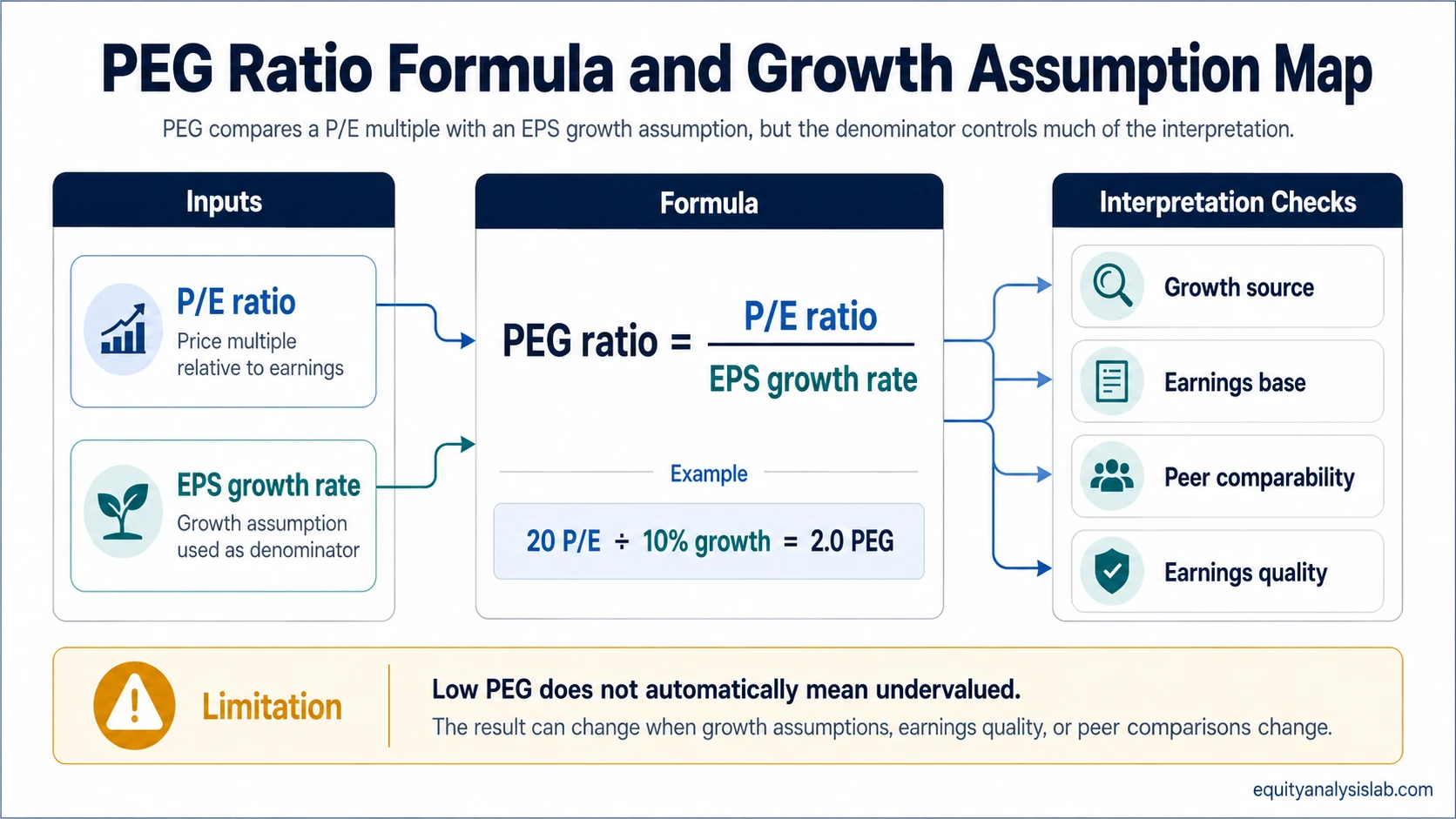
What PEG Ratio Means
PEG ratio links a price-to-earnings ratio to an earnings growth assumption. A company with a high P/E ratio may look less expensive on PEG if earnings are expected to grow quickly. A company with a low P/E ratio may look less attractive on PEG if earnings growth is weak or unstable.
The ratio does not measure business quality by itself or show whether the growth rate is realistic, durable, cash-flow supported, or already reflected in the share price.
Interpret PEG only after checking which growth assumption is being used and whether that assumption matches the earnings base, company quality, and peer group.
PEG Ratio Formula
The standard PEG ratio formula is:
PEG ratio = P/E ratio ÷ EPS growth rate
If a company has a P/E ratio of 20 and an expected EPS growth rate of 10%, the PEG ratio is 2.0. The growth rate is usually entered as 10, not 0.10, in the common valuation convention.
| Input | Example value | Role in the formula |
|---|---|---|
| P/E ratio | 20 | Shows the price multiple relative to earnings. |
| EPS growth rate | 10% | Acts as the growth denominator used to scale the P/E ratio. |
| PEG ratio | 2.0 | Shows the P/E multiple relative to the chosen growth assumption. |
Input consistency determines how much the result can tell you. A precise calculation can still create a weak valuation signal if the growth denominator is poorly chosen.
What the Growth Denominator Changes
The denominator is the main assumption in the PEG ratio. The same P/E ratio can produce different PEG ratios when the EPS growth input changes.
That growth rate may come from past EPS growth, analyst estimates, company guidance, a multi-year forecast, or an investor’s own model. Each source answers a different valuation question.
| Denominator choice | What it measures | Main risk |
|---|---|---|
| Historical EPS growth | How earnings grew over a previous period. | Past growth may not continue, especially after a cycle peak or one-off recovery. |
| Forward EPS growth estimate | How earnings are expected to grow in a future period. | Estimates can be too optimistic or too short-term. |
| One-year growth rate | Expected growth over the next year. | A single year can be distorted by rebounds, cost cuts, or temporary margins. |
| Multi-year growth rate | Expected growth across several years. | Longer forecasts can depend on many assumptions that are difficult to verify. |
| Analyst consensus growth | The market’s aggregated estimate set. | Consensus may lag changing business conditions or embed optimistic assumptions. |
| Investor-modeled growth | A custom estimate based on the investor’s assumptions. | The result is only as strong as the model’s revenue, margin, share-count, and reinvestment assumptions. |
Check whether the multiple uses trailing earnings, forward earnings, or another earnings base.
Check the forecast period, the source of the estimate, and whether the growth assumption matches the earnings base.
Separate operating growth from EPS changes caused by buybacks, dilution, accounting effects, or temporary margins.
PEG comparisons are more useful when the companies have similar economics, accounting quality, and growth durability.
If the P/E ratio is based on forward earnings, the growth rate should normally relate to the same forward earnings base. Mixing a trailing P/E with an optimistic forward growth estimate can make the PEG result look cleaner than the underlying assumptions deserve.
How Investors Interpret PEG Ratio
Investors often use PEG ratio to ask whether a P/E multiple looks high or low relative to expected growth. A lower PEG ratio can make a stock look cheaper relative to growth, while a higher PEG ratio can make the same stock look more expensive relative to growth.
A PEG ratio near 1 means that the P/E multiple and the growth percentage are numerically similar under the selected inputs. The result still depends on the quality and durability of those inputs.
Values below or above 1 can help compare how much P/E an investor is paying relative to the selected EPS growth rate.
Whether that relationship is attractive depends on growth durability, earnings quality, reinvestment needs, capital intensity, risk, and peer economics.
A company can deserve a higher PEG ratio if its growth is more durable, margins are stronger, reinvestment opportunities are better, or earnings quality is higher. A lower PEG ratio can be more reasonable when growth is cyclical, capital-intensive, diluted by share issuance, or dependent on temporary earnings conditions.
Peer comparability also matters. Comparing a stable software company, a cyclical commodity producer, and a bank through one PEG threshold can create a false sense of precision.
Why Low PEG Does Not Prove Undervaluation
A low result may reflect a credible growth outlook, but it can also come from an aggressive estimate, a temporary earnings rebound, weak earnings quality, sector mismatch, or a P/E ratio built on an earnings number that is not durable.
Forward growth is an assumption. Historical growth records what already happened. Neither automatically shows what the business can earn over a full cycle.
A low PEG ratio can be misleading when earnings are recovering from a depressed base. It can also be misleading when margins are temporarily elevated, when buybacks flatter EPS growth, when dilution offsets business growth, or when reported earnings differ from cash earnings.
PEG should therefore be read alongside quality of earnings, balance-sheet risk, cash flow, business durability, and peer comparability.
Forward PEG vs Trailing PEG
Forward PEG and trailing PEG use different growth bases. The difference matters because one depends on expectations and the other depends on historical results.
- Uses expected future EPS growth.
- Depends on forecast quality and the reasonableness of the estimate.
- Can change quickly when earnings expectations are revised.
- Uses historical EPS growth.
- Depends on the relevance of the historical period.
- Can be distorted by conditions that may not repeat.
The same input distinction appears in P/E analysis. A fuller treatment belongs in forward P/E vs trailing P/E.
PEG Ratio Example
The example below is illustrative and does not imply that either result is attractive or unattractive.
Example: A company has a P/E ratio of 20. If expected EPS growth is 10%, the PEG ratio is 2.0. If another analyst assumes 20% growth, the PEG ratio becomes 1.0.
| Scenario | P/E ratio | EPS growth assumption | PEG ratio |
|---|---|---|---|
| Lower growth assumption | 20 | 10% | 2.0 |
| Higher growth assumption | 20 | 20% | 1.0 |
The company did not become cheaper in the second scenario. The ratio changed because the growth denominator changed.
Where PEG Works Best and Where It Weakens
PEG works best when earnings are positive, growth is reasonably stable, and the companies being compared have similar economics. If earnings are negative, the P/E input itself loses its standard interpretation. Zero, negative, or highly unstable growth can also make PEG difficult to interpret.
| Condition | PEG is more useful when | PEG is weaker when |
|---|---|---|
| Earnings base | Earnings are positive and recurring. | Earnings are negative, temporarily depressed, or inflated by one-off items. |
| Growth rate | Growth is positive, reasonably stable, and supported by the business. | Growth is zero, negative, highly volatile, or driven by a short rebound. |
| Peer group | Companies have similar business models and accounting profiles. | Companies differ widely by sector, margin structure, leverage, or capital intensity. |
| Earnings quality | Reported EPS is supported by cash flow and recurring operations. | EPS growth is helped by accounting items, temporary margins, or aggressive adjustments. |
| Share count | EPS growth reflects real business growth. | EPS growth is heavily affected by buybacks or diluted by share issuance. |
Growth is useful in valuation only when its durability, quality, and cost are understood.
Related Valuation Concepts
P/E ratio vs PEG ratio separates a pure earnings multiple from a growth-adjusted version of that multiple.
Valuation multiples place PEG alongside price, enterprise-value, earnings, sales, book-value, and cash-flow measures.
EPS growth provides the denominator that makes PEG sensitive to forecast quality, share-count changes, and earnings durability.