
Dollar cost averaging is an investing method that puts the same amount of money into an investment at regular intervals rather than committing the full amount on one purchase date. The schedule changes when capital is deployed and how many shares each contribution buys.
When the purchase price is lower, a fixed contribution buys more shares. When the price is higher, the same contribution buys fewer shares. Asset quality, valuation, and future return remain separate investment decisions.
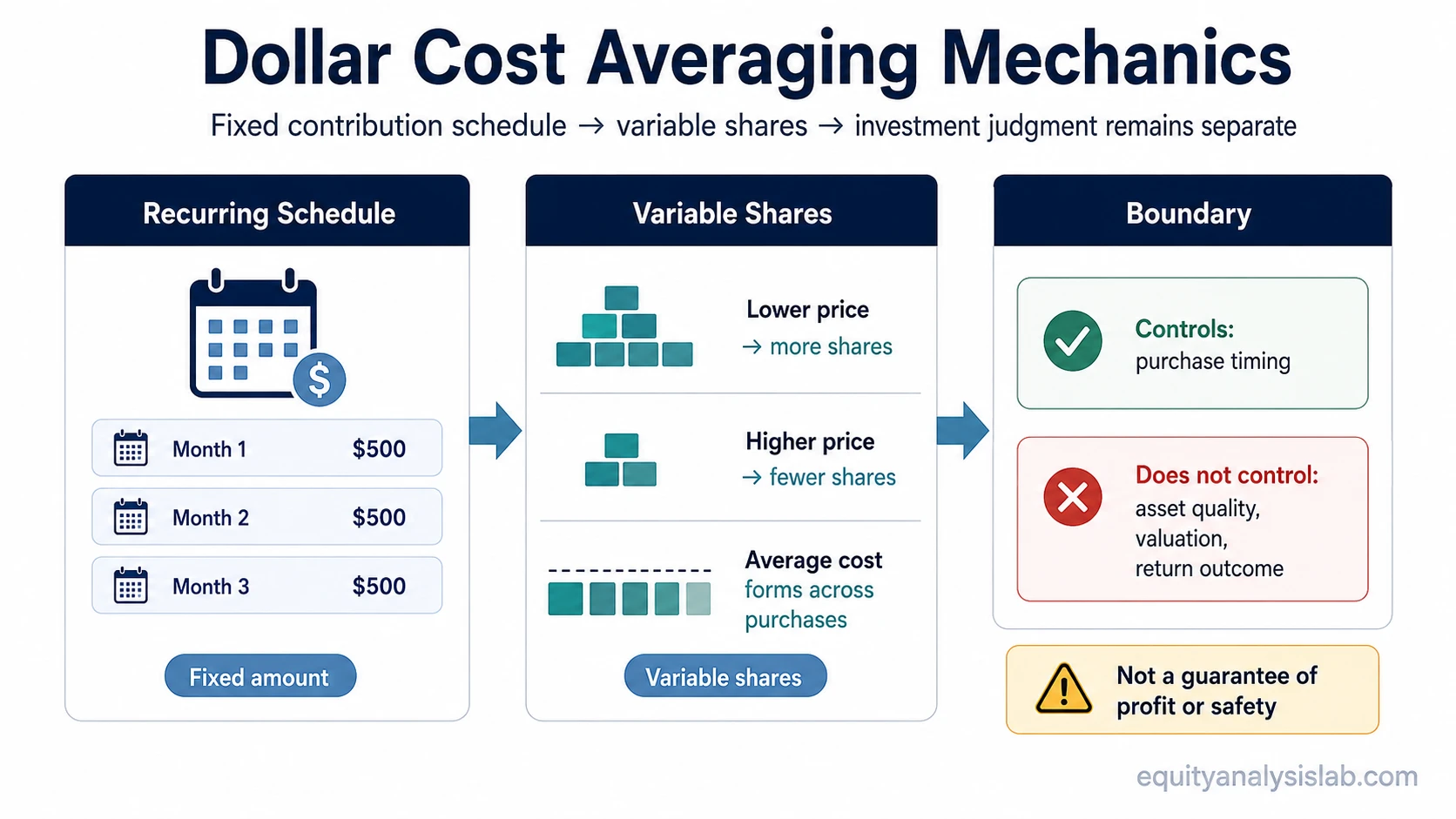
How Dollar Cost Averaging Works
A DCA schedule needs a contribution amount, a purchase interval, and an investment. Purchases continue according to that schedule rather than waiting for a forecasted market entry point.
| Month | Fixed contribution | Hypothetical price | Shares bought |
|---|---|---|---|
| Month 1 | $500 | $50.00 | 10.0 |
| Month 2 | $500 | $40.00 | 12.5 |
| Month 3 | $500 | $62.50 | 8.0 |
Across these three hypothetical purchases, $1,500 buys 30.5 shares. Dividing the total amount invested by the total shares purchased gives an average cost of about $49.18 per share before fees.
The calculation describes the purchase cost only. It does not establish a future profit, loss, or expected return.
What Dollar Cost Averaging Changes
| Area | What the schedule changes | What it does not determine |
|---|---|---|
| Purchase timing | Capital is spread across repeated purchase dates. | Whether a particular date turns out to be favorable. |
| Share quantity | The same dollar amount buys more shares at lower prices and fewer at higher prices. | Where the price moves after the purchase. |
| One-date exposure | The full amount is not dependent on one entry price. | Losses after capital has been invested. |
| Deployment pace | The schedule determines how quickly available capital enters the investment. | The opportunity cost of capital that remains uninvested. |
Cash Source Changes the DCA Trade-Off
Investor.gov defines dollar cost averaging as investing equal portions at regular intervals regardless of market movement. FINRA makes an additional implementation distinction: when a lump sum is already available and only part is invested at each interval, the remaining money stays out of the market and can create opportunity cost. That specific cash-waiting effect does not apply in the same way when regular contributions are invested as new income is earned.
This distinction matters when evaluating DCA. A monthly contribution from current income and a ten-month deployment of cash already sitting in an account may use the same purchase schedule, but the undeployed-capital trade-off is different.
Dollar Cost Averaging vs Market Timing
The scheduled date triggers the purchase. The investor continues the planned contribution without requiring a forecast that the current price is unusually attractive.
The purchase date changes because the investor is making a judgment about expected market or price movement.
Limits of Dollar Cost Averaging
A regular schedule can still accumulate an investment with poor business economics, excessive valuation, weak expected returns, or persistent losses. Spreading the purchases changes the entry path, not the underlying quality of what is being purchased.
In equity investing, scheduled purchases still leave the investor exposed to company risk, valuation risk, dilution, balance-sheet pressure, and market repricing.
Return assumptions still have to reflect the economics of the investment rather than the consistency of the purchase schedule.
Repeated transactions can also create commissions, spreads, fees, taxes, or other implementation costs depending on the account and instrument. When capital remains uninvested between scheduled purchases, its opportunity cost belongs in the comparison as well.
A regular schedule can support continued participation, while compounding depends on the returns actually earned, the time invested, reinvestment, and the capital that remains in the portfolio.
What Defines a DCA Plan
A DCA plan is easier to evaluate when its inputs are explicit:
- the amount invested at each interval;
- the frequency of purchases;
- the investment being purchased;
- how long the schedule is expected to continue;
- whether the capital already exists or is being earned over time;
- the transaction costs and other implementation frictions attached to repeated purchases.
Changing any of these inputs can change the economics of the plan even when the basic DCA mechanism remains the same.
Dollar Cost Averaging and Lump-Sum Investing
The most important comparison arises when the full amount of cash is already available. At that point the investor is choosing between immediate deployment and staged deployment, which introduces a separate trade-off between market exposure, short-term downside timing, and the opportunity cost of waiting in cash.