
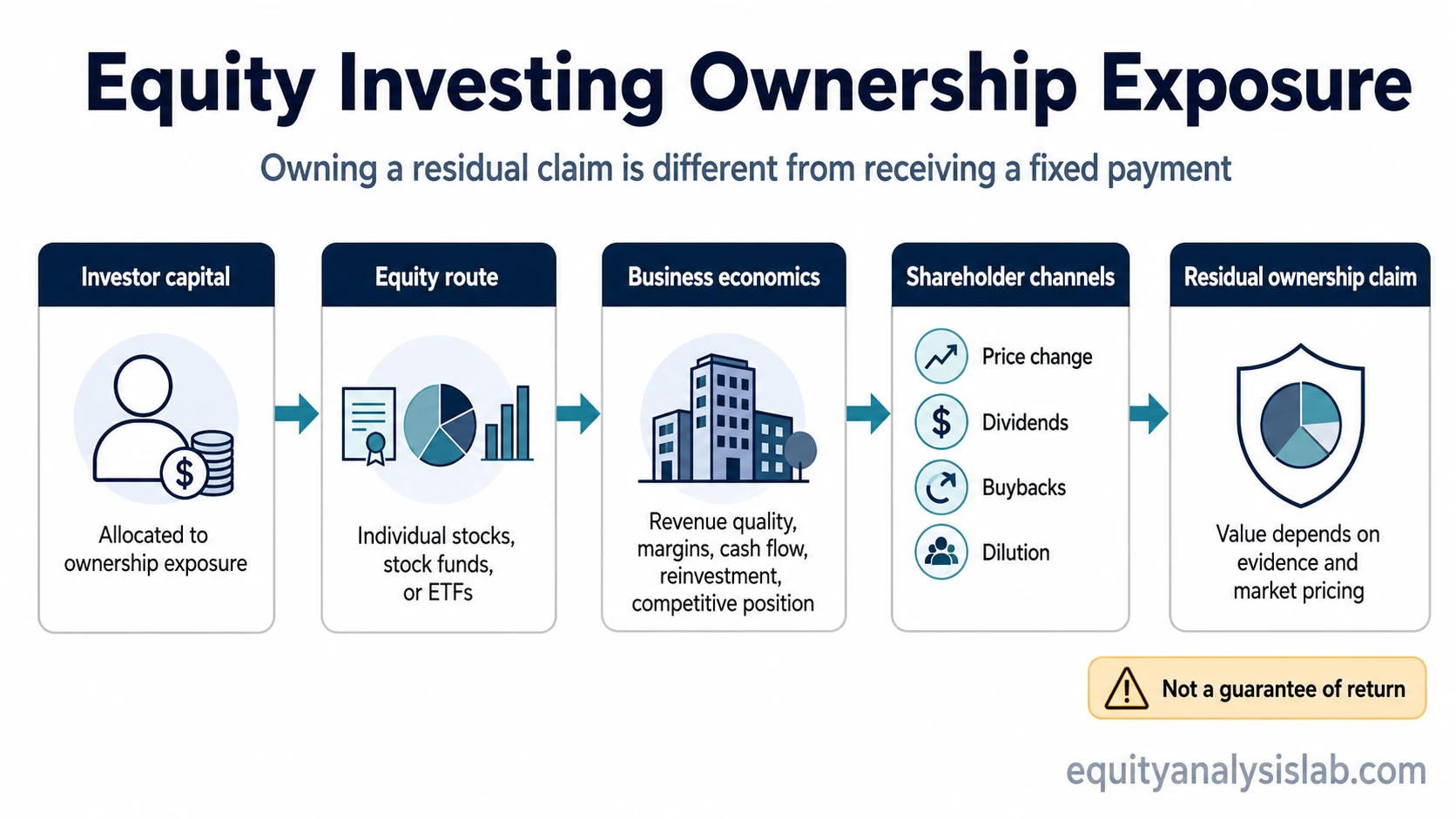
Equity investing means allocating capital to business ownership exposure, either by owning company shares directly or by owning a fund that holds equity securities. The return can come from changes in market value, dividends, or other shareholder distributions, while the investment can lose value when business results, valuation, financing, dilution, or market conditions deteriorate.
The equity label identifies the type of claim being held. It does not establish that the claim is attractive at the current price or suitable for a particular portfolio.
What Equity Investing Means
For a direct stock investment, the investor owns shares issued by a company. Common shareholders hold a residual claim on the business: creditors and other senior claims come before common equity if the company is liquidated. That position creates upside when the value available to shareholders grows, but it also leaves equity exposed when the business weakens or the market reprices the claim.
CFA Institute describes equity securities as ownership claims on a company’s net assets. Investor.gov explains that stocks give shareholders ownership in a company, while its stock-fund guidance describes equity funds as pooled vehicles that invest primarily in stocks. The economic exposure can therefore be equity-based even when the investor owns fund shares rather than the underlying company shares directly.
Direct Stock Ownership vs Pooled Equity Exposure
Both can provide equity exposure, but the investor is not holding the same legal claim in each structure.
The investor owns shares of the operating company directly. Company-specific business results, capital allocation, financing, valuation, and share-count changes can have a large effect on the position.
The investor owns shares or units of a pooled vehicle, and the fund owns the underlying equity securities. Analysis shifts toward the fund’s holdings, weighting, concentration, costs, and implementation as well as the risks of the underlying equities.
Equity Investing vs Related Terms
| Term | Meaning | Investor relevance | Boundary |
|---|---|---|---|
| Equity investing | Allocating capital to business ownership exposure. | Frames the investor as an owner or indirect holder of equity economics. | The label identifies the claim, not whether the investment is attractive. |
| Equities or stocks | Shares representing ownership interests in companies. | Usually the main instrument used for direct public-equity exposure. | A stock is the security; equity investing is the broader activity. |
| Equity funds or ETFs | Pooled vehicles that invest primarily in equity securities. | Can spread exposure across multiple companies, sectors, or regions. | The investor owns the fund interest rather than each underlying company share directly. |
| Shareholders’ equity | An accounting measure of assets minus liabilities attributable to owners. | Provides balance-sheet context for the company’s capital base and book value. | It is an accounting concept, not the act of investing in equities. |
| Private equity | Ownership exposure in privately held companies or private-company transactions. | Extends equity ownership beyond publicly traded stocks. | Liquidity, access, valuation, and investment structure differ from public equity. |
What Changes the Investment Outcome
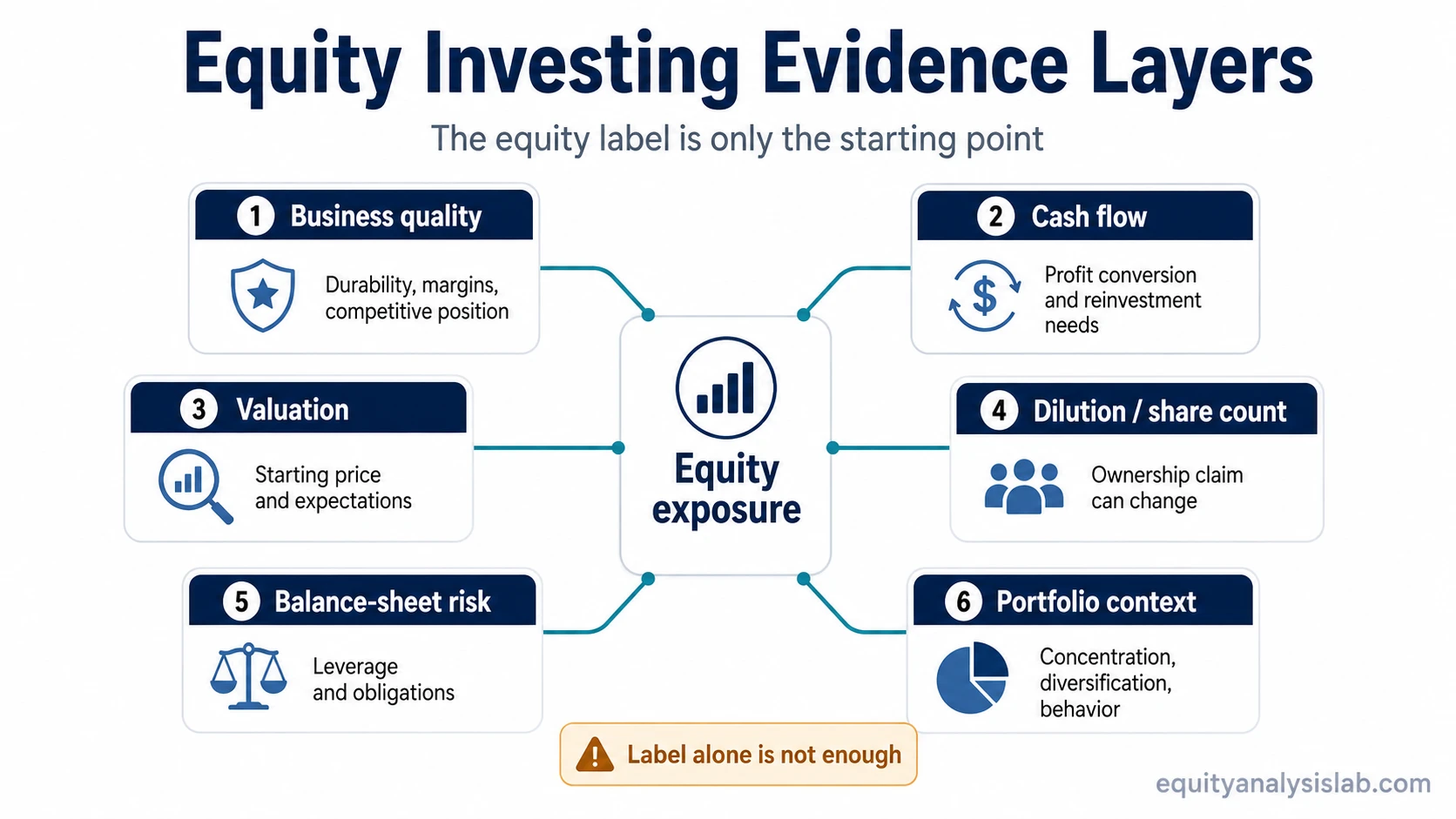
Two investments can both qualify as equity exposure and still have very different economics. The ownership claim has to be read together with the evidence behind the business, the price paid, the capital structure, and the investor’s portfolio context.
| Analytical layer | Question to ask | Why it changes interpretation |
|---|---|---|
| Business quality | Does the company have durable economics, pricing power, or a defensible competitive position? | Ownership is more fragile when returns depend on weak margins, temporary demand, or heavy reinvestment without clear economic payoff. |
| Cash flow | Does reported profit convert into cash after operating needs and reinvestment? | Cash generation helps test whether the ownership claim is supported by business economics rather than accounting profit alone. |
| Earnings quality | Are earnings recurring, cash-supported, and relatively free of one-off effects? | Weak earnings quality can overstate the economics available to shareholders. |
| Valuation | What expectations are already reflected in the market price? | A strong business can still produce a weak investment result when the starting valuation assumes too much future growth. |
| Balance sheet | Can debt, refinancing needs, or liquidity pressure reduce the value left for shareholders? | Equity is junior to debt claims, so financial stress can reduce the residual value available to common shareholders. |
| Share count | Is per-share ownership being diluted or supported by capital returns? | New issuance can spread the company’s economics across more shares, while repurchases change per-share exposure depending on price, funding, and execution. |
| Portfolio exposure | How much of the portfolio depends on one company, sector, country, or factor? | The same equity thesis can carry very different portfolio risk when position size and concentration change. |
Dividends, Buybacks, and Dilution
Business performance reaches shareholders through more than the market price. Dividends distribute cash when a company chooses to return part of its capital to shareholders. Repurchases can reduce shares outstanding, while new issuance and other dilutive instruments can increase the number of claims on the business.
The effect has to be judged on a per-share basis. A growing company can still produce weaker shareholder economics if dilution offsets part of the growth, while a buyback can be less useful when it is funded poorly or executed at an unattractive valuation.
Same Equity Label, Different Economics
Illustrative example: Company A produces steady cash flow, uses modest leverage, keeps its share count relatively stable, and trades at a valuation that assumes moderate growth. Company B reports faster revenue growth but burns cash, issues new shares regularly, and trades at a valuation that requires much stronger future results.
Both positions are equity investments. Their expected outcomes can still differ because the underlying business economics, financing needs, dilution, and valuation are not the same. The equity label identifies the ownership category; the evidence determines how the claim should be interpreted.
Risk, Time Horizon, and Compounding
Equity investing is often discussed with a long holding period because business results can take time to develop. A longer horizon can reduce the importance of some short-term price movement, but it also gives weak economics, dilution, poor capital allocation, or excessive leverage more time to affect the ownership claim.
A longer holding period cannot make an excessive starting valuation, persistent cash burn, repeated dilution, or an impaired business model economically sound. Time is useful only when the underlying evidence continues to support the ownership thesis.
Related Investing Concepts
Clarifies how uncertain outcomes relate to the return investors may require for bearing that uncertainty.
Organizes assumptions about possible outcomes without turning those assumptions into promises.
Explains how gains, losses, reinvestment, and changes in the capital base can accumulate over time.
Separates a contribution method from the quality, valuation, and ownership structure of the equity exposure.
Separates discretionary security selection from rules-based portfolio exposure.
Shows how holding period changes the relevance of evidence, liquidity needs, and decision constraints.