
Risk and return describe the relationship between uncertainty and the outcome an investor may receive. Risk is the possibility that the result differs from expectation, including loss or a weaker-than-expected gain. Return is the gain, loss, or income produced relative to the capital committed.
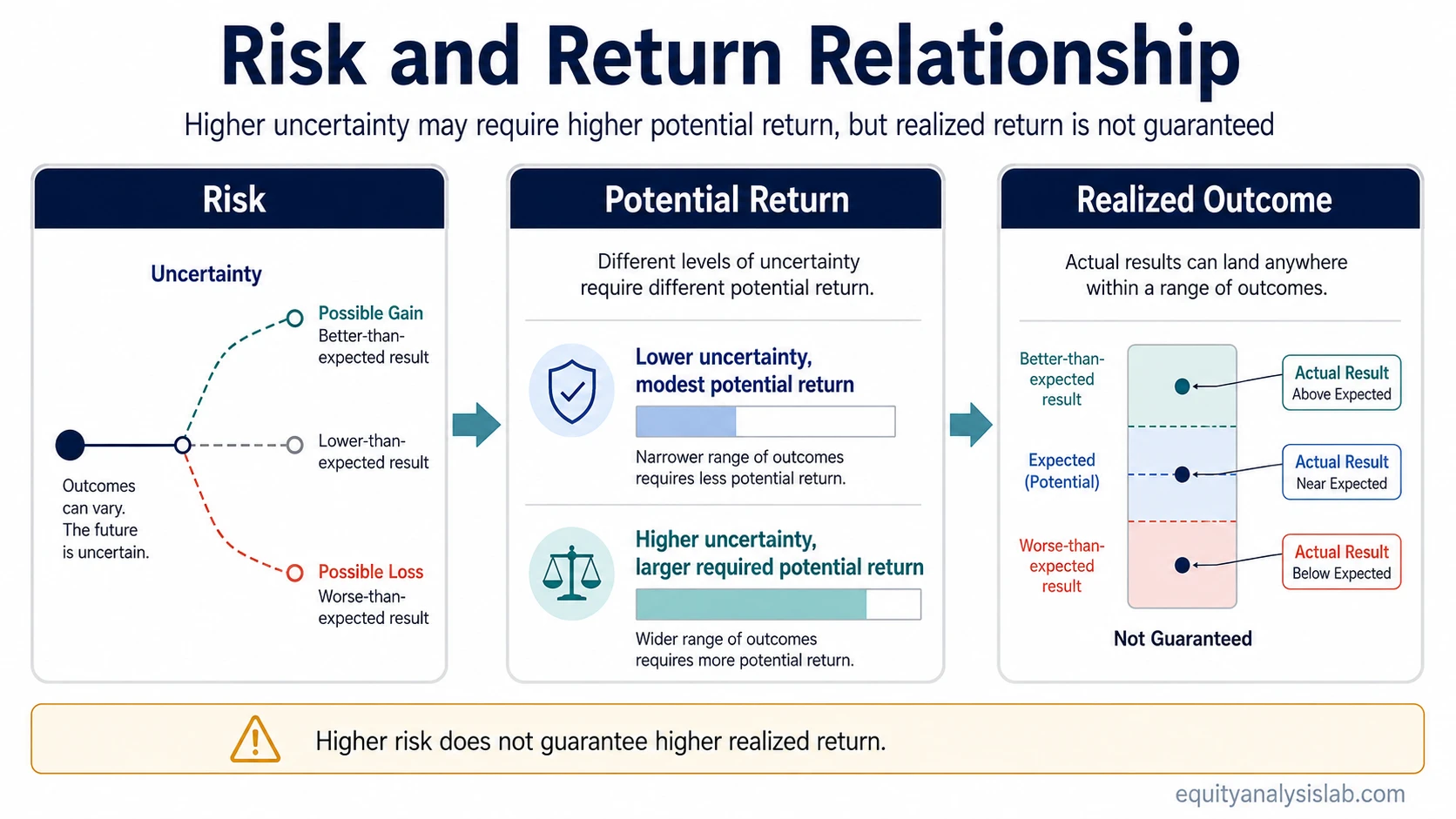
Investors generally require greater potential return to accept greater uncertainty, but the realized result can still be lower, flat, or negative. The relationship is useful because the same return can carry very different levels and types of risk.
What Risk and Return Mean
Risk can include price declines, permanent capital loss, unstable income, valuation error, business deterioration, liquidity problems, or a result that is simply weaker than expected.
Return can come from price appreciation, income, or both. It can also be negative when the investment loses value over the measurement period.
A 5% return from a relatively stable investment and a 5% return from a highly uncertain investment are not equivalent exposures. The return is the same, but the range of possible outcomes and the risk accepted to reach that result can be very different.
How the Risk-Return Relationship Works
The risk-return relationship concerns the compensation investors may require for accepting uncertainty before capital is committed. A more uncertain investment usually needs a larger potential or expected return to justify the additional risk.
More uncertainty widens the range of possible outcomes. The final result can still be positive, flat, or negative, so a larger possible gain should not be read as a promised payoff for taking more risk.
Standard portfolio theory separates systematic risk that affects the market or economy from nonsystematic risk that can be diversified away. CFA Institute notes that investors should not expect additional return for bearing nonsystematic risk that can be diversified away. This is a narrower point than the general risk-return tradeoff, but it prevents “more risk” from being treated as a universal rule.
How to Calculate Realized Return
Realized return measures what actually happened over a completed holding period. For a simple investment with income received during the period:
Holding-period return = (Ending value − Beginning value + Income received) ÷ Beginning value × 100
Example: An investment starts at $100, ends at $108, and pays $2 of income. The realized holding-period return is 10%: ($108 − $100 + $2) ÷ $100.
The calculation records the result. It does not show how uncertain the path was, how wide the possible outcomes were before the investment, or whether the same return could have been earned with less risk.
Expected Return vs Realized Return
Risk-return analysis often compares an estimate made before the investment with the result observed afterward. Keeping those two stages separate prevents an assumption from being mistaken for an outcome.
An expected return is an estimate based on assumed outcomes, probabilities, valuation, growth, or other inputs. Its usefulness depends on the assumptions behind it.
Realized return is the actual result over the completed period. It can differ materially from the estimate because the original assumptions or conditions may not develop as expected.
Risk, Return, and Time Horizon
Investment time horizon changes which risks matter most. A short holding period can make near-term price movement, liquidity, and timing more important. A longer horizon may shift more attention toward business durability, valuation, cash generation, reinvestment, and the ability to absorb temporary drawdowns.
A longer horizon does not remove risk. It changes the period over which the investment thesis has to work and the types of uncertainty that can matter along the way.
A Practical Risk-Return Review
| Question | What to identify | Why it changes the interpretation |
|---|---|---|
| What can go wrong? | The main downside paths and the sources of uncertainty | A return estimate is harder to judge without knowing what could impair it. |
| Which return is being discussed? | Potential, expected, or realized return | Each describes a different stage of the investment decision. |
| What time period applies? | The holding period, liquidity need, and timing constraint | The same risk can matter differently over short and long horizons. |
| What kind of risk is being accepted? | Market-wide risk, company-specific risk, liquidity risk, valuation risk, or another identifiable source | Different risks do not deserve to be treated as one interchangeable quantity. |
| What would weaken the case? | The assumption or condition that would make the expected return less credible | A defined failure condition keeps the analysis tied to evidence rather than preference. |
Related Risk and Return Concepts
Compounding changes how gains and losses build across multiple periods, but it does not remove the uncertainty of the investment path.
Dollar cost averaging changes when capital is deployed. It can change timing exposure without changing the underlying business or market risk of the asset being purchased.
Risk vs volatility separates the broader uncertainty of an investment outcome from observed price variability.