
Time horizon is the expected period before capital may be needed for a financial goal or evaluated against that goal. It connects the timing of the objective with liquidity needs and with the consequences of adverse price movement before the capital is required.
The same investor can have different time horizons for different pools of capital. A near-term purchase, a medium-term objective, and retirement savings can all require different timing assumptions even when they belong to the same person.
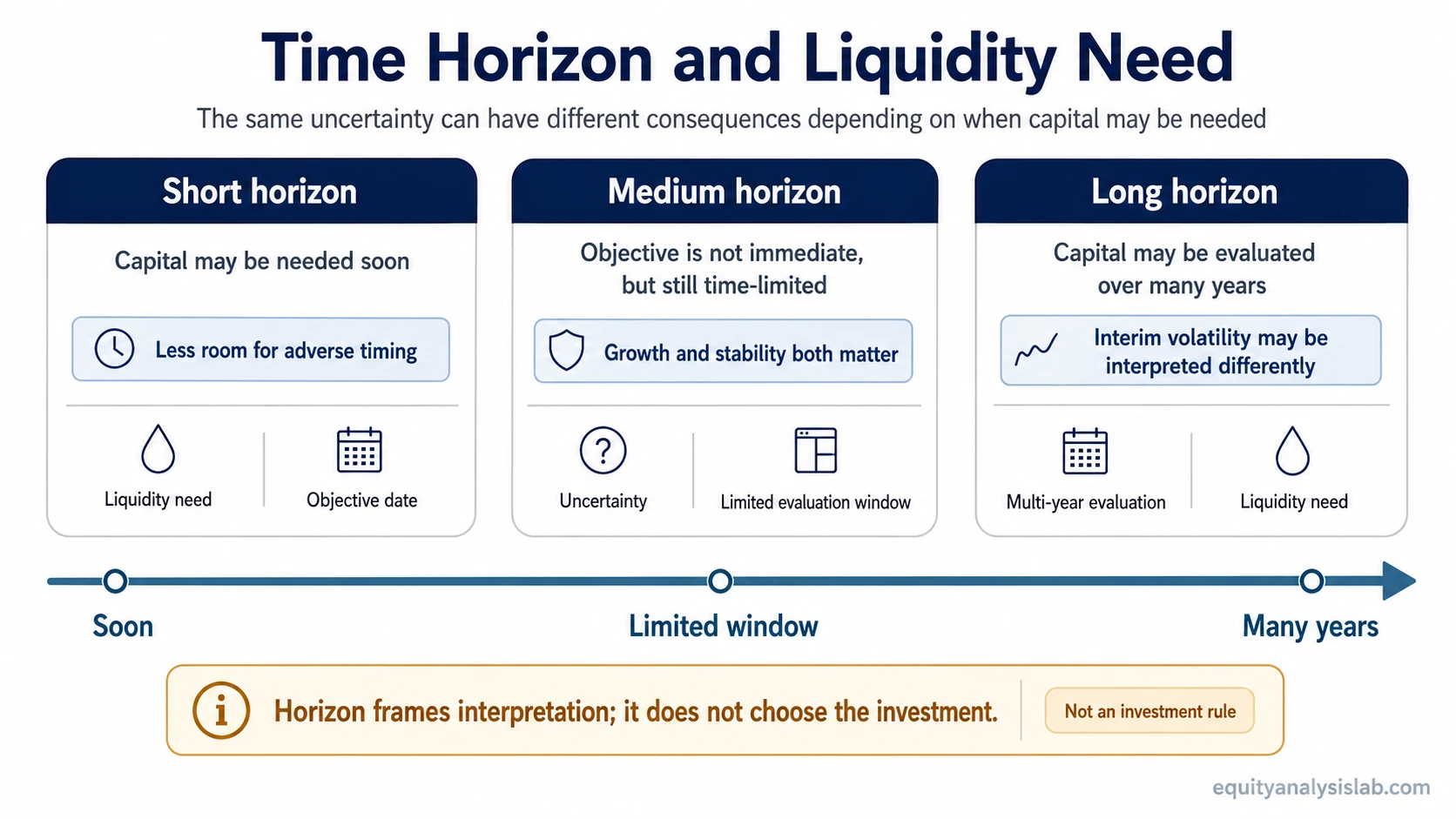
What Time Horizon Means
A time horizon runs from the investment decision to the point when capital may need to be withdrawn or the financial objective is evaluated. The relevant horizon therefore depends on the purpose of the capital, not simply on how long an investor generally prefers to hold investments.
FINRA describes time horizon in relation to the period an investor plans to invest to achieve a particular financial goal. Its suitability guidance also recognizes that a portfolio can contain investments with different liquidity needs, risk characteristics, and time horizons. One portfolio therefore does not need to be interpreted through a single universal horizon.
Why Time Horizon Changes Risk Interpretation
A price decline has different consequences when capital is needed next year than when the same capital has no scheduled near-term use. The market movement may be identical, while the pressure to realize the loss can be very different.
This is why time horizon belongs beside risk and return and liquidity need. It helps determine whether interim market movement can be absorbed or whether it threatens the timing of the objective.
Time available also needs to stay separate from return assumptions. A longer period can give an investment more time to develop, but expected return still depends on the assumptions behind the investment rather than on calendar length alone.
Short, Medium, and Long Time Horizons
The labels short, medium, and long are useful for orientation, but they are approximate. The relevant boundary depends on the goal date, liquidity requirement, and flexibility available before the capital must be used.
| Horizon | General meaning | Investor interpretation |
|---|---|---|
| Short time horizon | Capital may be required soon or the objective has little room for delay. | Liquidity and downside timing carry more weight because an adverse move can occur close to the required-use date. |
| Medium time horizon | The objective is not immediate, but the evaluation window remains limited. | There is more time to absorb uncertainty than with a near-term goal, while the withdrawal date can still constrain the investment decision. |
| Long time horizon | The capital may remain invested for many years or the objective is evaluated over a longer cycle. | Short-term price movement may carry less immediate consequence, while business quality, valuation, behavior, and permanent-loss risk still matter. |
What Sets the Effective Time Horizon
The calendar date is only one input. Liquidity needs and the flexibility of the objective can shorten or extend the period over which an investment can realistically be evaluated.
| Input | Question to ask | Why it changes interpretation |
|---|---|---|
| Goal date | When could the capital be required? | A fixed date reduces flexibility if an adverse market move occurs near the withdrawal point. |
| Liquidity need | How quickly must the capital be accessible? | A near-term need can make temporary market weakness consequential even when the underlying investment has a longer economic life. |
| Income or cash-flow timing | Can other cash flows reduce the need to sell the investment? | Reliable outside cash flow may reduce withdrawal pressure, while uncertain cash flow can shorten the effective horizon. |
| Objective flexibility | Can the goal date or required amount change? | A flexible objective provides more room to delay realization than a fixed obligation. |
| Ability to absorb an interim decline | Would a temporary loss force a sale before the objective date? | The horizon becomes more restrictive when adverse movement can force action before the investment case has time to develop. |
Same Market Move, Different Time Horizon
An investor expects to use the capital in one year for a fixed obligation. A large decline can become a liquidity problem because the money may need to be withdrawn before market conditions change.
Another investor has no scheduled near-term withdrawal and evaluates the capital over many years. The same decline still matters, but it does not create the same immediate requirement to realize the loss.
The difference comes from the timing constraint. The comparison does not establish whether the investment itself is attractive or whether the decline will recover.
Time Horizon and Risk Tolerance Answer Different Questions
The constraint comes from the timing of the financial goal, withdrawal need, or evaluation period.
The constraint comes from the investor’s willingness to live with uncertain outcomes and losses while remaining committed to the plan.
Risk capacity adds another layer because financial ability to absorb a loss can differ from emotional willingness to accept one. These inputs can point in different directions and should not be collapsed into the time-horizon label.
What a Longer Horizon Does Not Solve
A longer horizon cannot make an excessive valuation, persistent business deterioration, poor cash generation, permanent dilution, or an unsuitable liquidity profile disappear. It changes the evaluation window, not the underlying economics.
A longer period can give compounding more time to influence the result when returns accumulate. For equity investing, business quality, valuation, balance-sheet risk, dilution, and the price paid still determine whether that longer window is useful.