
Compounding occurs when gains remain in a base and future returns are earned on that changed amount. In investing, this can happen through retained interest, reinvested distributions, business earnings that are reinvested productively, or portfolio gains that remain invested.
The arithmetic is straightforward. The investment interpretation depends on the return actually earned, what remains in the base, how long the process continues, and how much is lost to withdrawals, costs, taxes, dilution, or adverse returns.
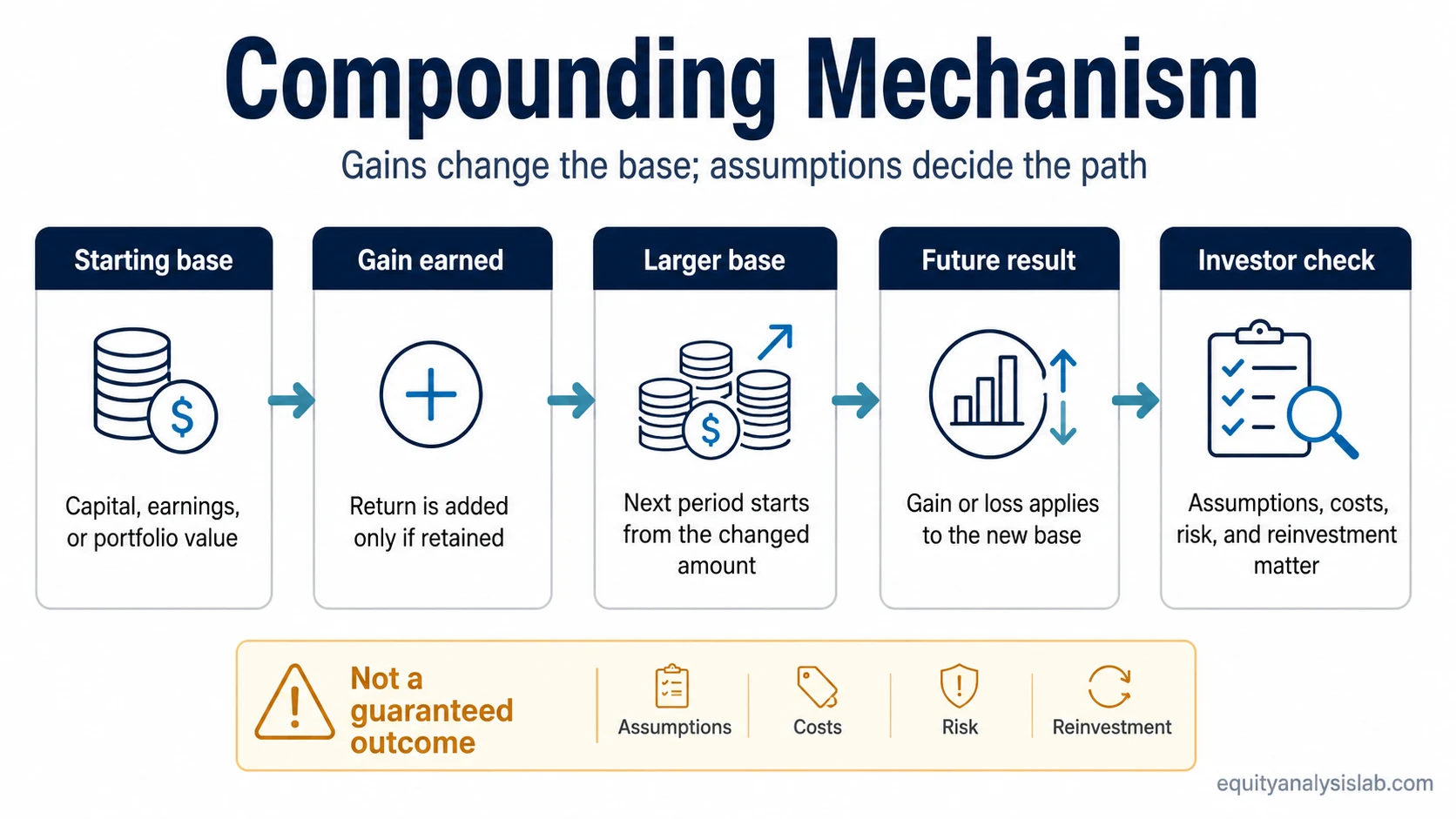
How Compounding Works
The base earns a return. If the gain remains invested, it becomes part of the base for the next period. Later percentage changes are then applied to that new amount rather than only to the original capital.
Assume a $100 base earns 5% and the gain remains invested. The balance becomes $105. If another 5% return occurs, the next gain is $5.25 because the return applies to $105. The extra $0.25 comes from earning a return on the prior gain.
The example isolates the mechanism. Actual investment returns can vary from period to period, and gains that are withdrawn no longer remain inside the same compounding base.
Compound Interest vs Compound Returns
Both involve a changing base, but the source of the return differs.
Interest is added to principal, and later interest can be calculated on the accumulated balance.
Investment gains that remain invested become part of the amount exposed to subsequent gains or losses. The return may come from price change, distributions, or other investment income rather than a fixed interest rate.
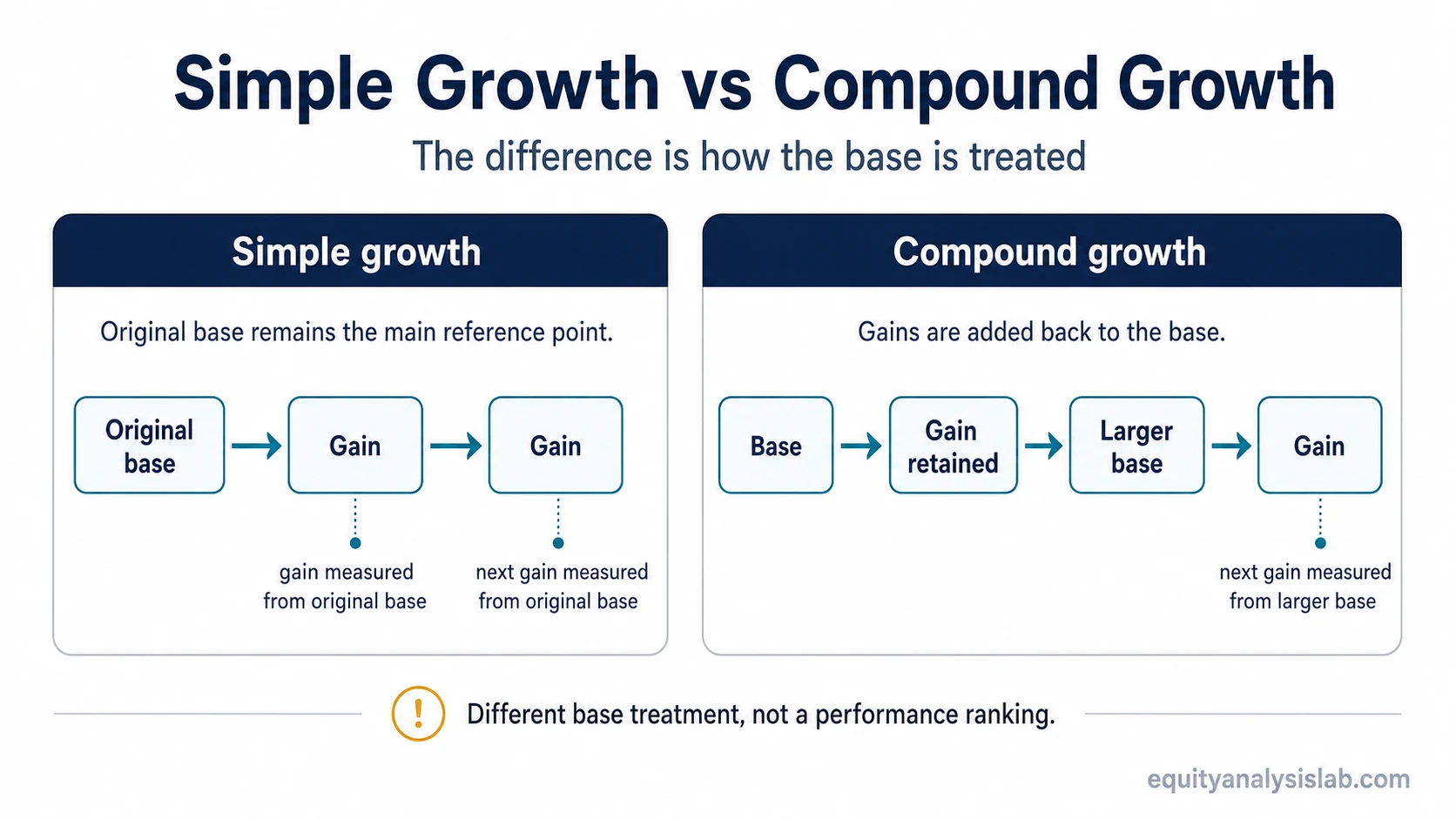
Simple Growth vs Compound Growth
Simple growth keeps the original amount as the reference point for later gains. Compound growth updates that reference point as retained gains change the base.
The difference may be small over a short interval. It can become larger when the process repeats across many periods, provided gains remain in the base and subsequent returns remain positive.
What Affects Compounding for Investors
| Input | Why it matters | Interpretation risk |
|---|---|---|
| Starting base | The amount already invested determines how much capital a percentage return is applied to. | Focusing on the return rate while ignoring the amount and quality of capital exposed. |
| Return assumption | The rate has a large effect when it is repeated over many periods. | Treating an assumed rate as if it were a stable future result. |
| Reinvestment | Returns must remain in the base for those gains to participate in later returns. | Projecting continued compounding after gains have been withdrawn or poorly reinvested. |
| Time | More periods create more opportunities for the mechanism to repeat. | Assuming that additional time can repair weak economics or unrealistic return assumptions. |
| Costs, taxes, fees, and dilution | Friction can reduce the amount or rate that actually remains available to the investor. | Projecting gross growth while ignoring reductions to the investable base or per-share economics. |
| Losses and withdrawals | A smaller base leaves less capital available for later returns. | Modeling only an upward path when actual investment outcomes can include negative periods and cash leaving the portfolio. |
Expected return assumptions require particular care because a compounding calculation can look precise even when the future rate is uncertain.
A realistic time horizon determines how many periods the mechanism may have to repeat, but a longer period also leaves more time for changes in business results, valuation, costs, inflation, and investor behavior.
Where Compounding Appears in Investing
Compounding can occur at several levels. A company may retain earnings and reinvest them into the business. A shareholder may reinvest distributions. A portfolio may keep prior gains invested so the next return applies to a different capital base.
In equity investing, these layers should be separated. Retaining earnings does not automatically create shareholder value. The result depends on how effectively capital is reinvested, what happens to per-share economics, and the price investors pay for the ownership claim.
Compounding Does Not Guarantee Growth
Investment returns do not need to stay positive or constant. Losses reduce the base, while fees, taxes, withdrawals, dilution, or poor reinvestment can weaken what remains available to compound. More time gives the process more periods to operate; it does not make an unrealistic return assumption reliable.
This is why compounding belongs inside a broader risk and return framework. Changes to the base matter in both directions, and the path depends on the returns actually realized rather than on a smooth projected curve.
Contributions and Compounding Are Different Mechanisms
New contributions increase invested capital from outside the return process. Compounding describes what happens when returns already generated by the investment remain in the base and participate in later returns.
When contributions are made on a recurring schedule, dollar-cost averaging is a separate concept. The contribution schedule determines when new capital enters. Compounding describes how the invested base changes as returns are retained over time.