
An investment thesis is a research-backed explanation of why an investor believes a company, asset, or strategy deserves attention under a specific set of assumptions.
For an equity investor, the thesis brings together the company, its financial results, valuation, major risks, and the evidence worth monitoring over time. The goal is to make the reasoning clear enough that it can be reviewed when new information appears.
A useful investment thesis gives the investor a record of the original idea and the conditions behind it. That makes it easier to see whether later developments strengthen the case, weaken it, or require a fresh assessment.
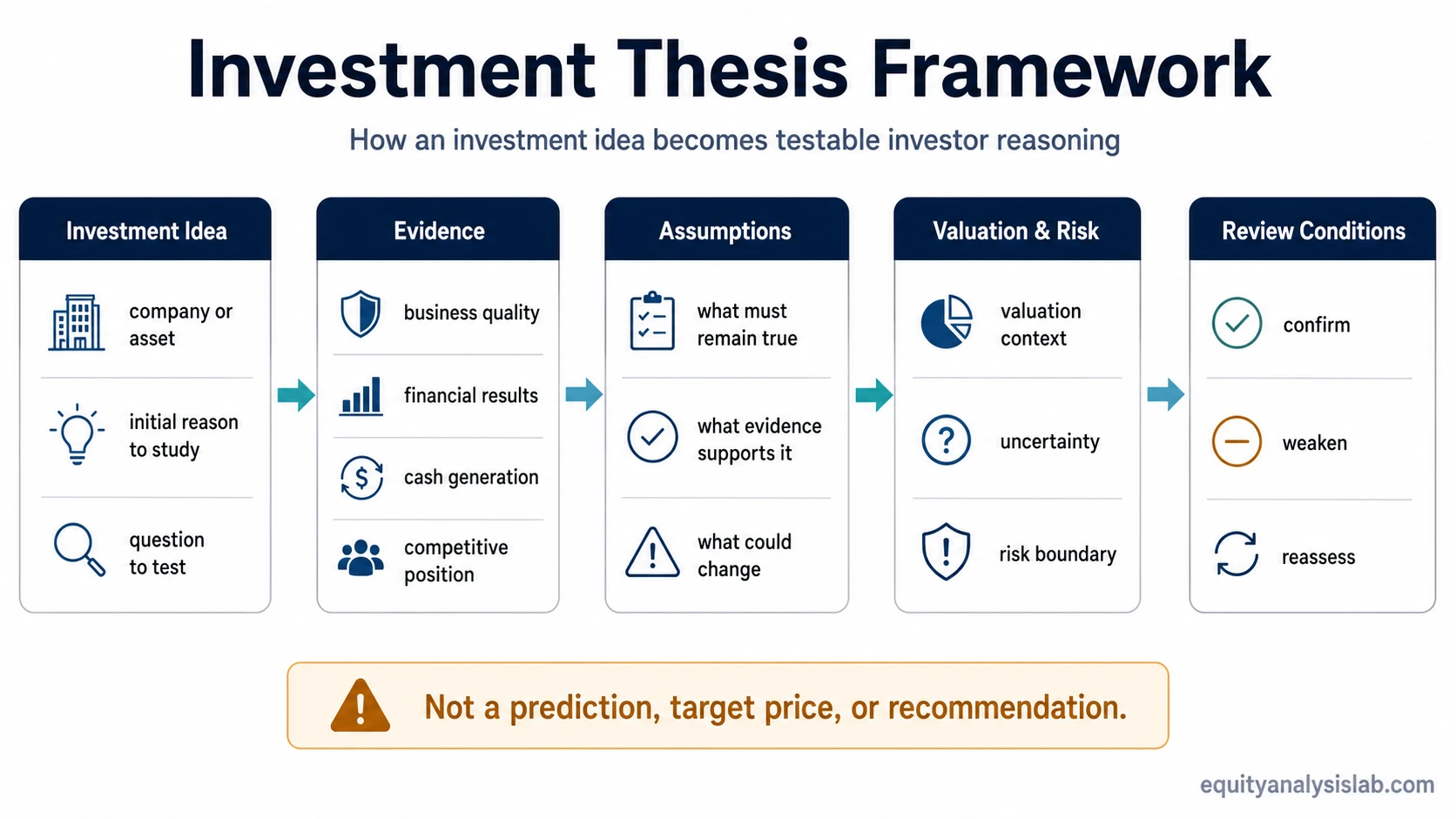
Key Points About an Investment Thesis
- An investment thesis turns a broad investment idea into structured reasoning.
- It connects business evidence, financial results, valuation, assumptions, and risk.
- Strong theses include clear conditions for reviewing or changing the original view.
- General claims such as “good company” or “cheap stock” need supporting evidence before they become useful investment reasoning.
- The thesis should evolve when the underlying facts change.
What Is an Investment Thesis?
An investment thesis is the central reasoning behind an investment idea. It explains why the opportunity deserves research, which evidence supports the case, what assumptions matter, and which developments could change the investor’s view.
In equity analysis, this usually includes the company’s business model, competitive position, financial performance, valuation, and major risks. The thesis can be short or detailed depending on the company, but the reasoning should be specific enough to revisit later.
This distinction becomes useful when an attractive business is trading at a demanding valuation, or when an inexpensive stock has weak underlying economics. The thesis gives the investor a framework for considering those factors together.
What an Investment Thesis Is Used For
An investment thesis helps organize investor judgment. It identifies why an idea deserves attention, which facts carry the most weight, and what should be monitored after the initial research is complete.
A strong brand, a popular product, rapid growth, or a rising share price may all attract attention to a company. Research then has to connect those observations to the economics of the business, its financial results, valuation, and major risks.
The thesis becomes a reference point for later reviews. Earnings reports, changes in competition, margin trends, capital allocation decisions, and valuation changes can all be compared with the assumptions that supported the original idea.
Core Evidence Behind an Investment Thesis
The evidence behind an investment thesis varies by company and industry. Most equity research, however, draws from several recurring areas.
| Evidence source | Investor interpretation | Assumption being tested | Limitation |
|---|---|---|---|
| Business quality | Whether the company can defend returns, pricing, or customer relationships | The company has durable advantages rather than temporary momentum | Quality can fade if competition, regulation, or customer behavior changes |
| Financial evidence | Whether revenue, margins, earnings, and cash generation support the story | The business model converts activity into durable owner value | Accounting profits can look stronger than cash economics |
| Valuation context | Whether the current price leaves enough room for the thesis to matter | The market is underestimating, overestimating, or misreading the company | A good business can still be a poor opportunity if expectations are too high |
| Risk boundary | What could make the thesis incomplete, outdated, or wrong | The downside risks are identifiable rather than ignored | Some risks are uncertain until new evidence appears |
| Thesis-change conditions | Which facts would require the investor to reassess the idea | The thesis is testable and can be updated as evidence changes | Evidence may be mixed before it becomes decisive |
Business-quality research may include whether a company has an economic moat. The next step is to look for evidence of that advantage in customer behavior, margins, returns, competitive positioning, or other operating results.
Financial evidence can include margins, reinvestment needs, debt, earnings quality, and free cash flow. These measures are most useful when they help test the assumptions behind the investment case.
How Evidence Becomes an Investor Assumption
Raw data becomes part of an investment thesis when the investor explains what it means for the future economics of the business. A high margin, for example, becomes more useful when the research addresses why that margin exists and whether the conditions supporting it are likely to continue.
Valuation works the same way. A low multiple may look attractive at first glance, but the analysis still has to consider growth, business quality, capital requirements, risk, and market expectations. Comparing the current valuation with estimated intrinsic value can help frame that question.
The assumptions should also have review conditions. If the thesis depends on strong margins, healthy demand, and improving cash generation, those are the variables to monitor. A sustained deterioration in one or more of them may justify changing the original view.
Real Company Case: DigitalOcean
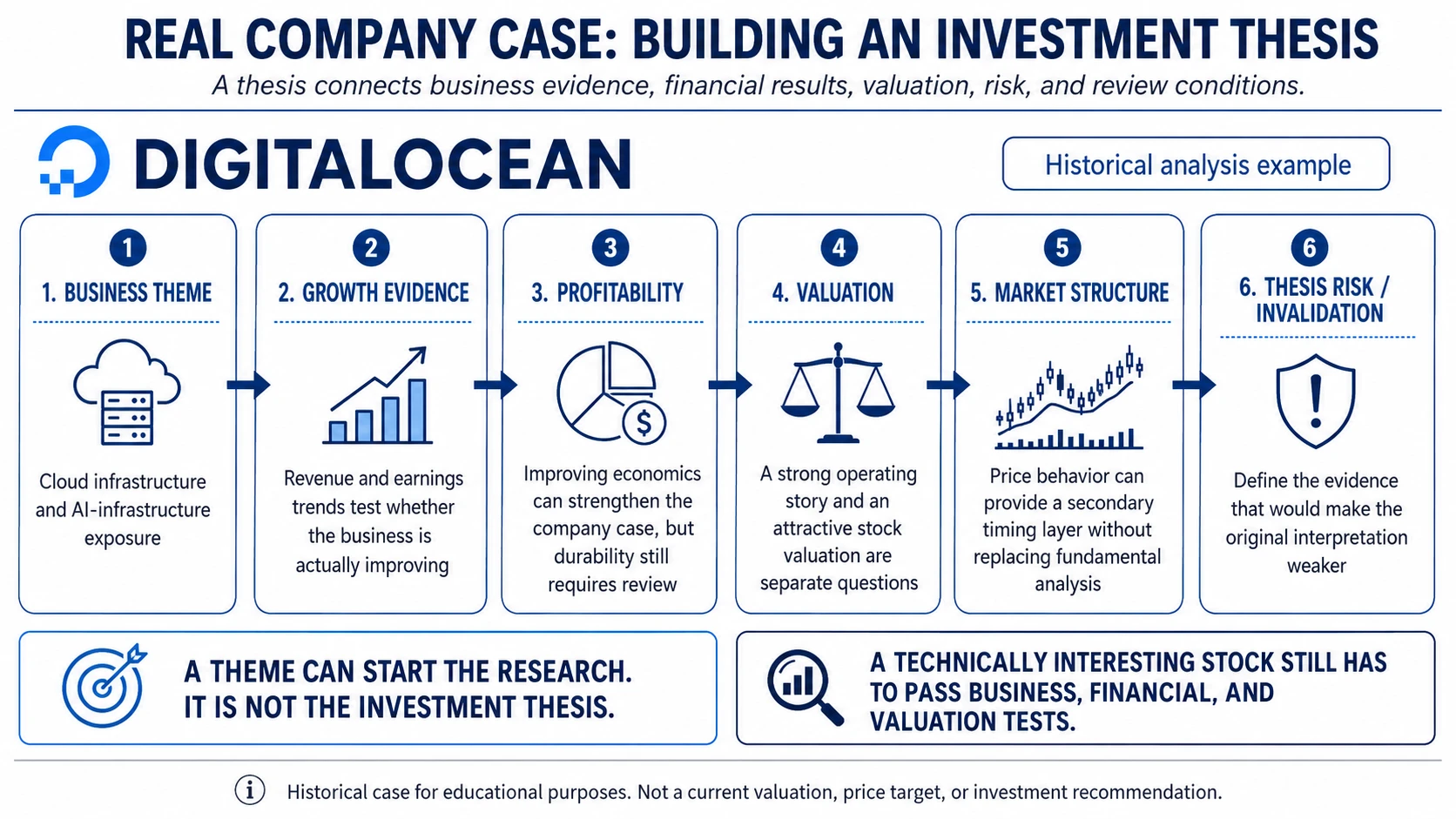
DigitalOcean provides a useful historical example of how an investment idea can develop into a broader thesis. Cloud infrastructure and growing AI-related demand created an interesting starting theme, but the theme alone did not answer whether the company represented an attractive investment opportunity.
The research therefore moved through several layers. Revenue and earnings trends provided evidence about business growth. Profitability helped show whether that growth was translating into stronger economics. Valuation then provided context for what investors were already paying for those expectations.
Market structure added another layer to the analysis by showing how the stock was behaving, particularly around important price areas. For a position-oriented investor, that information can help with timing and risk management while the company analysis remains focused on the underlying business and valuation.
The thesis also needed conditions for review. Slower growth, weaker profitability, deteriorating cash generation, increasing competitive pressure, or a substantial change in valuation could all alter the original interpretation.
This process turns a broad theme into something that can be monitored. The company, its financial performance, valuation, market behavior, and risks are considered together, with each new reporting period providing additional evidence.
Limits of an Investment Thesis
An investment thesis is built from information available at a particular point in time. Business conditions, competition, financial performance, and market expectations continue to change after the original research is completed.
Some assumptions will hold for years, while others can change quickly. New competition, weaker cash flow, deteriorating unit economics, capital allocation mistakes, or a sharp change in valuation can materially alter the investment case.
The broader risk-on risk-off environment can also influence how investors price a company. That macro backdrop provides useful context, while company-level evidence and valuation remain separate parts of the thesis.
A margin of safety can help account for uncertainty in valuation assumptions. The underlying business case still needs to be monitored because changes in the company can also change the estimate of value.
Common Mistakes When Reading an Investment Thesis
Using a broad story as the thesis. Themes such as AI, cloud computing, electrification, or demographic growth can identify areas worth researching. The company-level thesis still requires evidence about economics, financial performance, valuation, and risk.
Relying too heavily on conviction. Strong confidence in a company can make contradictory evidence easier to dismiss. Writing down the important assumptions gives the investor something concrete to review later.
Focusing on the target price. A valuation estimate is one output of the research process. Its usefulness depends on the assumptions and evidence behind it.
Leaving the thesis open-ended. An investor should know which developments deserve a review of the original case. Without those conditions, the thesis becomes harder to test as circumstances change.
FAQ
Is an investment thesis the same as a stock prediction?
No. An investment thesis records the reasoning behind an investment idea using the evidence and assumptions available at the time. Future prices remain uncertain.
What should an investment thesis include?
An investment thesis usually includes the core idea, supporting evidence, important assumptions, valuation context, major risks, and the conditions that would trigger a review.
Is a target price an investment thesis?
A target price is a valuation estimate. The investment thesis is the broader reasoning and evidence used to assess the company and arrive at that estimate.
Can an investment thesis change over time?
Yes. New financial results, changes in the business, valuation movements, competition, or other evidence can change the original thesis. Regular review is part of the process.