
A strike price in options is the fixed exercise price written into an option contract. For a call, the strike is the price at which the holder can buy the underlying asset if the option is exercised. For a put, the strike is the price at which the holder can sell the underlying asset if the option is exercised.
The strike price is compared with the current market price to classify the option as in the money, at the money, or out of the money. It also helps define intrinsic value. It is not the premium, and it does not by itself make an option suitable, safe, or profitable.
Key Points
- A strike price is the contract’s fixed exercise reference price.
- Call options and put options use the strike price in opposite ways.
- Moneyness compares the strike price with the current market price of the underlying asset.
- Intrinsic value exists only when the strike price is favorable relative to the market price.
- Premium is separate from strike price and can include extrinsic value.
- Strike price is a contract boundary, not a recommendation or quality signal by itself.
Strike Price Definition
Strike price definition: a strike price is the fixed price in an option contract that determines the price used if the holder exercises the option right.
The strike is also called the exercise price because it is the price applied when the option right is used. In broader option contract mechanics, the strike sits beside the underlying asset, expiration date, option type, and premium as one of the core contract terms.
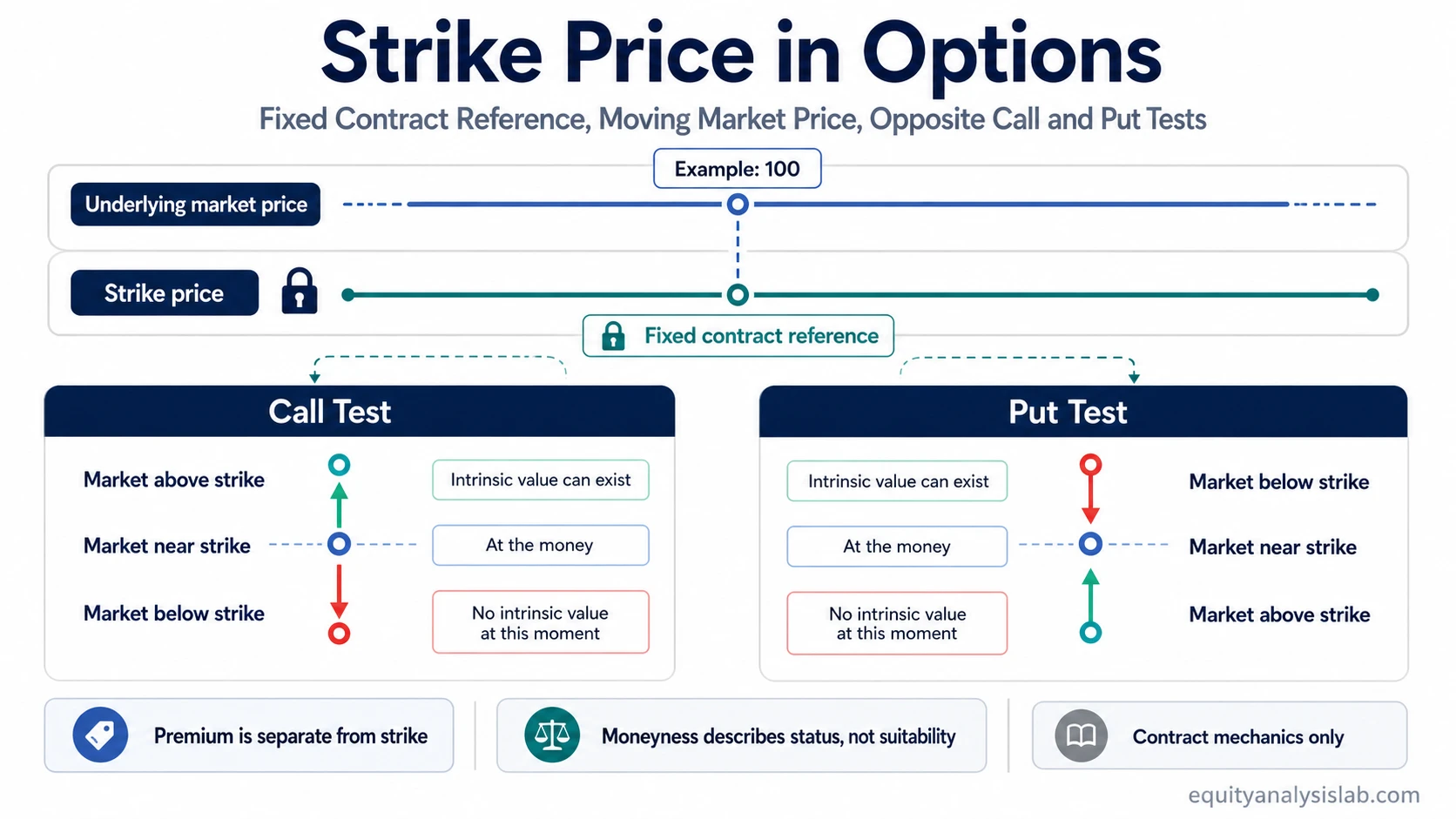
The strike price does not move because the stock or ETF price moves. Instead, the market price moves around the fixed strike. That comparison is what gives the strike its meaning.
| Contract element | What it controls | What it does not control alone |
|---|---|---|
| Strike price | The fixed exercise reference price | Whether the option is suitable or profitable |
| Market price | The current price of the underlying asset | The fixed contract terms |
| Premium | The price paid or received for the option contract | The strike at which the contract can be exercised |
| Expiration | The time limit on the contract | The fixed strike price itself |
How Strike Price Works for Calls and Puts
A call strike and a put strike use the same fixed-price idea, but they point in opposite directions. A call option contract gives the holder the right to buy the underlying asset at the strike price.
A put gives the holder the right to sell the underlying asset at the strike price. The same strike can therefore mean different things depending on whether the contract is a call or a put.
| Option type | Strike price means | Favorable market-price direction for intrinsic value |
|---|---|---|
| Call option | The price at which the holder can buy | Market price above the strike price |
| Put option | The price at which the holder can sell | Market price below the strike price |
This opposite direction is why strike price should not be read without option type. A strike above the market price can mean one thing for a call and another thing for a put.
Strike Price vs Market Price
Strike price and market price are different. The strike price is fixed in the option contract. The market price is the current price of the underlying asset and can change continuously while markets are open.
The comparison between the two determines the option’s current moneyness. It also helps show whether the contract has intrinsic value at that moment.
| Question | Strike price | Market price |
|---|---|---|
| Where does it come from? | Set in the option contract | Set by current market trading |
| Does it change during the contract? | No, not for that contract | Yes, as the underlying asset moves |
| What does it help determine? | Exercise reference and payoff boundary | Current moneyness and intrinsic value status |
| Does this alone determine suitability or fair pricing? | No, not by itself | No, not by itself |
Strike Price, Moneyness, and Intrinsic Value
Moneyness describes how the strike price compares with the current market price. The basic categories are in the money, at the money, and out of the money.
For a call, intrinsic value exists when the market price is above the strike price. For a put, intrinsic value exists when the market price is below the strike price. At the money and out of the money contracts do not have intrinsic value at that moment, although they may still have premium.
| Moneyness status | Call option test | Put option test |
|---|---|---|
| In the money | Market price is above strike price | Market price is below strike price |
| At the money | Market price is near the strike price | Market price is near the strike price |
| Out of the money | Market price is below strike price | Market price is above strike price |
Moneyness is descriptive. It tells the reader how the contract currently relates to the market price. It does not say whether the option is a good trade, a safe contract, or a fair price.
Strike Price vs Premium
Strike price is not the same as premium. The strike price is the fixed exercise reference. Premium is the amount paid by the buyer and received by the seller for the option contract.
Premium can include intrinsic value and extrinsic value. Intrinsic value comes from the favorable relationship between strike price and market price. Extrinsic value can reflect time remaining, volatility expectations, interest rates, dividends, supply and demand, and other pricing inputs.
Important distinction: a lower or higher strike price does not automatically mean the option is cheaper, better, or more attractive. Premium, expiration, volatility, liquidity, and contract risk all affect how the option should be interpreted.
Example: Same Underlying Price, Different Strike Tests
Assume an underlying asset trades at 100. A call option with a 90 strike gives the holder the right to buy at 90, while the market price is 100. That call is in the money because the market price is above the strike.
A put option with a 110 strike gives the holder the right to sell at 110, while the market price is 100. That put is also in the money because the market price is below the strike.
| Contract | Underlying market price | Strike price | Current status | Basic intrinsic value logic |
|---|---|---|---|---|
| Call option | 100 | 90 | In the money | Market price is 10 above the strike |
| Put option | 100 | 110 | In the money | Strike is 10 above the market price |
The example only shows contract mechanics. It does not rank the strikes, price the contracts, or decide whether either contract fits a specific investor situation.
How Expiration, Exercise, and Assignment Connect to Strike Price
The strike price matters only inside a contract with an expiration date. Time remaining can affect premium because the contract may still have value beyond current intrinsic value. Near expiration, the remaining premium often becomes more sensitive to where the market price sits relative to the strike, but expiration style, settlement rules, and contract terms still matter.
If the holder chooses to use the option right, the exercise process applies the strike price to the contract. For a call, exercise applies the right to buy at the strike. For a put, exercise applies the right to sell at the strike.
On the seller side, assignment is the obligation side of that same contract relationship. The strike price defines the price used if the seller is assigned under the contract terms.
Common Mistakes When Reading Strike Price
Mistake 1: treating strike price as premium. The strike is the exercise reference. Premium is the contract price.
Mistake 2: reading a strike without option type. A 100 strike has different meaning in a call than in a put.
Mistake 3: treating moneyness as a recommendation. In the money, at the money, and out of the money describe contract status, not whether the option is suitable.
Mistake 4: ignoring expiration. The same strike can carry different premium and risk implications depending on time remaining.
Mistake 5: assuming intrinsic value equals total value. Premium may include extrinsic value, especially before expiration.
Related Options Concepts
Strike price is one part of a larger contract structure. Readers who need the broader contract sequence can review how these option terms fit together.
Use the related concepts this way:
- Use call option mechanics to understand the right-to-buy side of strike price.
- Use exercise mechanics to understand how the strike price is applied when the contract right is used.
- Use assignment mechanics to understand the seller-side obligation connected to the strike.
- Use broader option mechanics to connect strike price with premium, expiration, rights, and obligations.
FAQ
Is strike price the same as exercise price?
Yes. In options, strike price and exercise price usually refer to the same contract price. It is the fixed price used if the option right is exercised.
Is strike price the same as premium?
No. Strike price is the fixed exercise reference in the contract. Premium is the price paid or received for the option contract.
How does strike price affect call and put moneyness?
For a call, the option is in the money when the market price is above the strike. For a put, the option is in the money when the market price is below the strike.
Can an out-of-the-money option still have value?
Yes. An out-of-the-money option has no intrinsic value at that moment, but it can still have premium because of time remaining, volatility expectations, and other pricing inputs.
Does a better strike price mean a better option?
No. Strike price alone does not determine whether an option is suitable, safe, or fairly priced. It must be read with option type, market price, premium, expiration, volatility, liquidity, and risk context.