
A stock research workflow organizes how an investor moves from a raw stock idea to watchlist tracking, thesis evidence, due diligence checks, and a clear decision boundary. It does not decide whether a stock should be bought; it keeps the research sequence disciplined before comparison or portfolio review.
The useful starting point is usually the investment research process, because it sets the order of evidence before a company is treated as a serious candidate. From there, the workflow can separate idea capture, watchlist organization, documentation, and risk-question review.
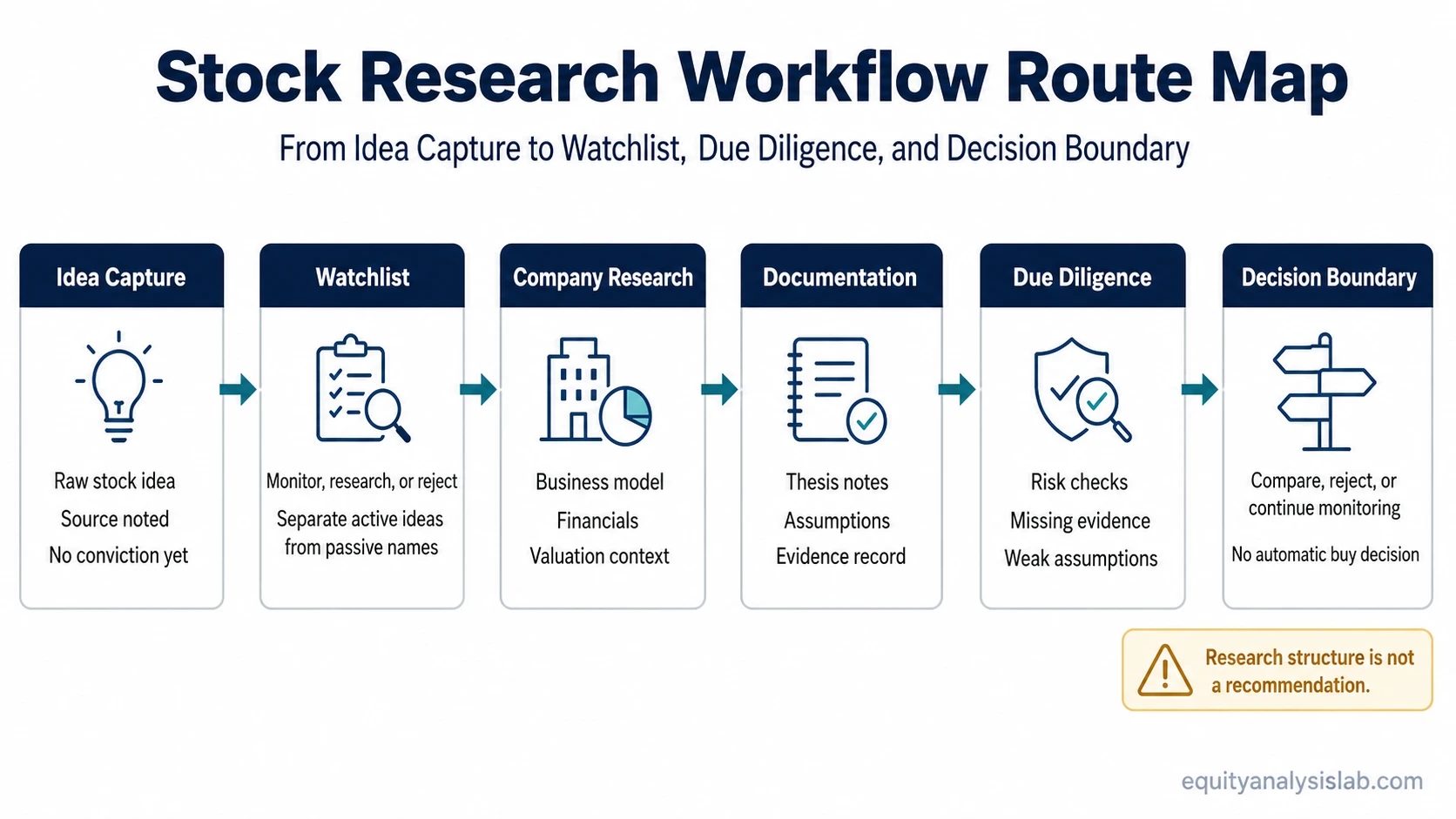
Where to Start in a Stock Research Workflow
A stock idea should not move directly from discovery to conviction. The first job is to decide whether the idea belongs in active research, passive monitoring, or rejection. A watchlist helps keep that distinction visible by separating names that are merely interesting from companies that have enough evidence for closer work.
After an idea is captured, the workflow should test what kind of question the investor is really asking. Some ideas need business model review. Others need valuation context, balance-sheet checks, earnings-quality work, or a clearer reason to keep following the company. The sequence matters because weak early evidence should stop the process before a template or checklist creates a false sense of completion.
Stock Research Workflow Groups
Each workflow step should answer a different research question. The groups below separate the main research tasks without turning the sequence into a recommendation system.
| Workflow group | Main question | Useful next step |
|---|---|---|
| Idea capture | Why did this stock enter the research universe? | Record the original source of interest without treating it as evidence. |
| Watchlist organization | Is the idea worth monitoring, researching now, or discarding? | Use how to build a stock watchlist when the main problem is sorting names into a usable tracking system. |
| Company research | What does the business do, and what evidence supports the thesis? | Review qualitative drivers, financial statements, margins, cash flow, balance-sheet risk, and valuation context. |
| Research documentation | Is the evidence organized enough to compare later? | Use a stock research template when notes, assumptions, and thesis points need a consistent format. |
| Due diligence checks | What could make the thesis incomplete, weak, or misleading? | Use a stock due diligence checklist when the question is whether key risks and evidence gaps have been tested. |
| Decision boundary | What would need to be true before comparison, rejection, or continued monitoring? | Write the unresolved questions before turning research into a portfolio decision. |
Priority Path for Investor Research
The cleanest stock research workflow usually begins with evidence order, not with a template. A template can organize notes, but it cannot decide whether the notes are strong. A checklist can expose missing questions, but it cannot prove that the thesis is correct.
A practical order is: capture the idea, place it in a watchlist, define the company question, gather qualitative and quantitative evidence, document the thesis, run due diligence checks, then decide whether the stock deserves comparison against alternatives. This keeps fundamentals, valuation, and risk review connected without pretending that any single step creates certainty.
Priority note: If the investor does not yet know why the company is being researched, start with the research process. If there are too many names and no tracking discipline, start with the watchlist. If the evidence is scattered, use a template. If the thesis already looks formed, pressure-test it with due diligence questions.
Template, Checklist, and Watchlist Boundaries
A watchlist, a template, and a checklist solve different problems. Mixing them together can make the workflow look more complete than it really is.
| Tool | Best use | Common misuse |
|---|---|---|
| Watchlist | Tracks ideas and separates monitoring from active research. | Treating every tracked company as attractive. |
| Research template | Organizes thesis notes, assumptions, evidence, and open questions. | Filling boxes without testing whether the evidence is strong. |
| Due diligence checklist | Pressure-tests risks, missing information, and thesis weak points. | Using checked items as proof that the investment case is valid. |
Short Workflow Example
An investor may notice a company after improving margins appear in recent financial results. The first step is not a decision; it is classification. The company may enter a watchlist, then move into active research only if the investor can define the thesis question, compare margin improvement with cash flow, check debt and reinvestment needs, and identify what would weaken the case.
If the evidence remains incomplete, the correct output may be continued monitoring rather than action. A useful stock research workflow protects that boundary by making unanswered questions visible.
What a Stock Research Workflow Cannot Prove
A stock research workflow can organize evidence, reduce scattered thinking, and make comparison easier. It cannot prove that a stock is safe, undervalued, likely to outperform, or suitable for a specific investor.
Valuation ratios, financial statements, business-quality notes, and due diligence questions all require interpretation. The workflow improves the order of that interpretation, but the final judgment still depends on evidence quality, assumptions, risk tolerance, portfolio fit, and alternative opportunities.
FAQ
What is a stock research workflow?
A stock research workflow is an organized sequence for moving from stock ideas to watchlist tracking, company research, thesis documentation, due diligence checks, and decision boundaries. It helps structure research, but it does not create a stock recommendation by itself.
Is a stock research workflow the same as a stock research template?
No. A workflow is the full order of research tasks. A template is only one documentation tool inside that order. A template can organize notes, but it does not replace evidence gathering, valuation context, or due diligence review.
Where does a due diligence checklist fit in the workflow?
A due diligence checklist usually fits after the thesis has enough initial evidence to test. It helps expose missing questions, weak assumptions, and risks before the investor treats the idea as comparable with other opportunities.