
A stock watchlist helps an investor control attention before a company idea becomes a full research decision. A stock watchlist is a monitored research queue of company or security ideas that are being tracked for evidence, valuation context, review triggers, and a next research action.
Definition: A stock watchlist is a structured list of companies or securities an investor wants to monitor before deciding whether deeper research is justified. It is not a buy list, a portfolio, a price target, or a signal that a stock is ready for action.
Key Points About a Stock Watchlist
- A stock watchlist is a research queue, not a portfolio.
- Each entry should have a reason for inclusion, an evidence need, and a review trigger.
- The watchlist helps organize attention; it does not make the investment decision.
- A watchlist without criteria can become a cluttered list of names with no decision value.
What Is a Stock Watchlist?
A stock watchlist is a working list of companies or securities that an investor wants to observe more closely. The useful part is not the list itself. The useful part is the reason each name is being watched and the evidence that would move it toward deeper research, continued observation, or removal.
In an investor research workflow, a watchlist usually sits between idea generation and detailed analysis. A company may enter the list because it appears in a sector screen, a valuation review, an earnings-quality scan, a peer comparison, or a business model observation. It should stay there only if the investor knows what question the company is supposed to answer.
For example, a watchlist entry may exist because the investor wants to know whether margin pressure is temporary, whether free cash flow is improving, or whether valuation has become more reasonable compared with the quality of the business. The watchlist keeps that question visible until the evidence becomes clearer.
What a Stock Watchlist Is Not
The biggest mistake is treating a watchlist as a hidden recommendation list. A company can belong on a watchlist because it is interesting, unresolved, or worth monitoring, not because it is ready to buy.
| What it is not | Why the distinction matters |
|---|---|
| A portfolio | A portfolio contains owned positions. A watchlist contains ideas that may never become positions. |
| A buy list | Adding a company to a watchlist does not mean the investor has enough evidence to act. |
| A stock screener | A screener filters a universe of securities. A watchlist tracks selected ideas after an initial reason for interest exists. |
| A research template | A template organizes the full research record. A watchlist only tracks why the idea is being monitored and what happens next. |
| A due diligence checklist | A due diligence checklist tests a company in depth. A watchlist decides whether that depth is worth starting. |
| A target-price tool | A watchlist can include valuation context, but it should not pretend that one price estimate completes the decision. |
What Belongs on a Stock Watchlist?
A useful watchlist entry should explain why the company is there, what evidence is missing, and what would change the next step. Without those fields, the list can become a collection of tickers that feel familiar but are not actually being researched.
| Watchlist field | What it should capture | Why it helps |
|---|---|---|
| Company or ticker | The name or symbol being monitored. | Keeps the entry identifiable without making the ticker the whole thesis. |
| Reason for inclusion | The specific reason the company deserves attention. | Prevents random additions based only on familiarity or recent price movement. |
| Source of idea | Where the idea came from, such as a screen, filing review, sector comparison, or peer observation. | Helps separate repeatable research sources from noise. |
| Thesis question | The main question the investor is trying to answer. | Turns the watchlist entry into a research prompt instead of a passive name. |
| Evidence needed | The facts, filings, metrics, or developments that would clarify the idea. | Defines what the investor is actually waiting to learn. |
| Valuation context | A short note on whether valuation appears demanding, reasonable, uncertain, or not yet reviewed. | Keeps price and business quality from being evaluated in isolation. |
| Research status | A simple label such as new idea, monitoring, needs filings review, or ready for deeper work. | Shows where the entry sits in the research queue. |
| Review trigger | The event or evidence that should cause the investor to revisit the entry. | Prevents the list from depending only on memory or market headlines. |
| Removal trigger | The condition that would make the idea no longer worth tracking. | Stops stale or low-quality ideas from staying on the list forever. |
| Next research action | The next concrete step, such as reading the annual report, checking margins, comparing peers, or removing the name. | Connects the watchlist to action without turning it into a buy or sell decision. |
For criteria, categories, review cadence, and maintenance rules, use the dedicated guide on how to build a stock watchlist.
How a Watchlist Fits the Investment Research Process
A stock watchlist is most useful when it has a clear position in the broader investment research process. It should not replace research. It should decide what deserves research time.
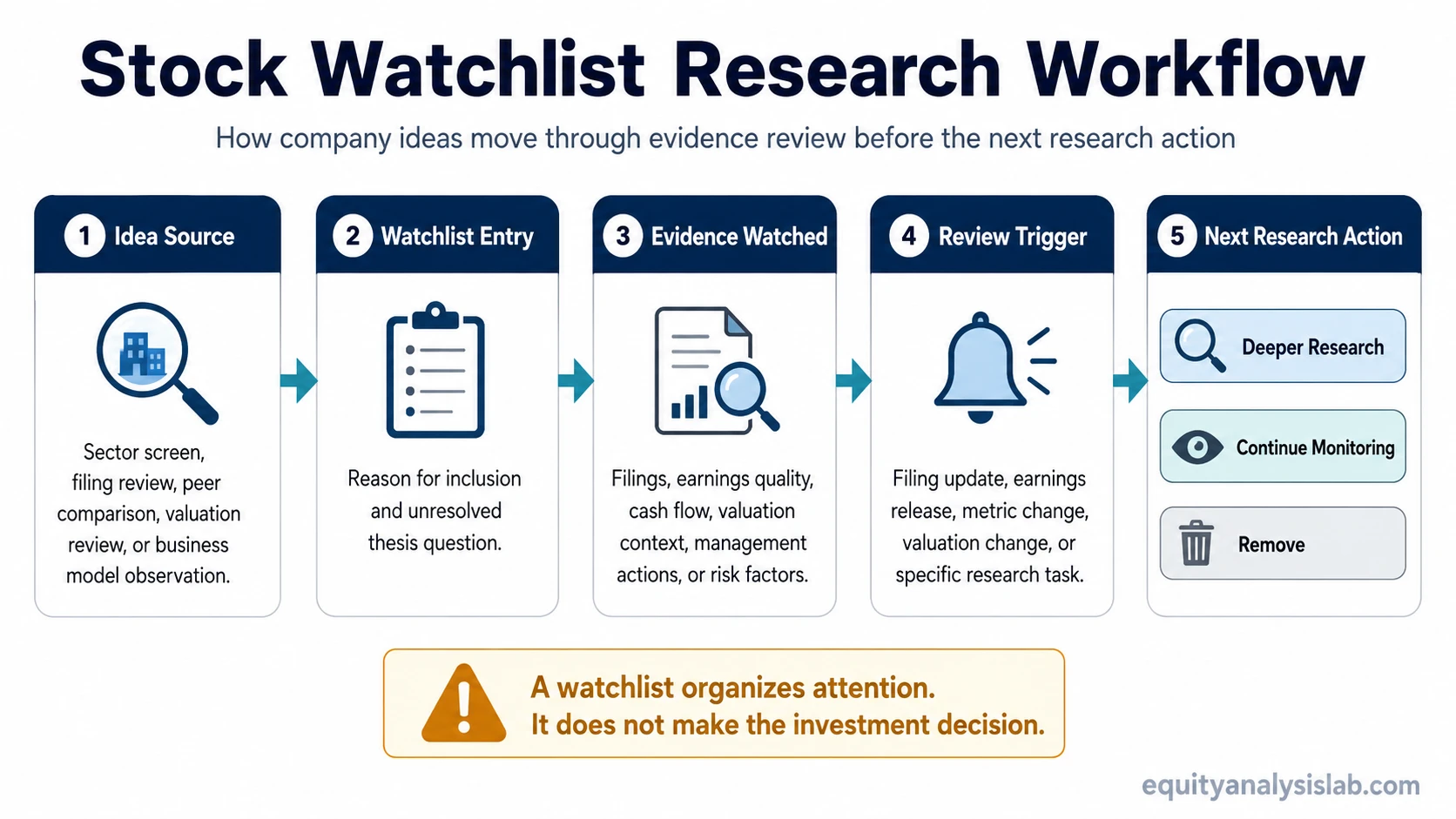
| Workflow stage | Role of the watchlist |
|---|---|
| Idea generation | A company first appears because something about the business, valuation, financials, or industry context looks worth noting. |
| Watchlist entry | The investor records why the idea belongs on the list and what question remains unresolved. |
| Evidence review | The investor watches for filings, earnings quality, cash flow, valuation change, management actions, or other relevant evidence. |
| Deeper research | If the evidence becomes strong enough, the company can move into fuller business, financial statement, valuation, and risk review. |
| Removal or continued monitoring | If the original reason weakens, the evidence does not develop, or the company no longer fits the research criteria, the entry can be removed or kept under limited review. |
This sequence keeps a watchlist from becoming a permanent parking lot. The list should create a decision path: add for a reason, monitor specific evidence, escalate when justified, or remove when the reason is gone.
Stock Watchlist vs Portfolio vs Screener vs Research Template
These tools often appear near each other, but they do different jobs. Confusing them can make the research process look more complete than it really is.
| Concept | Main job | Decision status |
|---|---|---|
| Stock watchlist | Tracks company ideas that need evidence, review triggers, and a next research action. | Pre-decision research queue. |
| Portfolio | Holds positions the investor already owns. | Post-decision ownership record. |
| Stock screener | Filters a broad universe using selected criteria. | Idea-generation tool. |
| Research template | Organizes the deeper analysis of a company. | Full research documentation tool. |
| Due diligence checklist | Tests whether the company, valuation, risks, and evidence have been reviewed thoroughly enough. | Decision-readiness control. |
Stock Watchlist Example
Consider an illustrative company idea, not a real historical case. An investor notices that a mid-sized business appears to have improving operating margins, but the latest cash flow record is still uneven. The company is not ready for a full investment conclusion, but it may deserve monitoring.
A clean watchlist entry could record possible margin improvement as the reason for inclusion, then define the thesis question: is the improvement supported by durable cash generation? The investor would wait for the next filing, operating cash flow trend, and management commentary. The review trigger is the next earnings release. The removal trigger is margin improvement without cash conversion or a valuation that no longer leaves room for error.
The watchlist does not decide whether the company is attractive. It keeps the research question visible and defines what evidence would justify the next step.
Common Stock Watchlist Mistakes
A watchlist becomes less useful when it grows faster than the investor’s ability to review it. The problem is not the number of names by itself; the problem is the absence of criteria, triggers, and removal logic.
| Mistake | Why it weakens the watchlist | Better control |
|---|---|---|
| Adding too many names | The list becomes a memory burden instead of a research tool. | Group entries by status and remove names with no active research question. |
| No reason for inclusion | The investor may forget why the company looked interesting. | Require a short written reason before adding the entry. |
| No review trigger | The list depends on headlines or price movement instead of evidence. | Attach each entry to a filing, earnings release, valuation change, metric update, or specific research task. |
| Confusing interest with readiness | A familiar name can start to feel more complete than the evidence supports. | Separate “watching” from “researched” and “decision-ready.” |
| Never removing stale ideas | Old entries can crowd out better research candidates. | Define removal triggers and review inactive names on a schedule. |
When a Watchlist Becomes Misleading
A watchlist becomes misleading when it creates false familiarity. Seeing the same company name repeatedly can make the idea feel researched even when the investor has not reviewed the business model, financial statements, valuation, management actions, ownership structure, or risk factors.
The safeguard is to treat every watchlist entry as unfinished. If the entry does not show what evidence is missing, what would trigger review, and what would cause removal, it is only a ticker note, not a research workflow item.
Related Investor Research Concepts
A stock watchlist is the starting queue for unresolved company ideas. The next step depends on what the investor needs to clarify.
| Next concept | Use it when |
|---|---|
| How to build a stock watchlist | You need the practical setup process for criteria, categories, review cadence, and maintenance rules. |
| Investment research process | You need to understand how idea generation, watchlist review, company analysis, valuation, risk review, and decision readiness connect. |
FAQ
Is a stock watchlist the same as a portfolio?
No. A portfolio contains positions the investor already owns. A stock watchlist contains company or security ideas that are still being monitored before a deeper research or investment decision.
Does adding a stock to a watchlist mean it is ready to buy?
No. Adding a stock to a watchlist only means there is a reason to monitor it. The idea still needs evidence, valuation context, risk review, and a clear next research action before it can move toward decision readiness.
What should a stock watchlist track?
A useful watchlist should track the reason for inclusion, source of idea, thesis question, evidence needed, valuation context, review trigger, removal trigger, research status, and next research action.
When should a stock be removed from a watchlist?
A stock can be removed when the original reason for interest no longer applies, the needed evidence does not develop, the company no longer fits the investor’s criteria, or the entry has no clear research question left.