
A stock watchlist is a structured research queue: a list of companies an investor wants to monitor before deciding whether deeper research is justified. It separates attention from action, so a company can be worth watching without being ready for a portfolio decision.
Definition: A stock watchlist is a controlled list of companies tracked for business quality, valuation context, thesis development, risk review, and possible portfolio fit. A company belongs on the list because there is a clear reason to keep watching it, not because its ticker recently moved.
The useful question is not “What should I buy?” The useful question is “Which companies deserve research attention, what evidence should I monitor, and what would make the idea stronger, weaker, or irrelevant?”
Key Points
- A watchlist should organize research attention, not create investment decisions by itself.
- Each company needs a reason for inclusion, such as business quality, valuation interest, earnings durability, balance-sheet risk, or industry relevance.
- Grouping names by research status is usually more useful than collecting a long list of tickers.
- A company should move up, stay under review, or be removed as evidence changes.
- The watchlist works best when it connects to a broader investment research process.
What a Stock Watchlist Is Supposed to Do
A stock watchlist gives an investor a place to store companies that may deserve future research. It does not decide whether a company is attractive, investable, or suitable for the portfolio. Its job is to make the next research step visible.
The watchlist should help answer three practical questions: why is this company being watched, what evidence would change the view, and what is the next research step? Without those answers, the list becomes a ticker dump.
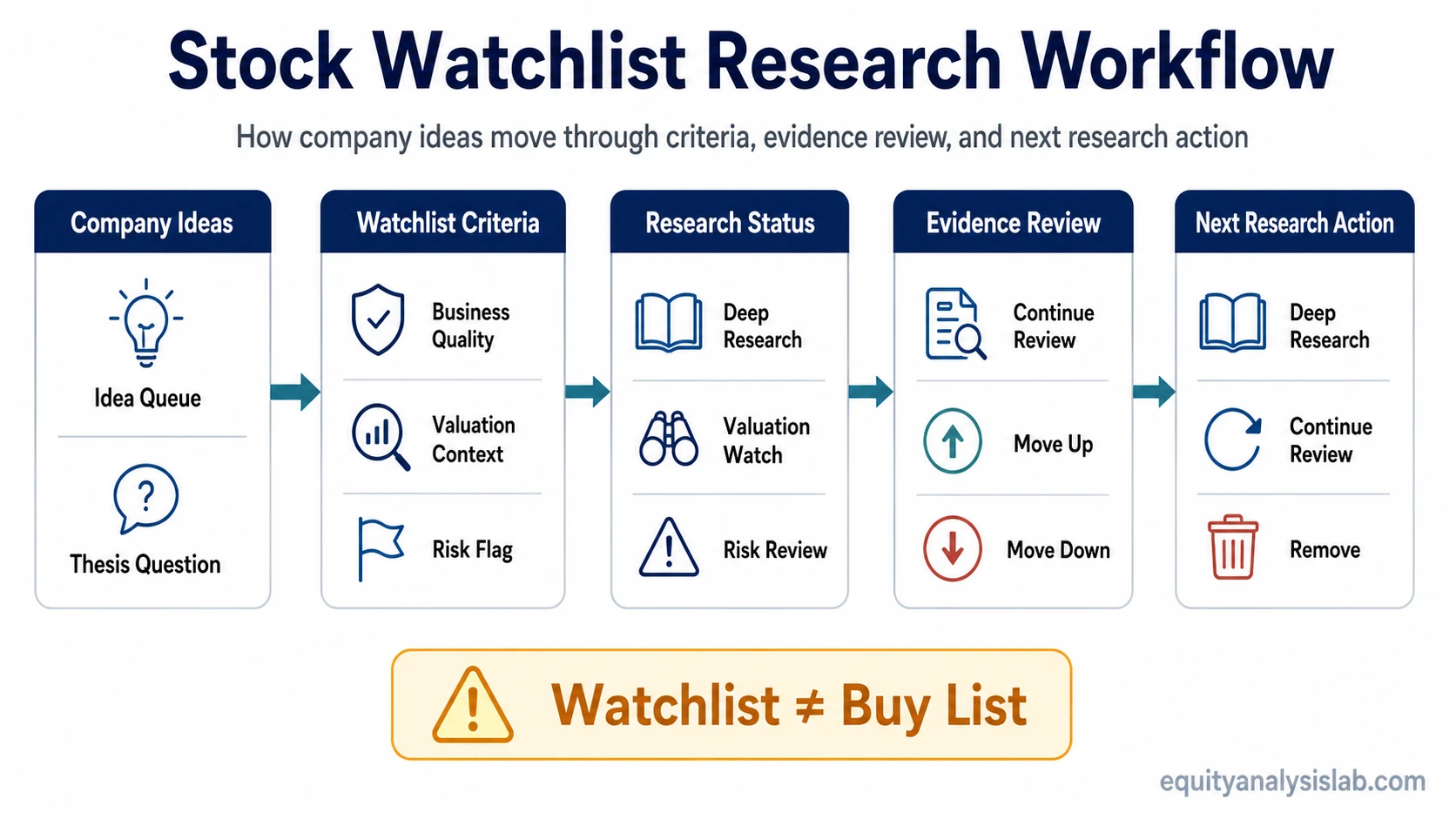
Important distinction: A portfolio contains owned positions. A watchlist contains possible research candidates. A buy list implies a much stronger decision state. A watchlist should only mean that the company has earned attention.
What Belongs on a Stock Watchlist
A company belongs on a watchlist when there is a specific research reason to keep it visible. The reason can come from the business, the valuation, the financial statements, the industry structure, or a thesis question that is not yet resolved.
Good watchlist candidates usually have at least one observable feature that can be reviewed later. That feature might be margin improvement, cash-flow durability, debt reduction, valuation compression, pricing power, customer concentration risk, or a management decision that changes the thesis.
| Reason to watch | What to monitor | Why it belongs on the list |
|---|---|---|
| Business quality | Margins, returns on capital, customer retention, pricing power | The company may deserve deeper research if quality appears durable. |
| Valuation interest | Multiple compression, cash-flow yield, valuation range, peer context | The business may become worth studying if price and fundamentals move closer to a reasonable research range. |
| Earnings or cash-flow trend | Revenue quality, margin direction, free cash flow, working capital pressure | The thesis depends on whether financial improvement is real or temporary. |
| Balance-sheet risk | Debt maturity, liquidity, interest coverage, dilution risk | The company may be interesting, but risk needs monitoring before deeper work. |
| Industry relevance | Sector structure, regulation, demand cycle, competitive position | The company can help track a theme or peer group even if it is not yet a research priority. |
| Thesis question | One unresolved question that would make the idea stronger or weaker | The watchlist keeps the question visible until enough evidence appears. |
A weak watchlist entry has only a ticker and a vague reason such as “looks cheap” or “people are talking about it.” A stronger entry has a clear monitoring reason and a defined next action.
How to Choose Stock Watchlist Criteria
Watchlist criteria should be simple enough to use repeatedly. The goal is not to build a perfect scoring model. The goal is to prevent random additions and make every company answer the same basic research questions.
| Criterion | Question to answer | Keep it on the watchlist if… |
|---|---|---|
| Research reason | Why is this company being tracked? | The reason is specific enough to review later. |
| Evidence to monitor | What would make the idea stronger or weaker? | There are observable financial, business, or thesis indicators to follow. |
| Valuation context | Is valuation part of the reason to watch? | The company has a valuation question worth revisiting, not just a lower price. |
| Risk flag | What could make the company unsuitable? | The main risk can be named and tracked instead of ignored. |
| Portfolio role | What role could the company theoretically serve? | The company has a plausible role, such as quality compounder, cyclical candidate, income candidate, turnaround watch, or comparison peer. |
| Next research action | What happens next? | There is a next step, such as reading the annual report, reviewing margins, checking debt, comparing peers, or waiting for the next filing. |
The best criteria reduce noise. If the same company would stay on the list for months without any review question, it may not belong there.
How to Organize a Stock Watchlist
A stock watchlist becomes more useful when it is organized by research status rather than by excitement. Status-based grouping shows what needs attention now, what can wait, and what should be removed.
| Group | Use it for | Typical next step |
|---|---|---|
| Idea queue | Companies with a clear reason to monitor but limited research completed | Define the thesis question and decide whether the company deserves deeper work. |
| Deep research candidates | Companies where the business, valuation, or thesis looks promising enough for a full review | Read filings, analyze financial statements, compare peers, and test thesis assumptions. |
| Valuation watch | Companies that appear high quality but not yet attractive enough for deeper valuation work | Track valuation range, fundamentals, and whether business quality remains intact. |
| Thesis watch | Companies where one important question is unresolved | Monitor the evidence that would confirm, weaken, or change the thesis. |
| Risk review | Companies with an interesting angle but a serious concern | Watch whether the risk improves, worsens, or makes the idea irrelevant. |
| Peer or theme monitor | Companies tracked mainly for industry comparison or sector context | Use them to understand the industry rather than treating each as a likely investment candidate. |
Sector and theme tags can help, but they should not replace research status. A list organized only by sector can still hide the more important question: which names deserve work now?
How to Add, Review, and Remove Names
A stock watchlist should change when evidence changes. Adding, moving, or removing a name should reflect the research reason, not just price movement, social attention, or recent performance.
| Action | Use when | Decision input |
|---|---|---|
| Add | A company has a specific reason to monitor. | What makes the company worth watching? |
| Move up | Evidence becomes stronger or the research question becomes more urgent. | What changed in business quality, valuation, risk, or thesis evidence? |
| Hold in review | The idea remains plausible, but the evidence is incomplete. | What needs to happen before deeper research is justified? |
| Move down | The original reason is weaker, but not fully resolved. | Is the company still relevant, or is attention being wasted? |
| Remove | The reason disappears, evidence becomes stale, risk dominates, or the list becomes too large. | Would this company still be added today under the same criteria? |
Review cadence should match the reason for watching. A company tied to quarterly earnings may be reviewed after filings. A company on valuation watch may need less frequent review. A risk-review name should be revisited when the risk variable changes.
Capacity rule: A smaller watchlist with clear reasons is usually more useful than a large list that cannot be reviewed. When every ticker looks equally important, the watchlist has stopped prioritizing research.
Common Stock Watchlist Mistakes
Mistake 1: Treating the watchlist as a buy list. A company on a watchlist has not passed the full research process. It has only earned attention.
Mistake 2: Adding stocks only because the price fell. A lower price can create a valuation question, but it does not prove that the business quality, balance sheet, or thesis has improved.
Mistake 3: Tracking too many tickers. More names can create the feeling of coverage while reducing the depth of actual research.
Mistake 4: Confusing activity with progress. Updating prices, colors, or labels is not the same as improving the thesis.
Mistake 5: Letting social attention decide the list. A company should be added because it fits the investor’s research criteria, not because it is currently popular.
A Simple Example of Watchlist Movement
Imagine a company with steady revenue, improving margins, and a balance sheet that looks manageable but not yet fully understood. It enters the idea queue because the business quality may deserve research.
After reviewing the latest filings, the investor sees that free cash flow is improving and debt risk is less severe than expected. The company moves into deep research candidates because the evidence now supports a fuller review.
If later filings show margin pressure, weak cash conversion, or rising leverage, the company may move into risk review or be removed. The decision is not based on whether the stock price moved up or down. It is based on whether the original research reason still holds.
This movement keeps the watchlist tied to evidence. The list becomes a research workflow instead of a collection of names.
How a Watchlist Connects to the Research Process
A useful stock watchlist sits between discovery and full company analysis. It captures possible ideas, filters them through criteria, and sends only the strongest candidates into deeper research.
The watchlist should not replace valuation work, financial statement analysis, business model review, or portfolio fit assessment. It should help decide which companies deserve that work first.
Route the workflow: Use the watchlist to identify research candidates, then use the investment research process to test the business, financials, valuation, risks, and portfolio role before any investment decision is considered.
FAQ
Is a stock watchlist the same as a portfolio?
No. A portfolio contains positions an investor owns. A stock watchlist contains companies the investor wants to monitor or research. A watchlist entry does not mean the company belongs in the portfolio.
Is a watchlist the same as a buy list?
No. A watchlist means a company deserves attention or further research. A buy list implies a much stronger decision state. Treating every watchlist name as a possible near-term purchase can create poor research discipline.
How many stocks should be on a watchlist?
There is no universal number. The list should be small enough that each company can be reviewed with a clear reason, evidence point, and next action. If the list cannot be reviewed, it is probably too large.
When should a stock be removed from a watchlist?
A stock can be removed when the original research reason disappears, the evidence becomes stale, the risk outweighs the thesis question, or the company no longer fits the investor’s research priorities.