
To compare stocks in the same industry, start by checking whether the companies are genuinely comparable. Then put their operating, financial, and valuation evidence on the same measurement basis before judging which differences may justify a premium or discount.
A peer comparison is most useful when it explains why the companies differ. Growth, margins, capital efficiency, leverage, valuation, and business quality need to be read together rather than ranked as isolated metrics.
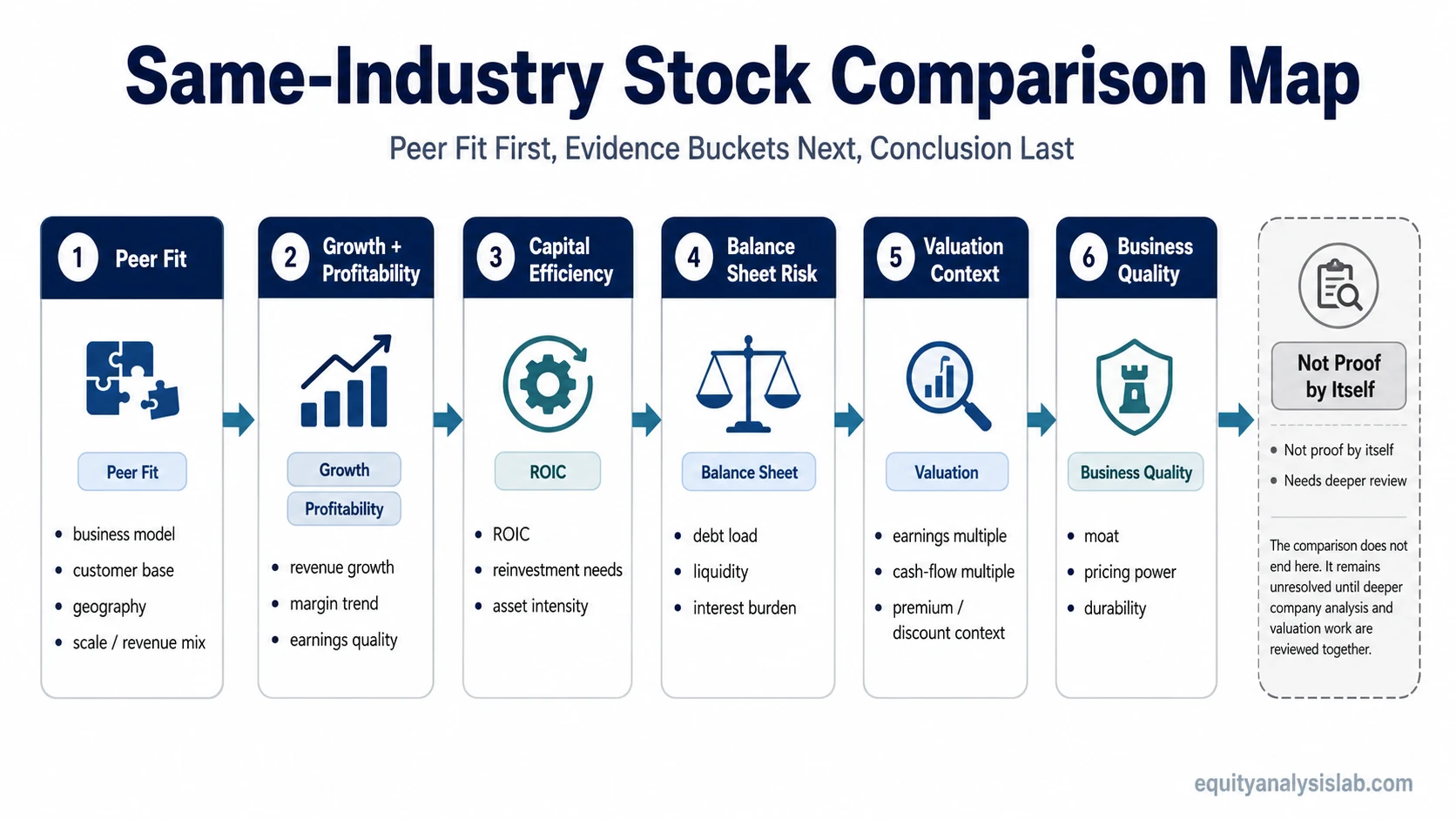
Start With a Comparable Peer Group
Companies can share an industry label and still have different economics. Business model, customer mix, geography, scale, and capital structure can change the meaning of every metric that follows.
| Peer-fit check | What to compare | Why it matters |
|---|---|---|
| Business model | Revenue model, products, recurring vs transactional demand, and reinvestment needs | Different models can produce structurally different margins, growth rates, and capital requirements. |
| Sub-industry | Economic role inside the broader sector | A broad sector can contain businesses with little direct operating comparability. |
| Customer base | Consumer, enterprise, government, wholesale, or channel exposure | Demand stability, pricing power, and customer concentration can differ substantially. |
| Geography | Revenue exposure, currencies, regulation, taxation, and market maturity | Geographic differences can affect both reported results and valuation. |
| Scale and revenue mix | Company size, diversification, product concentration, and operating leverage | Scale can change margins, bargaining power, resilience, and reinvestment economics. |
Normalize the Metrics Before Ranking the Companies
Peer data can look precise while measuring different things. Periods, accounting choices, forecast assumptions, and denominator definitions should be aligned before differences are treated as business evidence.
| Metric | Normalize | Why the adjustment matters |
|---|---|---|
| Revenue growth | Reporting period, organic vs acquired growth, and major currency effects | Reported growth may reflect acquisitions or foreign exchange rather than stronger underlying demand. |
| Margins | Margin level and GAAP vs adjusted basis | Gross margin, operating margin, and adjusted EBITDA margin answer different questions. |
| ROIC | Cash, goodwill, leases, and invested-capital definitions | Different denominator choices can materially alter the apparent capital efficiency. |
| Leverage | Gross vs net debt and treatment of lease liabilities | A methodology difference can look like a balance-sheet advantage. |
| P/E | Forward vs trailing earnings and treatment of unusual items | Forecast-based and historical multiples should not be ranked as if they use the same earnings base. |
| EV/EBITDA | Enterprise-value inputs and EBITDA adjustments | Lease treatment, adjusted EBITDA policies, and capital intensity can change the comparison. |
| Free cash flow | Capital spending and other cash-flow adjustments | Similar cash-flow yields can hide different reinvestment requirements. |
Compare the Evidence in a Consistent Order
Compare revenue growth, earnings growth, market-share changes, and the durability of demand. Faster growth can support a premium only if the underlying economics remain sound.
Review margin levels and direction. gross margin can help show differences in product economics, pricing power, mix, and cost structure.
Compare reinvestment requirements and return on invested capital using a consistent calculation basis. Growth that requires much more capital may deserve a different interpretation.
Compare debt, liquidity, interest burden, maturities, and cash reserves. A peer discount may partly reflect greater balance-sheet risk.
Use earnings multiple context together with growth, margins, capital returns, leverage, and business durability. The multiple shows the pricing difference; the operating evidence helps explain it.
Check whether an economic moat, customer retention, switching costs, cost advantages, or other competitive factors help explain persistent differences between the peers.
Example: Explaining a Valuation Premium
Consider two companies with similar customers and business models:
| Metric | Company A | Company B |
|---|---|---|
| Revenue growth | 16% | 8% |
| Operating margin | 18% | 22% |
| ROIC | 20% | 12% |
| Net debt / EBITDA | 0.5x | 2.0x |
| P/E | 30x | 21x |
Valuation premium = (30 / 21 – 1) × 100 ≈ 43%
Company A grows faster, earns a higher return on invested capital, and carries less leverage. Company B has the stronger operating margin. Those differences provide possible reasons for the premium, but they do not establish whether 30x earnings is attractive.
The remaining research question is whether Company A’s operating advantages are durable enough to support the valuation gap.
Screening Can Narrow the Peer Set
A screening filter workflow can narrow a large universe by industry, size, profitability, leverage, growth, or valuation.
Once the shortlist is defined, the comparison tests whether differences in operating quality, capital efficiency, financial risk, and business durability explain the valuation gap.
Where Peer Comparisons Fail
Companies share a broad industry label but have different business models, customers, geographies, or capital structures.
Forward and trailing multiples, GAAP and adjusted margins, or different ROIC definitions are ranked as if they were directly comparable.
The cheapest multiple, fastest growth rate, or highest margin is treated as the conclusion while other material differences are ignored.
Rebuild the peer set or normalize the evidence before deciding whether the premium or discount reflects a real economic difference.
Limits of Peer Comparison
A cheaper peer may deserve its discount because growth, profitability, capital efficiency, financial strength, or business durability is weaker. A premium-priced company may have stronger economics while still embedding assumptions that are difficult to justify. Peer analysis should identify the differences that need deeper company-specific research rather than turn the peer ranking into an investment decision.