
Portfolio basics are the starting concepts that explain how holdings, weights, diversification, concentration, drawdown, position sizing, and rebalancing shape total portfolio exposure. They do not tell every investor which portfolio to own. They help organize the questions that determine what the portfolio actually depends on.
A portfolio can contain many positions and still behave as if it depends on only a few exposures. The useful starting point is to separate what the portfolio owns, how much each holding matters, where overlap may exist, how losses are measured, and when weights may need review.
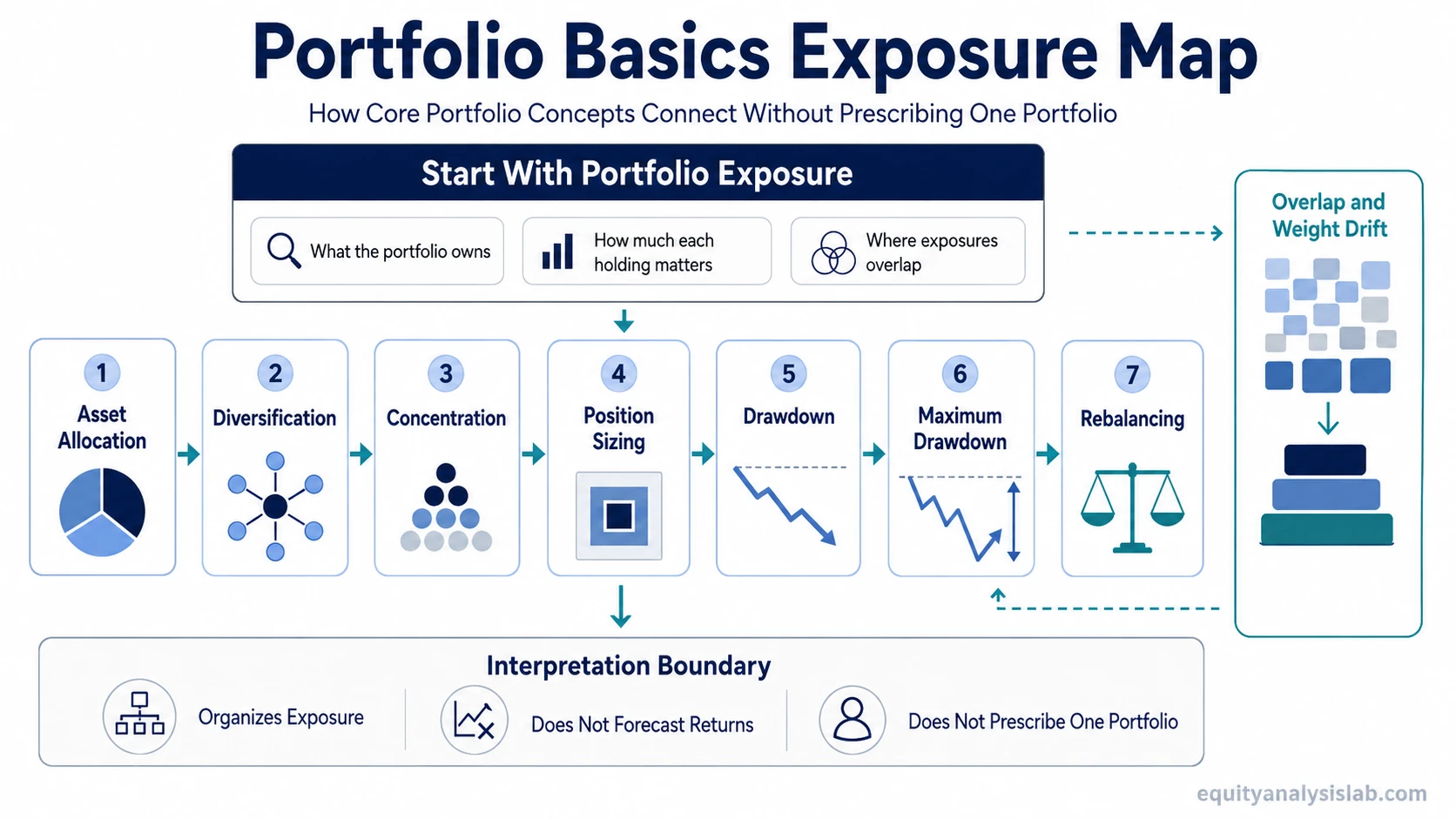
Portfolio Basics Learning Path
The first step is to understand the concepts that control exposure before moving into more specific portfolio frameworks. Each concept below answers a different portfolio-construction question.
| Learning area | What it helps clarify | Concept to study next |
|---|---|---|
| Asset allocation | How broad portfolio exposure is divided across asset classes, categories, or investment sleeves. | asset allocation |
| Diversification | Whether exposure is spread across different sources of risk instead of depending on one narrow area. | portfolio diversification |
| Concentration | Which holdings, sectors, factors, or themes can dominate portfolio behavior. | concentration |
| Position sizing | How much one holding can affect the portfolio if its value changes sharply. | position size |
| Drawdown | How portfolio declines are described from a prior high. | drawdown |
| Maximum drawdown | How the deepest peak-to-trough decline is measured over a period. | maximum drawdown |
| Rebalancing | How portfolio weights are reviewed when they drift away from the intended structure. | rebalancing |
What Portfolio Basics Includes
Portfolio basics begin with allocation because broad exposure often matters before individual security selection. Allocation shows whether the portfolio mainly depends on stocks, bonds, cash, sectors, regions, factors, or another exposure mix.
Diversification then asks whether those exposures are genuinely different. A portfolio with many holdings may still rely on the same sector, index, factor, currency, or economic sensitivity.
Concentration identifies what can dominate results. A single large holding, a narrow industry group, or repeated exposure across several funds can make the portfolio less balanced than the position count suggests.
Position sizing connects each holding to total portfolio impact. A strong idea can still create an oversized risk if the position is large enough to dominate the portfolio’s decline or recovery.
Drawdown and maximum drawdown describe portfolio decline from prior highs. They do not forecast future losses, but they help investors understand how much value has been lost during a measured period.
Rebalancing belongs after exposure is understood. It is a review discipline for weight drift, not a promise of higher return or lower risk.
What Portfolio Basics Does Not Decide
Portfolio basics do not identify one correct portfolio for every investor. They do not forecast returns, remove the possibility of loss, replace personal financial planning, or prove that a particular allocation is suitable.
The concepts are useful because they make portfolio exposure visible. They do not decide the investor’s objectives, risk capacity, tax situation, liquidity needs, time horizon, or personal constraints.
They also do not turn diversification into a safety guarantee. Diversification can reduce dependence on one exposure, but losses can still occur when many holdings are affected by the same market, sector, factor, or liquidity condition.
Why Weights and Overlap Matter
The number of holdings can be misleading. Ten holdings may be more concentrated than they look if several depend on the same business cycle, interest-rate sensitivity, sector trend, or index exposure.
Overlap can hide concentration. A portfolio can look diversified because it contains many holdings, but still behave like a concentrated portfolio if those holdings overlap, depend on the same sector or factor, or if one position is large enough to dominate results.
This is why portfolio basics should be read as an exposure map, not as a list of terms. The practical question is not only “how many investments are owned?” It is also “what exposures actually drive the portfolio?”
A second issue is weight drift. A holding that grows faster than the rest of the portfolio can become a larger driver of future results even if it was originally sized modestly.
A Practical Order for Learning Portfolio Basics
Start with allocation and diversification because they define the broad exposure map. These concepts show what the portfolio owns and whether the exposure is meaningfully spread.
Next, study concentration and overlap. This step helps identify whether several holdings are repeating the same exposure or whether one position has become large enough to dominate portfolio behavior.
After that, use drawdown and maximum drawdown to understand how declines are measured. These concepts help separate normal portfolio movement from deeper loss periods without turning the measure into a prediction.
Position sizing and rebalancing come after the exposure map is clearer. Position sizing shows how much each holding can matter, while rebalancing focuses on how portfolio weights are reviewed when they drift.
Related Portfolio Basics Topics
The next topics help separate portfolio structure, weighting method, concentration, and review discipline without suggesting one model allocation for every investor.
| Topic | When it becomes useful |
|---|---|
| Concentrated vs diversified portfolio | When the main question is whether fewer holdings or broader exposure better describes the portfolio’s structure. |
| Equal weight vs market cap weight | When the weighting method changes which companies or sectors influence the portfolio most. |
| Core satellite portfolio | When the portfolio separates broad base exposure from smaller, more targeted positions. |
| Concentrated stock portfolio construction framework | When the investor needs a stricter framework for managing fewer, higher-impact holdings. |
| How many stocks should you own? | When the question is about position count, diversification limits, and practical portfolio complexity. |
| How often to rebalance your portfolio | When the question is about review discipline after weights have moved away from the intended structure. |
Portfolio Basics FAQ
What are portfolio basics?
Portfolio basics are the starting concepts that explain how holdings, weights, allocation, diversification, concentration, drawdown, position sizing, and rebalancing shape total portfolio exposure.
Does diversification guarantee that a portfolio is safe?
No. Diversification can reduce dependence on one exposure, but it does not guarantee protection from losses. Holdings can still overlap or decline together under the same market conditions.
Why does position size matter in a portfolio?
Position size matters because it determines how much one holding can affect the total portfolio. A small holding and a large holding can have very different effects even if the investment idea is the same.
Is rebalancing a return strategy?
Rebalancing is better understood as a weight-review discipline. It can restore intended portfolio weights, but it should not be treated as a guaranteed way to improve returns.