
Behavioral biases are recurring decision errors that can affect how an investor filters evidence, reacts to uncertainty, anchors to old reference points, follows crowds, or avoids uncomfortable choices.
The useful starting point is not to label the investor. It is to identify the decision problem first. If the problem is selective evidence, begin with evidence-filtering biases. If the problem is regret, loss, or discomfort, begin with emotional-pressure biases. If the problem is a fixed price, past forecast, or original thesis, begin with reference-point biases.
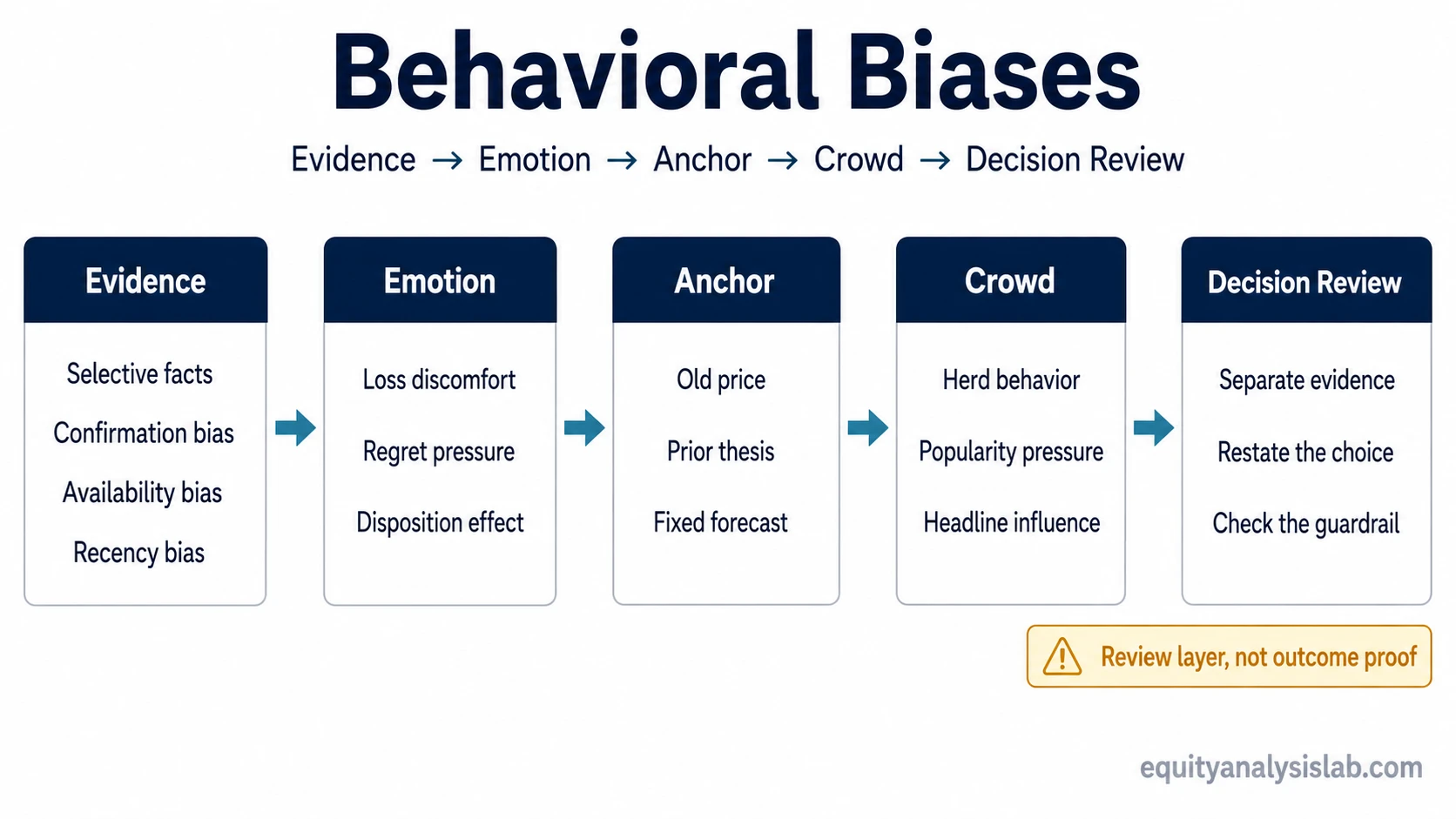
What Behavioral Biases Change in Investor Decisions
Behavioral biases can change the review process before the final investment decision is made. They can affect which facts receive attention, how risk feels, how much weight is given to recent information, and whether a holding is judged as a fresh decision or as something already owned.
Core boundary: behavioral biases are decision-review risks, not proof that an investor is irrational and not proof that a specific investment decision is correct or incorrect.
For investing purposes, the main value is classification. A bias label should help identify where the checklist may be weak: evidence collection, emotional pressure, reference-point dependence, ownership attachment, crowd pressure, or framing of the decision.
Start With the Bias Type That Matches the Decision Problem
The fastest path is to match the observable decision problem to the bias family that can distort it. Each category below points to a different review guardrail before the detailed bias check begins.
| Decision problem | Bias category | Relevant bias types | Review guardrail |
|---|---|---|---|
| Evidence is being selected to support an existing view. | Evidence filtering | Confirmation bias, availability bias, and recency bias | Separate supporting evidence from contradictory evidence before updating the thesis. |
| A price, forecast, prior opinion, or original thesis is carrying too much weight. | Reference-point error | Anchoring bias and hindsight bias in investing | Separate the old reference point from the current evidence set. |
| Loss, regret, or fear of being wrong is driving the review. | Emotional pressure | Loss aversion and the disposition effect | Check whether the decision is based on evidence or on discomfort with realizing a loss. |
| Ownership makes the current holding feel more valuable than an outside alternative. | Ownership attachment | The endowment effect and status quo bias in investing | Compare the current holding with the decision that would be made from a clean starting point. |
| Popularity, headlines, or peer behavior is replacing independent review. | Social pressure | Herd behavior | Identify whether evidence or crowd agreement is carrying the argument. |
| The same fact looks different depending on wording, category, or account bucket. | Framing and classification | Framing bias, mental accounting, and representativeness bias | Restate the decision in neutral terms before comparing the alternatives. |
| The investor needs the broader discipline before reviewing individual biases. | Field overview | Behavioral finance concepts | Use the field overview to understand the framework, then return to the specific bias. |
Priority Behavioral Biases for Investor Review
Not every bias belongs in every investment review. The strongest starting point is usually the bias that matches the observable decision weakness.
Evidence-filtering review: if the investor is collecting only facts that support the existing thesis, begin with confirmation bias. If the investor is overweighting the most visible or memorable information, availability bias may be the better starting point. If the latest news has displaced the longer evidence record, recency bias becomes more relevant.
Reference-point review: if the decision is still organized around the purchase price, a past valuation, or an old forecast, anchoring bias should be reviewed before the current evidence is judged.
Emotional-pressure review: if the decision is shaped by regret, loss avoidance, or discomfort with being wrong, loss aversion and the disposition effect can help identify whether emotion is changing the process.
Social-pressure review: if the thesis is becoming stronger mainly because other investors agree with it, herd behavior should be separated from the independent evidence.
Bias Review Is Not a Portfolio Decision
Behavioral-bias review can improve the quality of the decision process, but it cannot select the correct portfolio, prove suitability, forecast returns, or decide whether a security should be bought, sold, or held. A bias check asks whether the process is distorted before the investment evidence is reviewed.
Important limitation: identifying a possible bias does not automatically mean the opposite decision is correct. A stock may be unattractive for fundamental reasons even if the investor also feels loss aversion. A popular investment may still have strong evidence even if herd behavior is present. The bias label is a review prompt, not a verdict.
How to Use Behavioral Bias Categories
A practical bias review begins with the decision under review, not with a long list of bias names. The investor can ask what part of the process is most likely to be distorted.
| Review question | What it tests | Bias family |
|---|---|---|
| Am I giving equal attention to evidence against the thesis? | Selective evidence use | Evidence filtering |
| Would I make the same decision if I did not already own the position? | Ownership attachment | Endowment and status quo effects |
| Is the purchase price still acting as the main reference point? | Old anchor dependence | Anchoring |
| Am I avoiding the decision because realizing a loss feels uncomfortable? | Loss and regret pressure | Loss aversion and disposition effect |
| Is popularity replacing independent review? | Social validation pressure | Herd behavior |
| Would the decision look different if the same facts were framed another way? | Wording or category dependence | Framing and mental accounting |
Common Mistake: Treating Bias Labels as Diagnosis
The bias label should not become a personality judgment or a diagnosis. In an investing workflow, the safer use is narrower: identify the part of the decision process that needs review.
For example, an investor who refuses to sell a position below purchase price may be affected by loss aversion, but the correct review is not to assume the investor is wrong. The review is to ask whether the current thesis still works after the purchase price is removed from the decision frame.
Example: Separating Bias From Investment Evidence
An investor owns a company after a sharp decline. The original thesis was based on revenue growth, but margins have weakened and the balance sheet has become more stretched. If the investor focuses only on old bullish evidence, confirmation bias may be relevant. If the investor refuses to reconsider because the position is below the purchase price, loss aversion or the disposition effect may become relevant as a second review layer.
The scenario does not prove what the investor should do. It only shows how the decision problem can be separated into review areas before the investment case is judged on its current evidence.
FAQ
What are behavioral biases in investing?
Behavioral biases in investing are recurring decision errors that can affect evidence review, emotional response, reference points, ownership judgment, and crowd influence. They are review lenses, not proof that a specific investment decision is right or wrong.
Are behavioral biases the same as behavioral finance?
No. Behavioral finance is the broader field that studies how psychology can affect financial decisions. Behavioral biases are specific patterns inside that broader field.
Can identifying a behavioral bias prove the correct portfolio decision?
No. Identifying a bias can improve the review process, but it does not prove suitability, allocation quality, future return, or whether an investment should be bought, sold, or held.
Use Bias Review as a Decision Guardrail
Behavioral-bias review is most useful when it turns a vague concern into a specific checklist question. Is the evidence balanced? Is the old reference point still relevant? Is emotion changing the interpretation? Is ownership making the holding look different from a fresh alternative?
Once the decision problem is identified, the next step is to review the specific bias that matches it. The bias label should narrow the question, not replace the investment analysis.