
Cash flow yield compares a defined cash-flow measure with a defined value measure. The term can refer to different formulas, so the numerator and denominator should be stated before the percentage is interpreted.
As a valuation lens, cash flow yield translates cash generation into a percentage of value. A higher percentage can make a company look less expensive, but the ratio can also reflect temporary cash flow, leverage, cyclicality, falling valuation, or underinvestment. The useful question is whether the selected cash-flow measure is sustainable and whether the value base represents the same economic claim.
Key Points
- Cash flow yield is not always calculated from one standardized numerator and denominator.
- Operating cash flow, FCFE, FCFF, and normalized cash flow describe different cash-flow bases.
- Equity cash flow should normally be compared with equity value, while firm-level cash flow should normally be compared with enterprise value.
- Operating cash flow is not the same as free cash flow because it is measured before capital expenditures.
- A high yield can reflect strong recurring cash generation, but it can also reflect working-capital timing, cyclicality, leverage risk, falling valuation, or underinvestment.
What Cash Flow Yield Means
Cash flow yield measures cash flow relative to a chosen valuation base. The result is usually expressed as a percentage, which allows the analyst to compare cash generation with the price or value assigned to the equity or the business.
The complication is that cash flow yield does not always refer to the same formula. One source may use operating cash flow relative to market capitalization. Another analyst may use free cash flow to equity relative to equity value. A firm-level valuation may instead compare free cash flow to the firm with enterprise value.
Those percentages should not be treated as interchangeable simply because they all carry a cash flow yield label. The cash-flow definition and value denominator determine what economic claim the ratio measures.
Cash Flow Yield Formula
The broad formula is:
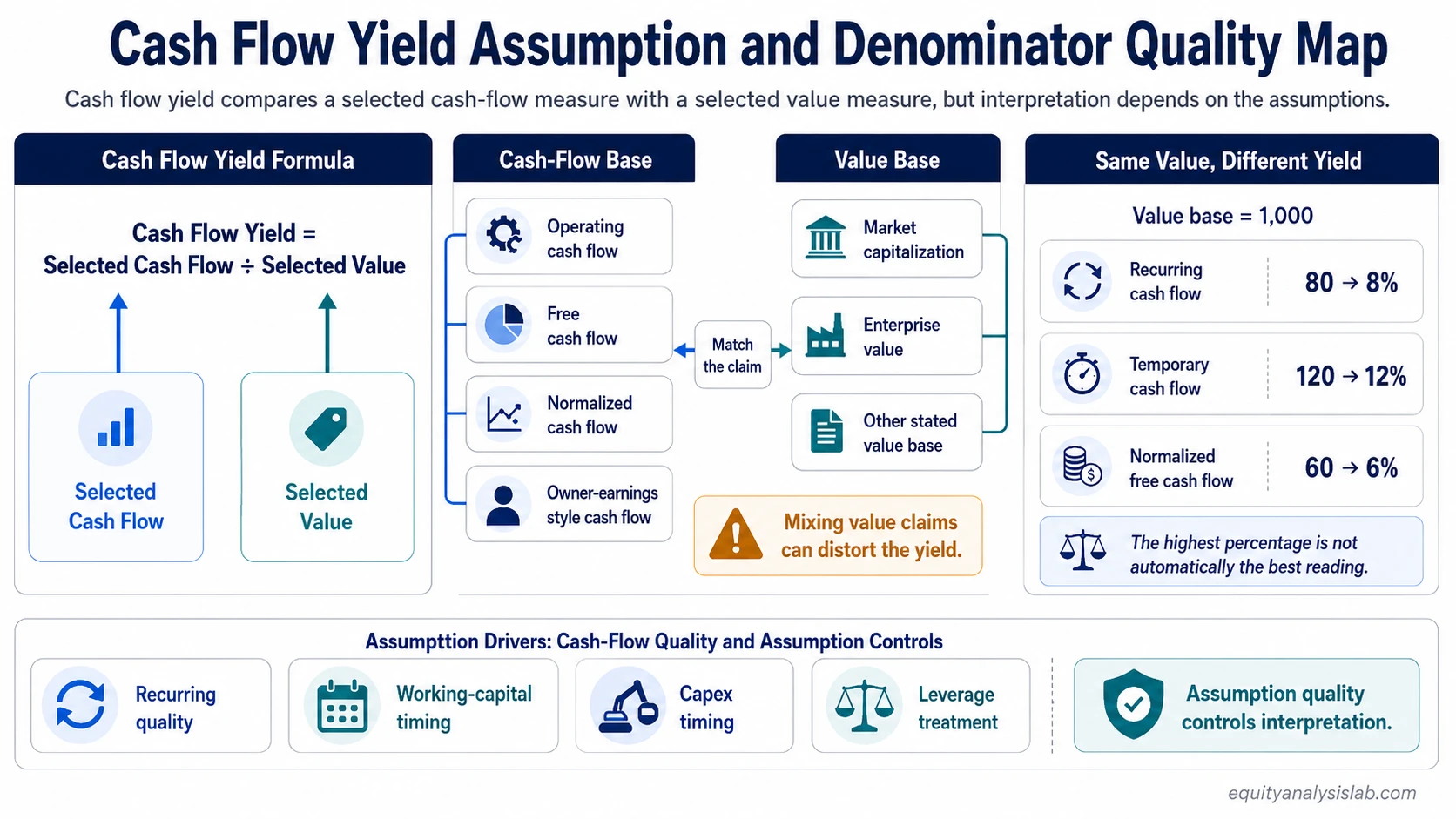
Cash flow yield = selected cash-flow measure / selected value measure
The selected cash-flow measure may be operating cash flow, free cash flow to equity, free cash flow to the firm, normalized cash flow, or another clearly defined measure. The denominator may be market capitalization, equity value, enterprise value, or another explicitly stated valuation base.
The formula becomes meaningful only after both sides are defined. A percentage calculated from operating cash flow and market capitalization is not economically identical to FCFE divided by equity value or FCFF divided by enterprise value.
Cash Flow Yield Is Not a Standardized Formula
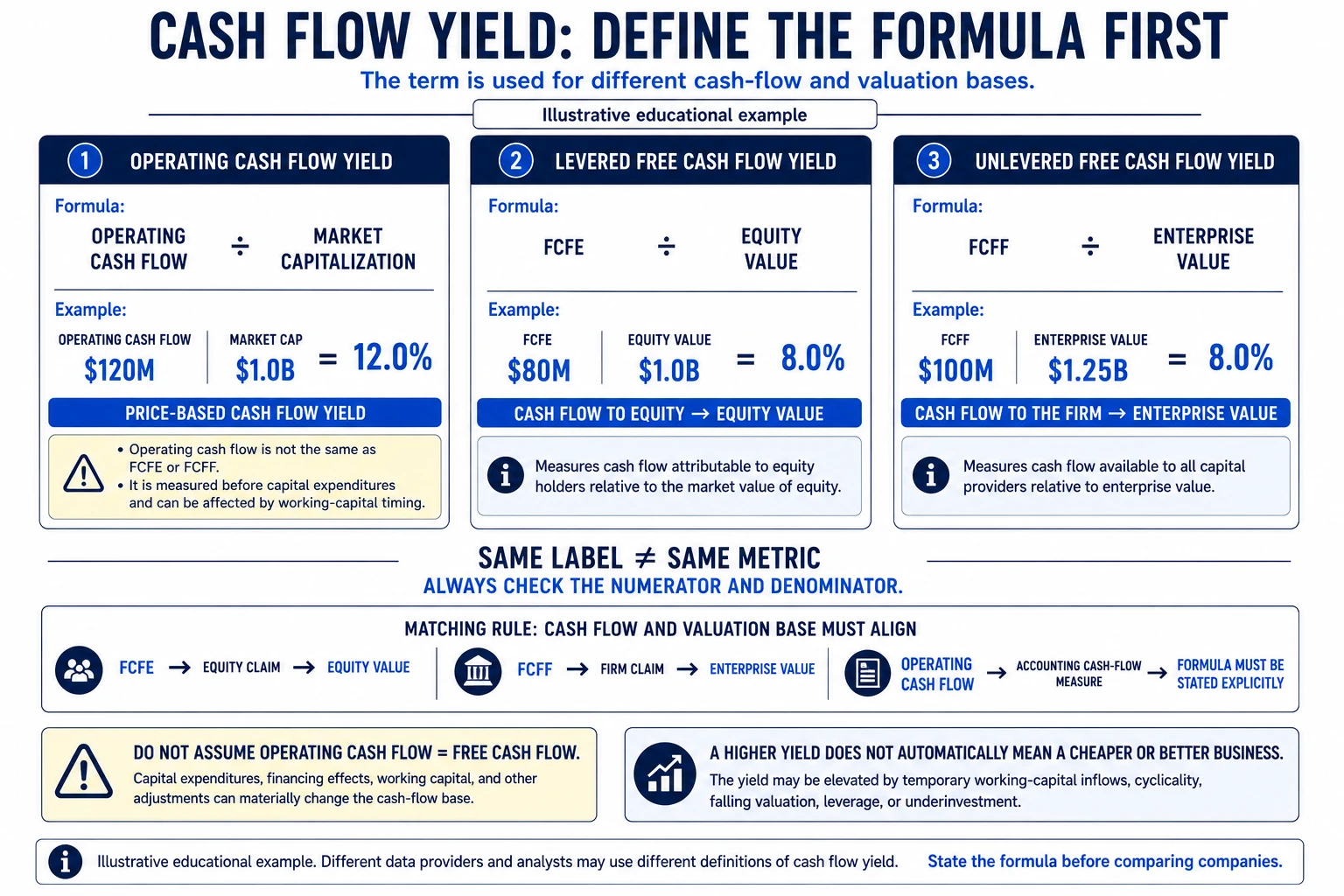
Three constructions illustrate why the definition matters.
| Cash-Flow Yield Version | Numerator | Denominator | Economic Reading |
|---|---|---|---|
| Operating cash flow yield | Operating cash flow | Market capitalization or another stated price base | A price-based comparison using accounting operating cash flow. |
| Levered free cash flow yield | FCFE | Equity value | Cash flow attributable to equity holders relative to the value of equity. |
| Unlevered free cash flow yield | FCFF | Enterprise value | Cash flow available to all capital providers relative to the value of the firm. |
Operating cash flow requires special care because it is an accounting cash-flow measure before capital expenditures. It should not be relabeled automatically as FCFE or FCFF. Capital expenditures, financing effects, working-capital movements, taxes, and other adjustments can materially change the economic cash-flow base.
Matching rule: FCFE belongs to an equity claim and normally pairs with equity value. FCFF belongs to the whole firm and normally pairs with enterprise value. If operating cash flow is used, the exact formula and denominator should be stated explicitly.
Why the Cash-Flow Base Matters
The numerator controls much of the interpretation. Operating cash flow can include working-capital movements that may not repeat. Free cash flow includes capital expenditures, but capex can be temporarily high, temporarily low, or deferred. Normalized cash flow can smooth unusual timing, but normalization introduces analyst judgment.
A strong yield from recurring cash generation is different from a strong yield caused by delayed supplier payments, inventory reduction, temporarily low capex, or another short-term cash inflow. The percentage may look similar while the economics are very different.
| Input | What It Controls | Common Distortion | Interpretation Question |
|---|---|---|---|
| Operating cash flow | Cash generated before capital expenditures | Working-capital timing can temporarily lift or reduce it | Is the cash flow recurring or mostly timing-driven? |
| FCFE | Cash flow available to equity holders | Debt issuance, repayment, and leverage changes can affect the reading | Does the numerator represent the same equity claim as the denominator? |
| FCFF | Cash flow available to debt and equity capital providers | Operating assumptions, taxes, reinvestment, and normalization can change the result | Does the denominator represent the value of the whole firm? |
| Normalized cash flow | A smoothed estimate of cash generation | Normalization can hide deterioration if assumptions are too generous | Which adjustments were made, and are they defensible? |
| Market capitalization or equity value | The market value of equity | Can create a claim mismatch if paired with firm-level cash flow | Does the numerator belong to equity holders? |
| Enterprise value | The value of the operating business across capital providers | Debt, cash, leases, minority interests, and other adjustments can affect comparability | Does the numerator represent firm-level cash flow? |
How Different Cash-Flow Assumptions Change the Yield
Even when the denominator stays unchanged, different cash-flow assumptions can produce very different yield readings.
| Value Base | Cash-Flow Assumption | Cash Flow Used | Cash Flow Yield | What the Reading May Miss |
|---|---|---|---|---|
| 1,000 | Recurring operating cash flow | 80 | 8.0% | Still needs capex and claim-matching context |
| 1,000 | Temporarily boosted operating cash flow | 120 | 12.0% | A working-capital release may not repeat |
| 1,000 | Normalized free cash flow | 60 | 6.0% | Normalization may depend heavily on capex and other adjustments |
The highest percentage is not automatically the strongest valuation signal. A 12% yield produced by temporary working-capital inflow can be weaker evidence than an 8% yield supported by recurring cash generation.
The analyst therefore needs to understand why the numerator changed before treating a higher cash flow yield as evidence of a cheaper business.
Cash Flow Yield vs Free Cash Flow Yield and Earnings Yield
Cash flow yield, free cash flow yield, and earnings yield are related, but they answer different valuation questions. Cash flow and earnings can diverge because depreciation, capital expenditures, working capital, stock-based compensation, taxes, financing, or one-time items affect the measures differently.
| Metric | Main Base | Best Used For | Main Caution |
|---|---|---|---|
| Cash flow yield | Selected cash-flow measure | Broad cash-generation comparison after the formula is defined | The numerator and denominator can vary across analysts and data providers |
| Free cash flow yield | Defined free cash flow measure | Comparing valuation with cash remaining after relevant reinvestment needs | FCFE and FCFF should not be treated as the same cash-flow claim |
| Earnings yield | Earnings, often EPS or net income | Comparing accounting earnings with price or market value | Earnings may not convert into cash, and accounting items can affect comparability |
When Cash Flow Yield Can Mislead
A high cash flow yield can reflect strong recurring cash generation, but it can also appear because the valuation denominator has fallen, cash flow is temporarily elevated, the company is near a cyclical peak, leverage has increased, or necessary investment has been delayed.
Working capital is a common source of distortion. A company can generate a temporary inflow by reducing inventory, collecting receivables faster, or extending supplier payments. That cash is real, but the same benefit may not repeat in future periods.
Capital expenditures create another problem. Operating cash flow is measured before capex, while free cash flow attempts to account for reinvestment. A company with heavy asset requirements can therefore look much stronger on an operating-cash-flow yield than on a free-cash-flow basis.
A low yield can also have several explanations. It may reflect weak cash generation, heavy reinvestment, a high valuation, or expectations of stronger future cash flow. The ratio frames the valuation question; it does not resolve the entire investment case.
How to Use Cash Flow Yield in Valuation
Start by writing the formula explicitly. State the numerator, state the denominator, and identify whether the ratio measures an equity claim, a firm-level claim, or a price-based accounting cash-flow measure.
Next, examine the numerator. Check working-capital changes, capital expenditures, financing effects, taxes, cyclicality, and any normalization adjustments that materially affect the cash-flow figure.
Then review the denominator. Market capitalization and equity value describe the equity claim, while enterprise value is designed to capture the operating business across capital providers. A mismatch between the cash flow and value base can make comparisons misleading.
For peer analysis, cash flow yield is more useful when the same formula is applied consistently across companies with reasonably comparable capital intensity, accounting treatment, leverage, tax profiles, and reinvestment needs.
A practical review can therefore be reduced to four questions: What cash flow is being used? What value base is being used? Do the economic claims match? Is the cash flow sustainable?