
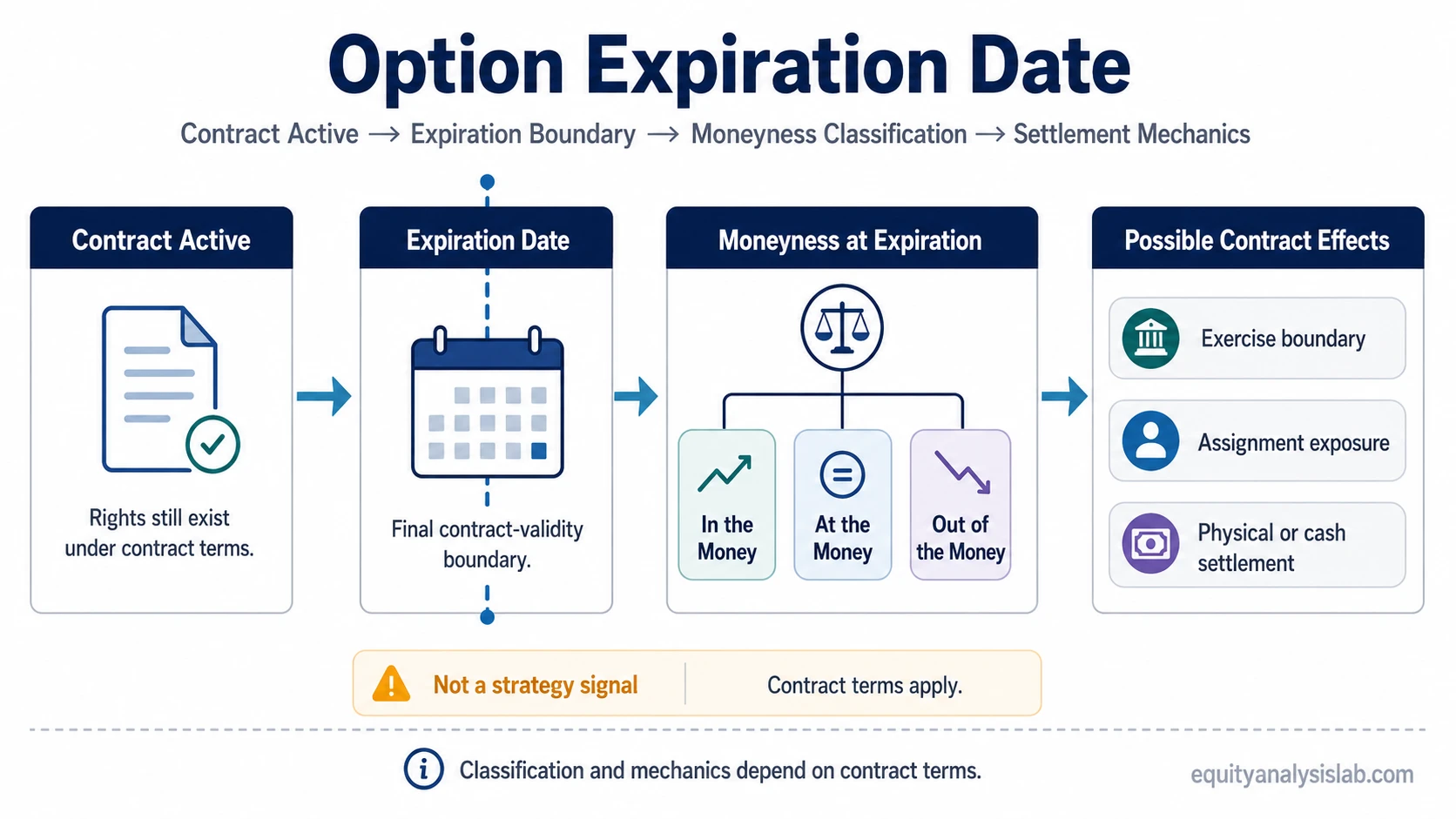
An option expiration date is the contract deadline after which the option no longer carries exercisable rights. The date affects remaining time value, moneyness at expiration, exercise and assignment boundaries, and whether settlement can occur.
Definition: An option expiration date is the final date or time boundary attached to an options contract. Before that boundary, the contract may still have exercisable rights under its terms. After that boundary, the option no longer exists as an active right, and any remaining contract outcome depends on moneyness, exercise style, and settlement terms.
For an investor, expiration is not just a calendar label. It is the point where time value becomes limited, intrinsic value becomes central, and the contract’s rights and obligations move toward their final state.
Key Points
- The expiration date marks the contract-validity boundary for an option.
- As expiration approaches, remaining extrinsic value usually becomes more time-sensitive, but premium can still move unevenly.
- Moneyness at expiration determines whether the option is in the money, at the money, or out of the money.
- Exercise, assignment, and settlement become more relevant near the contract deadline.
- The expiration date does not determine investment quality, future volatility, or the full risk profile by itself.
What an Option Expiration Date Means
The expiration date belongs to the contract terms of an option. It defines how long the contract can remain valid and when the holder’s rights stop existing. A stock option, index option, or other listed option may have different terms, but the same core idea applies: the option is time-limited.
The buyer of a call option has a right linked to the underlying asset and strike price, but that right is not open-ended. The expiration date limits the time available for the contract to have practical value.
Expiration dates also appear in option chains and expiration calendars. Those references help identify available contract dates, but the concept itself is broader than a calendar lookup. The date acts as a contract boundary for value, rights, obligations, and settlement.
What the Expiration Date Controls vs What It Does Not Control
The expiration date controls several contract mechanics, but it should not be treated as a full explanation of risk or outcome. A useful distinction is to separate contract boundaries from investor interpretation.
| What the expiration date controls | What it does not control by itself |
|---|---|
| The final contract-validity boundary | Whether the original investment decision was good |
| The amount of remaining time value available to the contract | Future volatility without price, liquidity, and market context |
| The point where exercise and writer obligation can become time-sensitive | Assignment certainty before the relevant contract and exercise conditions are known |
| Payoff classification at expiration through moneyness | The full investor risk profile without premium, position size, liquidity, and contract terms |
| Whether settlement terms may become relevant | Broker-specific outcomes without the actual contract terms and account context |
What Changes as Expiration Approaches
As expiration gets closer, the option has less time for the underlying asset to move in a way that affects the contract’s value. That remaining time component is commonly described as extrinsic value or time value.
Time value often shrinks as expiration approaches, but it does not decay in a perfectly straight line. The premium can still change because the underlying price moves, implied volatility changes, liquidity shifts, or the contract moves closer to or farther from the strike price.
Limitation: Expiration should not be read as a fixed daily premium path. A near-expiration option can still reprice quickly when the underlying asset is close to the strike price or when volatility changes.
That is why expiration affects time sensitivity, but it does not replace the need to understand premium, intrinsic value, extrinsic value, and contract style.
What Happens at Expiration
At expiration, the relationship between the underlying asset price and the strike price becomes central. That relationship determines whether the option is in the money, at the money, or out of the money.
| Expiration classification | Basic meaning | Why it matters |
|---|---|---|
| In the money | The option has intrinsic value based on the strike price and underlying price. | Exercise or settlement mechanics may become relevant depending on contract terms. |
| At the money | The underlying price is very close to the strike price. | Small price changes can materially affect classification near the deadline. |
| Out of the money | The contract may expire without exercisable value, subject to contract terms and applicable exercise or settlement rules. | The option has no intrinsic value at expiration. |
Intrinsic value is the value that comes from the option’s strike relationship at expiration. Extrinsic value is the remaining premium component tied to time, volatility, and uncertainty before expiration. As the deadline arrives, the distinction becomes sharper because there is little or no time left for future movement inside that contract.
Exercise, Assignment, and Settlement
Expiration creates the boundary around when the holder may be able to exercise the option. The exact timing depends on the contract’s exercise style and the rules attached to that contract.
For the writer of an option, the same deadline can make obligation exposure more relevant. If an option is exercised and the writer is selected through assignment, the result is an obligation linked to the contract terms.
Settlement can be physical or cash-based, depending on the option. Physical settlement generally involves delivery or receipt of the underlying asset under the contract terms. Cash settlement generally resolves the contract through a cash amount rather than delivery of the underlying asset.
Mechanics note: Expiration, exercise, assignment, and settlement are connected, but they are not the same concept. Expiration defines the time boundary; exercise concerns the holder’s right; assignment concerns the writer’s obligation; settlement concerns how the contract is resolved.
American vs European Exercise Style
Exercise style affects when exercise may be possible. An American-style option can generally be exercised before expiration, while a European-style option can generally be exercised only at expiration. The expiration date still matters in both cases, but the timing path differs.
This distinction should stay separate from strategy selection. Exercise style is a contract feature that changes timing rights and mechanics, not a stand-alone conclusion about whether an option is attractive.
Simple Option Expiration Date Example
A hypothetical call option has a strike price of 50 and expires on a specified contract date. If the underlying asset is at 55 at expiration, the option is in the money because the underlying price is above the strike. If the underlying asset is near 50, the option is at the money. If the underlying asset is at 45, the option is out of the money.
The example is only a classification exercise. It does not answer whether the premium paid was reasonable, whether breakeven was reached, whether liquidity was adequate, or whether the contract suited an investor’s risk process. Those questions require the broader contract framework, including premium, liquidity, risk exposure, and how the option fits into the investor’s process.
What Expiration Date Does Not Tell You
An expiration date does not show whether the option was priced attractively, whether the underlying asset is fundamentally attractive, or whether volatility exposure is suitable. It also does not remove the need to understand premium, liquidity, and position-level risk.
Common mistake: Treating expiration as a minor administrative date can hide important mechanics. Near the deadline, contract value, exercise rights, writer obligation exposure, and settlement terms can become more sensitive to small changes in the underlying price.
When the broader options framework is still unclear, understanding the full contract structure helps connect expiration with strike price, premium, rights, obligations, and payoff behavior.
Related Options Mechanics
Expiration is best understood as the contract deadline that connects several separate mechanics: the holder’s exercise right, the writer’s possible obligation, the option type, and the settlement method. Keeping those mechanics separate prevents the expiration date from being treated as a complete explanation of value, risk, or outcome.
FAQ
What is an option expiration date?
An option expiration date is the contract deadline after which the option no longer carries exercisable rights. It defines how long the option contract remains active.
What happens when an option expires?
At expiration, the option is classified by moneyness. It may be in the money, at the money, or out of the money, and exercise or settlement mechanics may apply depending on contract terms.
Does the expiration date determine the option premium?
The expiration date affects time value, but it does not determine premium by itself. Underlying price movement, volatility, liquidity, strike price, and moneyness can also affect premium.
Why does exercise style matter for expiration?
Exercise style affects when exercise may be possible. American-style options can generally be exercised before expiration, while European-style options are generally exercised only at expiration.