
A call option is an options contract that gives the buyer the right, but not the obligation, to buy an underlying asset at a specified strike price before or at expiration. The seller, also called the writer, takes the corresponding obligation if the option is exercised or assigned.
The contract map comes first: what can be bought, at what price, until what date, for what premium, and who carries the obligation. Payoff is easier to read after those boundaries are clear.
Key points about call options
- A call option gives the buyer a contractual right to buy the underlying asset at the strike price.
- The buyer pays a premium for that right; the seller receives the premium and accepts the assignment obligation.
- A long call has a defined premium cost, but that buyer-side risk boundary does not apply to every call position.
- At expiration, a long call’s intrinsic value depends on whether the underlying price is above the strike price.
- Before expiration, the option’s market value can also change with time value, implied volatility, liquidity, and bid-ask spreads.
What is a call option?
Definition: A call option is a derivative contract that gives its buyer the right to buy an underlying asset at a fixed strike price before or at the option’s expiration, depending on the contract style. The seller is obligated to deliver the underlying asset or settle the contract if assignment occurs under the contract rules.
The call is not the same thing as owning the underlying asset. It is a separate option whose value is connected to the underlying price, the strike price, the remaining time, the premium paid, and market conditions around the option itself.
A call option is also not automatically a strategy recommendation. The same contract type can create very different exposure depending on whether the investor is the buyer or the writer, whether the position is hedged, and how the contract is priced relative to the underlying asset.
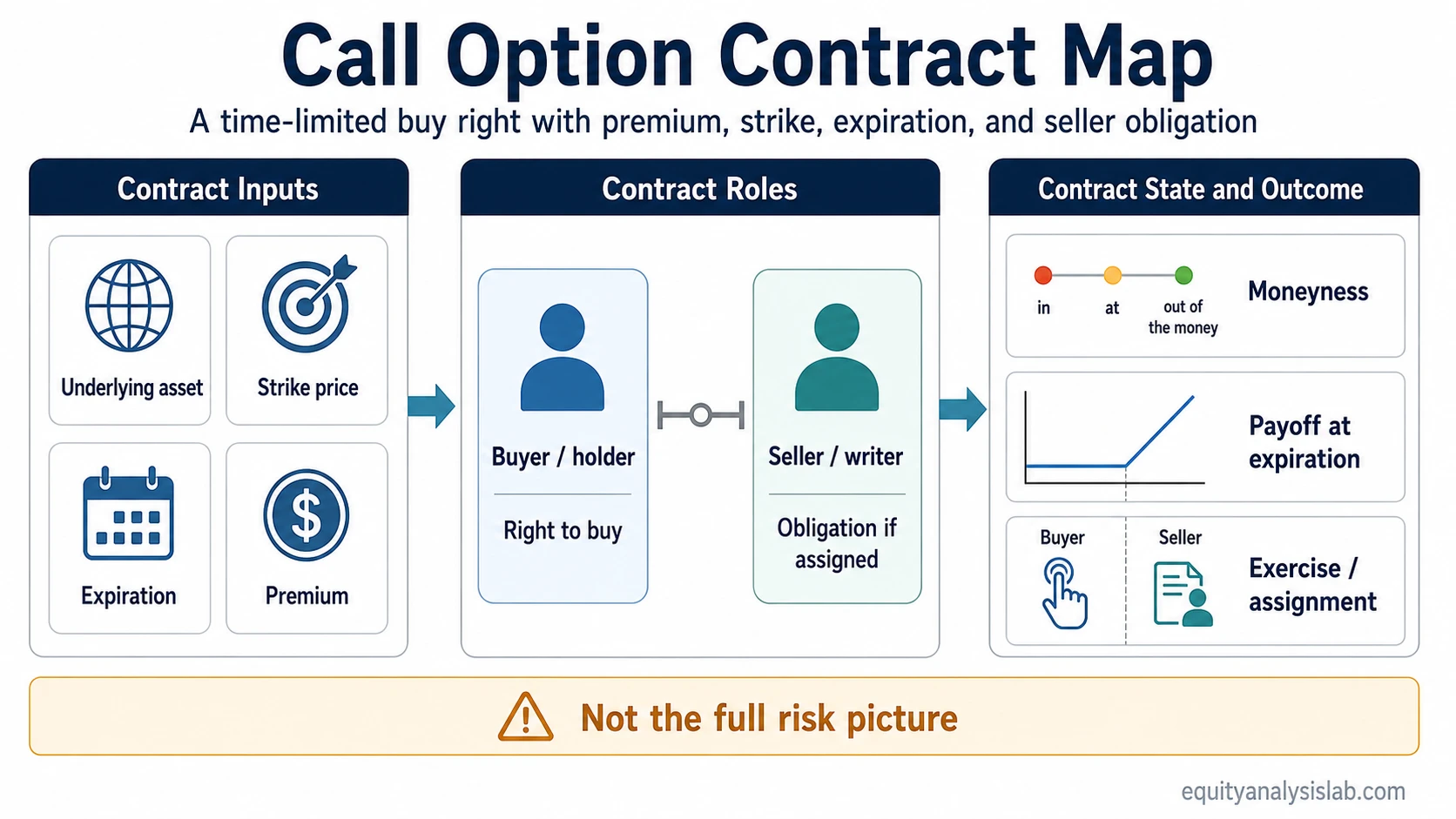
Call option contract terms
A call option should be read as a set of terms before it is read as a payoff shape. Each term defines a boundary: what the buyer controls, what the seller may owe, and when the option stops existing.
| Contract term | What it means | Why it matters |
|---|---|---|
| Buyer / holder | The party that owns the call option. | Has the right to buy under the contract terms, but does not have to use that right. |
| Seller / writer | The party that sells the call option. | Receives the premium and accepts the obligation if assignment occurs. |
| Underlying asset | The stock, ETF, index product, or other asset referenced by the option. | Its price movement affects the option’s intrinsic value and market value. |
| Strike price | The price at which the buyer can buy the underlying asset under the contract. | Sets the price boundary used to measure whether the call has intrinsic value. |
| Expiration | The date after which the option no longer exists. | Creates the time boundary for the buyer’s right and the seller’s obligation. |
| Premium | The market price paid by the buyer and received by the seller. | Defines the buyer’s upfront cost and affects breakeven for a long call at expiration. |
| Exercise | The buyer uses the contractual right to buy under the option terms. | Turns the right into an action under the contract rules. |
| Assignment | The seller is required to fulfill the contract obligation. | Shows why seller exposure is different from buyer exposure. |
This contract-first view keeps the explanation from becoming too simple. A call option is not just a bet on price direction; it is a time-limited right with a premium cost and a matching obligation on the other side.
How call option payoff works
At expiration, a call option has intrinsic value when the underlying asset price is above the strike price. The basic intrinsic value formula for a call is the underlying price minus the strike price, with zero intrinsic value if the underlying price is at or below the strike.
| Expiration condition | Intrinsic value for a call | Basic interpretation |
|---|---|---|
| Underlying price above strike | Positive intrinsic value | The call gives the buyer a right to buy below the market price. |
| Underlying price equal to strike | No intrinsic value | The contract is at the strike boundary before premium is considered. |
| Underlying price below strike | No intrinsic value | The right to buy at the strike is not economically useful at expiration. |
For a long call held to expiration, breakeven is usually described as strike price plus premium paid. That breakeven formula is a simplified expiration calculation. It does not describe every possible mark-to-market change before expiration.
Illustrative example: Suppose a call has a strike price of 50 and the buyer pays a premium of 4. At expiration, the simplified long-call breakeven is 54. If the underlying is below 50, the call has no intrinsic value. If the underlying is 56, the call has 6 of intrinsic value, but the buyer’s simplified net result must still account for the 4 premium paid. This example is only a contract illustration, not a recommendation to buy or sell an option.
The payoff line can look clean at expiration, but the actual contract experience before expiration can be less clean because the option’s market price may change with time value, implied volatility, and liquidity.
Long call vs short call
The words “call option” do not describe one risk profile by themselves. The buyer of a call and the seller of a call sit on opposite sides of the same contract.
| Position | Contract role | Primary exposure | Risk boundary |
|---|---|---|---|
| Long call | Buyer / holder | Owns the right to buy at the strike price. | The buyer’s maximum loss is generally the premium paid, if the position is only a long call and is held without other linked positions. |
| Short call | Seller / writer | Has the obligation if assigned. | The seller’s risk depends on whether the call is covered, uncovered, offset, or part of another structure. |
This distinction prevents a common overgeneralization. Saying “a call has limited risk” is only accurate for the buyer of a standalone long call. It is not a universal statement about every call option position.
Moneyness and contract state
Moneyness describes where the underlying price sits relative to the strike price. For a call option, the contract is in the money when the underlying price is above the strike, at the money when the price is near the strike, and out of the money when the underlying price is below the strike.
| Call option state | Relationship to strike | Meaning at a high level |
|---|---|---|
| In the money | Underlying price is above the strike price. | The call has intrinsic value. |
| At the money | Underlying price is near the strike price. | The contract is near its price boundary. |
| Out of the money | Underlying price is below the strike price. | The call has no intrinsic value at that moment. |
Moneyness is a contract-state label, not a complete judgment about whether an option position is attractive, correctly priced, or suitable.
Premium, time value, and volatility
The premium is the price of the option contract. For the buyer, it is the cost of obtaining the call right. For the seller, it is the amount received for accepting the contract obligation.
The premium paid for the option is not made only of intrinsic value. Before expiration, a call option may also contain time value, which reflects the remaining possibility that the contract could become more valuable before it expires. Implied volatility can also affect the premium because it changes the market’s pricing of potential future movement.
Contract interpretation note: A call can move in value even when the underlying price has not crossed the strike. Time remaining, implied volatility, bid-ask spread, and market liquidity can all affect the option’s quoted price before expiration.
Option premium connects intrinsic value, time value, volatility, and other pricing inputs beyond the basic call definition.
Exercise, assignment, and expiration
Exercise is the buyer using the call option’s right to buy under the contract terms. Assignment is the matching event for the seller, who must fulfill the contract obligation if assigned under the applicable rules.
Expiration is the final boundary. If the call has no economic use at expiration, it may expire without being exercised. If it has value or is subject to automatic exercise rules, the contract can create exercise and assignment consequences that are separate from simply reading a payoff chart.
An exercise option decision can depend on exercise style, settlement, account treatment, and assignment rules.
Common misunderstanding: payoff shape is not the full risk picture
Limitation: A call option payoff diagram is a simplified expiration view. It does not fully show premium changes before expiration, implied volatility changes, bid-ask spreads, liquidity, early exercise rules, assignment exposure, or the difference between buyer and seller risk.
The buyer’s risk on a standalone long call is generally limited to the premium paid, but that statement should not be transferred to the seller. A short call can have a very different risk profile, especially if the seller does not already hold the underlying exposure or an offsetting position.
Another common mistake is treating “upside exposure” as the whole story. A call can gain value if the underlying rises enough, but the premium, expiration date, and contract liquidity still shape whether the contract behaves as expected before or at expiration.
How options work connects calls, puts, premium, exercise, assignment, and expiration across the full contract map.
Call option vs put option
A call option gives the buyer a right to buy the underlying asset at the strike price. A put option gives the buyer a right to sell the underlying asset at the strike price. The contrast is useful, but the contract exposure still depends on buyer versus seller role, premium, expiration, and assignment rules.
Clean distinction: A call centers on a buy right. A put centers on a sell right. Both are options contracts, both involve premium and expiration, and both create different obligations for the seller.
FAQ
Is a call option the same as buying the stock?
No. Buying a stock gives ownership of the share. Buying a call option gives a contract right to buy the underlying at the strike price before or at expiration, depending on the contract terms.
Can a call option expire worthless?
Yes. If a call has no intrinsic value at expiration, the buyer may lose the premium paid for a standalone long call. That buyer-side result is different from the seller’s obligation and risk profile.
Does a call option always gain value when the underlying rises?
Not always. A rising underlying price can help a call, but the option’s market value can also be affected by time decay, implied volatility, bid-ask spreads, liquidity, and how far the underlying remains from the strike price.
What is the breakeven for a long call at expiration?
In a simplified expiration calculation, the long-call breakeven is the strike price plus the premium paid. This does not describe every possible price change before expiration.