
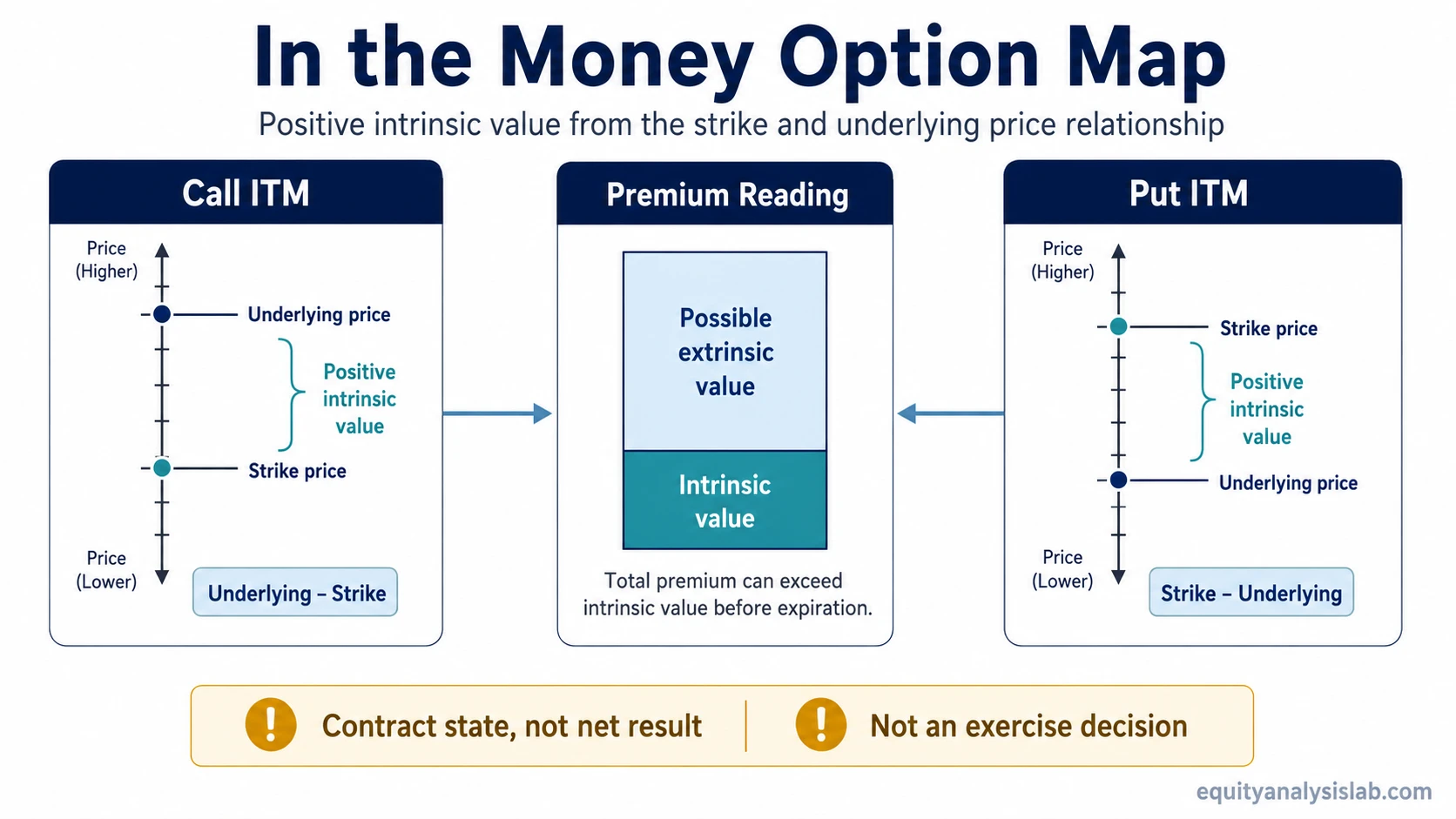
An in-the-money option is an option with positive intrinsic value because the strike price is favorable relative to the current underlying price. A call is in the money when the underlying price is above the strike price; a put is in the money when the underlying price is below the strike price.
Definition: An in-the-money option is a moneyness state where exercising the option would create intrinsic value before considering premium paid, fees, bid-ask spread, or remaining extrinsic value.
ITM status describes the relationship between the option strike and the underlying price. It does not automatically mean the position has a positive net result, is safer than another option, or should be exercised.
Key Points
- An ITM call has a strike price below the current underlying price.
- An ITM put has a strike price above the current underlying price.
- ITM status means positive intrinsic value, not guaranteed net profitability.
- Total option premium can still include extrinsic value before expiration.
What an In-the-Money Option Means
An option is in the money when its strike price gives the holder a favorable exercise relationship compared with the current underlying price. The direction of that relationship depends on whether the contract is a call or a put.
A call option is in the money when the underlying price is above the strike price because the contract right is to buy below the current market price. A put is in the money when the underlying price is below the strike price because the contract right is to sell above the current market price.
| Option state | Condition | Core interpretation |
|---|---|---|
| Call is in the money | Underlying price > strike price | The call has positive intrinsic value. |
| Put is in the money | Underlying price < strike price | The put has positive intrinsic value. |
| At the money | Underlying price is near the strike price | Intrinsic value is usually small or near zero. |
| Out of the money | The strike relationship is unfavorable for exercise value | The option has no intrinsic value at that moment. |
The opposite moneyness state is an out-of-the-money option, where the contract may still trade for a premium before expiration but has no intrinsic value at the current underlying price.
Intrinsic Value and Option Premium
Intrinsic value is the amount by which an option is already favorable based on the current underlying price and strike price. For an ITM call, intrinsic value is the underlying price minus the strike price. For an ITM put, intrinsic value is the strike price minus the underlying price.
| Contract type | Intrinsic value formula | When value is positive |
|---|---|---|
| Call option | Underlying price − strike price | When the underlying price is above the strike price |
| Put option | Strike price − underlying price | When the underlying price is below the strike price |
Total option premium can be higher than intrinsic value before expiration. The difference is extrinsic value, which can reflect remaining time, implied volatility, interest-rate assumptions, dividends where relevant, liquidity, and market demand for the contract.
Extrinsic value can also decline before expiration as time passes or pricing inputs change, even when the option remains in the money.
Premium boundary: ITM status confirms that intrinsic value is present. Net outcome still depends on the premium paid or received, transaction costs, bid-ask spread, remaining extrinsic value, and the path of the underlying price before expiration.
Simple In-the-Money Option Example
Call example: A stock trades at 55 and a call has a 50 strike. The call is in the money because the holder has a contractual right to buy at 50 while the underlying price is 55. The intrinsic value is 5 before considering the full cost and current market spread of the contract.
Put example: A stock trades at 45 and a put has a 50 strike. The put is in the money because the holder has a contractual right to sell at 50 while the underlying price is 45. The intrinsic value is 5 before considering the full cost and current market spread of the contract.
Contract value and total investment result are different. A contract can be ITM while the total position is still below breakeven if the premium and other costs are larger than the intrinsic value available at that moment.
What Happens Near Expiration
ITM status can change before expiration as the underlying price moves. A call can move from ITM to at the money or out of the money if the underlying price falls toward or below the strike. A put can move from ITM to at the money or out of the money if the underlying price rises toward or above the strike.
At expiration, moneyness becomes more mechanically important because remaining extrinsic value decays toward zero. An ITM option at expiration is primarily defined by its intrinsic value, while an out-of-the-money option expires without intrinsic value.
Exercise and assignment boundary: An option exercise decision belongs to the holder side of the contract. Assignment is the matching obligation faced by the writer side when exercise occurs under the contract rules. ITM status helps describe the contract state, but it does not decide the correct action for either side.
ITM Interpretation Boundary
In-the-money status is useful because it identifies positive intrinsic value. The mistake is treating that state as a complete decision signal or as a full measure of profitability.
Common limitation: An ITM option is not automatically profitable, safe, suitable, or better than another contract. It only says that the strike relationship currently creates intrinsic value.
| Misreading | Cleaner interpretation |
|---|---|
| ITM means the trade is profitable. | ITM means intrinsic value exists; net result depends on premium and costs. |
| ITM means exercise is the obvious choice. | Exercise is a separate contract action with its own consequences. |
| ITM means the option has no time or volatility sensitivity. | Before expiration, premium may still include extrinsic value. |
| ITM means risk is removed. | Price movement, liquidity, spread, assignment mechanics, and premium still matter. |
How ITM Fits Into Options Mechanics
In-the-money status is one part of options moneyness. A complete contract reading also considers the option type, strike price, expiration, premium, exercise style, assignment mechanics, and the difference between intrinsic and extrinsic value.
The broader contract structure is easier to follow after the basic mechanics of how options work are clear: the buyer holds a right, the writer accepts a matching obligation, and the premium reflects more than the current intrinsic value alone.
FAQ
Does an in-the-money option always make money?
No. An in-the-money option has intrinsic value, but the total result also depends on the premium paid or received, fees, bid-ask spread, remaining extrinsic value, and what happens before expiration.
When is a call option in the money?
A call option is in the money when the underlying price is above the strike price. That strike relationship gives the call positive intrinsic value.
When is a put option in the money?
A put option is in the money when the underlying price is below the strike price. That strike relationship gives the put positive intrinsic value.
Can an ITM option still have extrinsic value?
Yes. Before expiration, an ITM option can trade above intrinsic value because the premium may still include time value, implied volatility, liquidity effects, and other pricing inputs.