
An out of the money option is an option contract that has no intrinsic value at the current underlying price. A call option is out of the money when the underlying price is below the strike price. A put option is out of the money when the underlying price is above the strike price.
Definition: An out of the money option, often shortened to OTM option, is a call or put whose strike price does not create favorable exercise value right now. It can still trade for a premium before expiration because time value, implied volatility, and market demand can remain in the option price.
Key Points About Out of the Money Options
- An OTM option has no intrinsic value at the current underlying price.
- An OTM call has a strike price above the current underlying price.
- An OTM put has a strike price below the current underlying price.
- OTM does not always mean worthless before expiration because extrinsic value may remain.
- If an option expires OTM, it normally expires without exercise value.
- A lower premium means lower upfront cost, not lower total risk of loss.
What Is an Out of the Money Option?
Out of the money describes the relationship between the strike price and the current price of the underlying asset. The label is not a forecast. It only says that exercising the contract at the current price would not create intrinsic value.
For a call option, the buyer has the right to buy the underlying asset at the strike price. The call is out of the money when the strike is higher than the current underlying price. Buying through the contract would be less favorable than buying at the current market price.
For a put option, the buyer has the right to sell the underlying asset at the strike price. The put is out of the money when the strike is lower than the current underlying price. Selling through the contract would be less favorable than selling at the current market price.
Out of the Money Call and Put Tests
| Option type | OTM condition | Simple test | Why there is no intrinsic value |
|---|---|---|---|
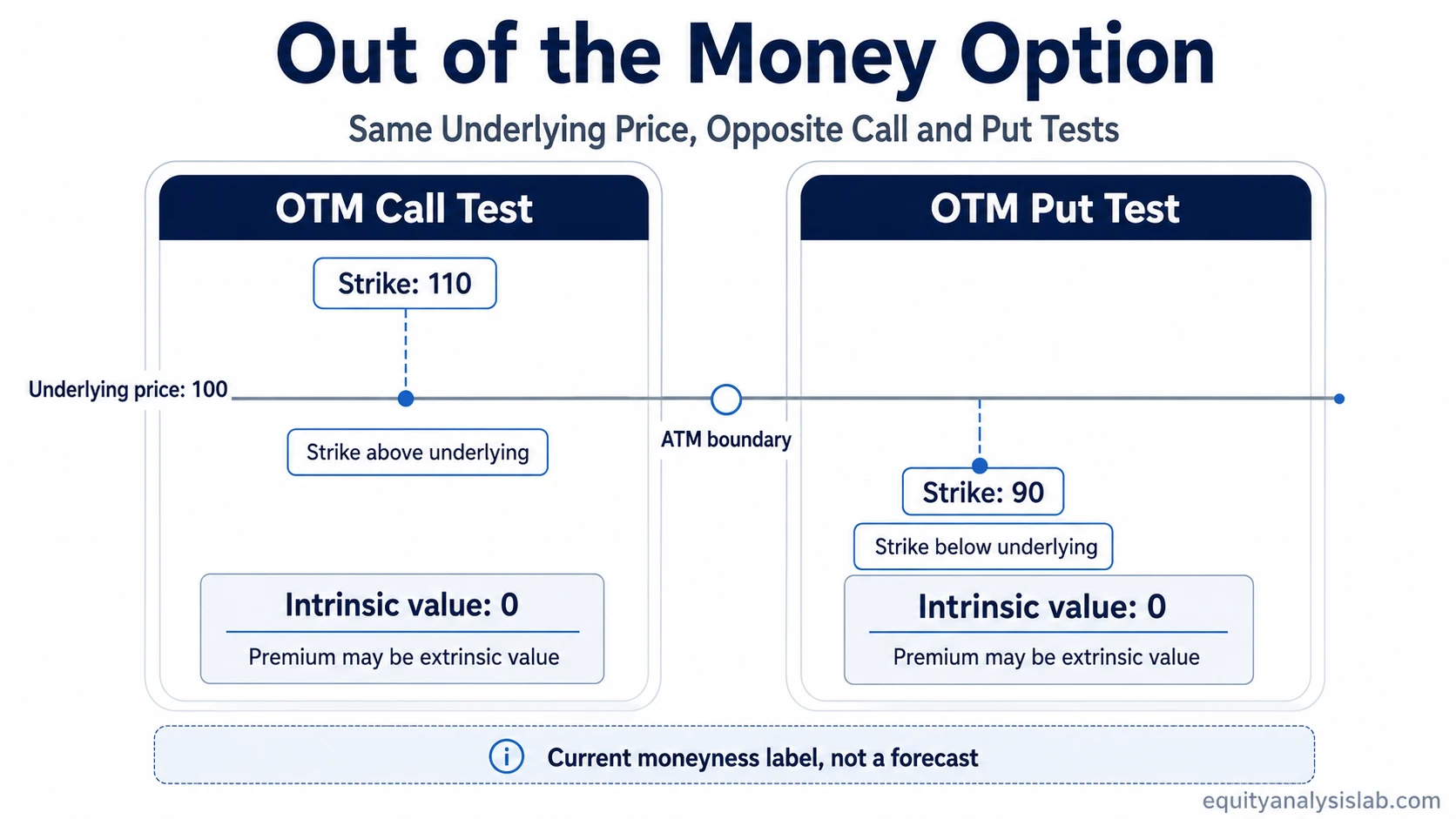
| Call option | Underlying price is below the strike price | Stock at 100, call strike at 110 | The right to buy at 110 has no exercise value while the market price is 100. |
| Put option | Underlying price is above the strike price | Stock at 100, put strike at 90 | The right to sell at 90 has no exercise value while the market price is 100. |
The call and put tests move in opposite directions. A higher strike can make a call out of the money, while a lower strike can make a put out of the money. The same underlying price can therefore create different moneyness labels depending on the contract type.
Intrinsic Value and Extrinsic Value
An out of the money option has zero intrinsic value. Intrinsic value is the amount that would exist if the option were exercised immediately under current prices. For an OTM call, the market price is not high enough to make the buy right valuable. For an OTM put, the market price is not low enough to make the sell right valuable.
That does not mean the option premium must be zero before expiration. OTM options can still have extrinsic value. Extrinsic value reflects factors such as remaining time, implied volatility, interest rates, dividends where relevant, and market expectations about whether the underlying price could move before expiration.
Example: If a stock trades at 100 and a call has a strike price of 110, the call is out of the money. It has no intrinsic value because buying at 110 is not favorable while the stock trades at 100. If the call still trades for 2, that 2 is extrinsic value rather than intrinsic value.
What Happens at Expiration
Expiration changes the meaning of OTM status because remaining time disappears. If a call expires with the underlying price below the strike, the call normally expires without exercise value. If a put expires with the underlying price above the strike, the put normally expires without exercise value.
Before expiration, the market may still price the possibility of a future move. At expiration, that possibility no longer has time value. The contract either has intrinsic value or it does not.
The mechanics of exercising an option depend on contract terms, broker procedures, and expiration rules. The core OTM boundary remains the same: exercise value is absent when the strike relationship is unfavorable for the option holder.
What Out of the Money Is Not
| Incorrect shortcut | More precise interpretation |
|---|---|
| OTM means worthless before expiration. | OTM means no intrinsic value now. Extrinsic value may still remain before expiration. |
| OTM means lower risk because the premium is lower. | A smaller premium reduces upfront cost, but the contract can still expire with no value. |
| OTM means the option is unlikely to matter. | Moneyness can change if the underlying price moves before expiration. |
| OTM is the same test for calls and puts. | Calls and puts use opposite strike-price tests. |
Why Premium Can Remain When Intrinsic Value Is Zero
An OTM option can still trade because the contract has optionality until expiration. More time gives the underlying price more opportunity to move through the strike. Higher implied volatility can also increase the market value of that possibility.
The premium therefore reflects more than current exercise value. A clean reading separates current moneyness from the total option price. Current moneyness answers whether the option has intrinsic value now. Premium also reflects what the market is willing to pay for remaining uncertainty.
That distinction is part of the basic option contract mechanics: price, strike, expiration, and contract type interact, but they do not all mean the same thing.
OTM vs ITM and ATM in Plain Terms
Out of the money, in the money, and at the money are neighboring moneyness labels. OTM means no intrinsic value. ITM means immediate exercise would create intrinsic value before considering premium paid or transaction costs. ATM usually means the strike price is at or very near the current underlying price, so it sits near the boundary rather than clearly inside or outside intrinsic value.
| Concept | Call option | Put option |
|---|---|---|
| Out of the money | Underlying price below strike | Underlying price above strike |
| At the money | Underlying price near strike | Underlying price near strike |
| In the money | Underlying price above strike | Underlying price below strike |
The comparison with an option that has intrinsic value is useful because it separates two questions: whether the contract has value if exercised now, and whether the total premium is justified by remaining time and uncertainty.
Common Mistakes When Reading OTM Options
Mistake 1: Treating OTM as a complete risk label. OTM only describes current moneyness. It does not decide whether the premium is reasonable, whether the contract fits an objective, or whether the risk is acceptable.
Mistake 2: Ignoring expiration. An OTM option with months remaining is different from an OTM option near expiration because the remaining time value is different.
Mistake 3: Mixing up calls and puts. A call becomes less favorable when the strike is above the underlying price. A put becomes less favorable when the strike is below the underlying price.
Limitations of the OTM Label
OTM status is a current-price classification, not a full valuation model. It does not measure implied volatility, liquidity, bid-ask spread, time decay, assignment procedures, taxes, portfolio suitability, or the probability that a contract will finish with value at expiration.
The label is still useful because it gives a fast boundary test. It tells whether the strike relationship creates intrinsic value now. A complete option reading still has to separate moneyness from premium, expiration, liquidity, and the investor’s broader risk process.
Out of the Money Option FAQ
Can an out of the money option still have value?
Yes. An out of the money option has no intrinsic value, but it can still have extrinsic value before expiration. Remaining time, implied volatility, and market demand can keep the option premium above zero.
What happens if an option expires out of the money?
If an option expires out of the money, it normally expires without exercise value. A call expires OTM when the underlying price remains below the strike. A put expires OTM when the underlying price remains above the strike.
Is an out of the money call the same as an out of the money put?
No. The label means no intrinsic value for both contract types, but the strike test is opposite. A call is OTM when the underlying price is below the strike. A put is OTM when the underlying price is above the strike.
Does out of the money mean the option is cheap?
Not necessarily. OTM options often have lower premiums than comparable ITM contracts, but the premium still depends on time, volatility, liquidity, and contract demand. Lower upfront cost does not automatically mean lower decision risk.