
Option premium is the price of an options contract. It is the amount the buyer pays to enter the contract and the amount the seller receives for taking the other side.
A quoted premium is not the same as profit, expected return, or trade quality. It is a market price shaped by the relationship between the underlying price, the strike price, time remaining, volatility expectations, and quote conditions.
Definition: Option premium is the total quoted price of an option contract, usually understood as the sum of intrinsic value and extrinsic value.
Key Points
- Option premium is the contract price paid by the buyer and received by the seller.
- Premium can include both intrinsic value and extrinsic value.
- Time to expiration, implied volatility, moneyness, and bid/ask conditions can change the quoted premium.
- A premium quote is an observable market price, not a recommendation or expected return.
- The premium alone does not show whether an option position will be profitable after cost, spread, exercise, assignment, or expiration effects.
What Is an Option Premium?
An option premium is the price attached to a call option or put option. For the buyer, it is the cost of entering the contract. For the seller, it is the amount received for accepting the contract obligation.
The premium can move before expiration as the underlying price changes, as time passes, as implied volatility changes, or as the bid/ask spread widens or narrows.
The important boundary is that premium is a contract price. It does not automatically show the buyer’s final gain, the seller’s final risk, or whether exercising or accepting assignment would make sense.
How Option Premium Is Built
The simplest way to break down option premium is:
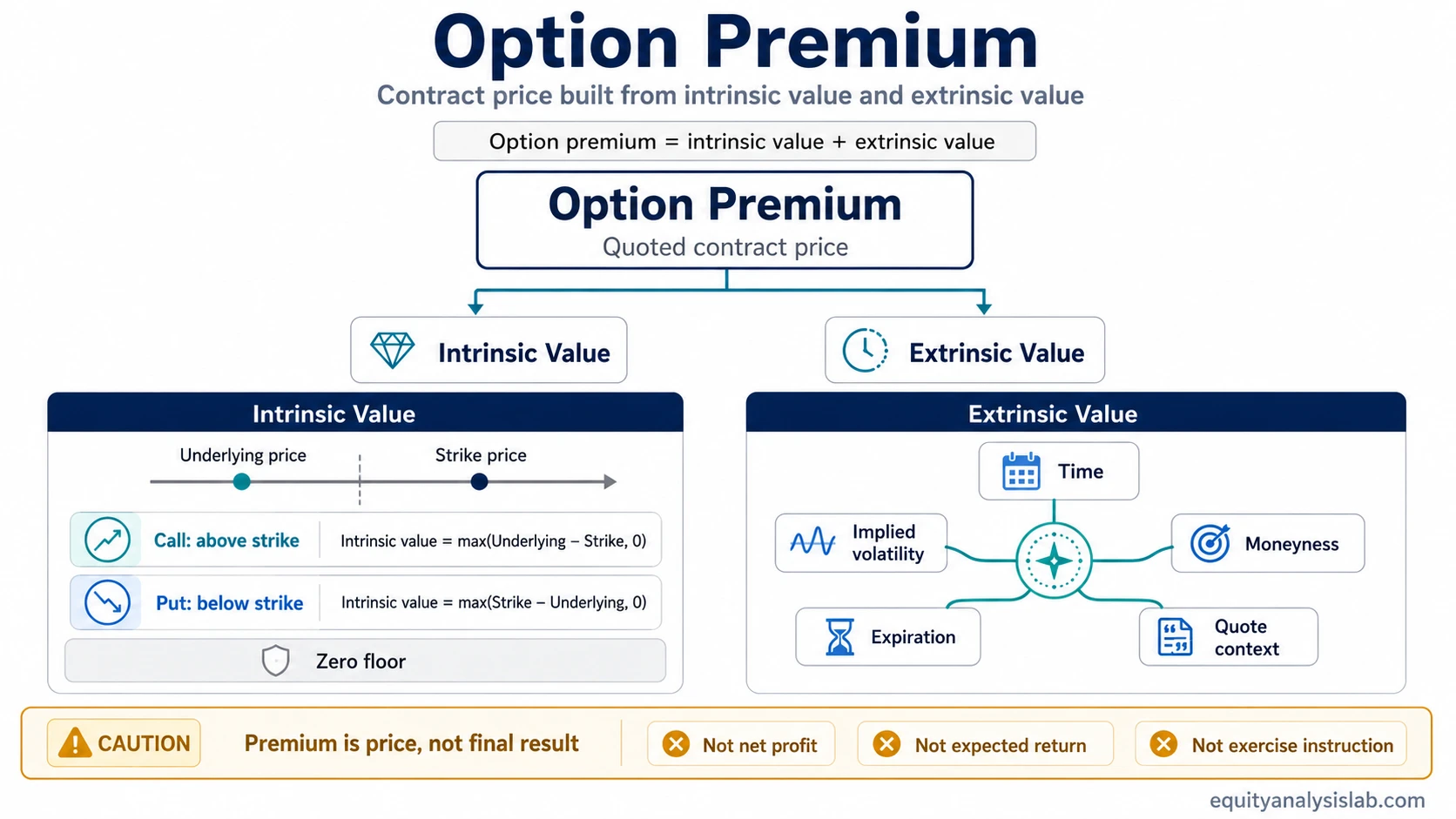
Formula: Option premium = intrinsic value + extrinsic value.
Intrinsic value is the part of the premium created by an in-the-money relationship between the underlying price and the strike price. A call has intrinsic value when the underlying price is above the strike. A put has intrinsic value when the underlying price is below the strike.
Extrinsic value is the remaining part of the premium beyond intrinsic value. It can reflect time remaining, implied volatility, moneyness, interest-rate or dividend assumptions, and market quote conditions.
A contract can still have premium when it has no intrinsic value. In that case, the premium is entirely extrinsic value. This is common for out-of-the-money options, where future price movement remains uncertain before expiration.
What Changes an Option Premium?
Option premium changes because the contract’s value is linked to several observable inputs. These inputs do not work in isolation, but separating them helps explain why two contracts on the same underlying asset can have very different prices.
| Factor | How it can affect premium | Important limitation |
|---|---|---|
| Underlying price | A move in the underlying can increase or reduce intrinsic value depending on whether the option is a call or a put. | The same price move can affect different strikes differently. |
| Strike price | The strike determines the price level used to judge whether the option is in the money, at the money, or out of the money. | A lower or higher strike is not automatically better; it changes contract exposure and premium composition. |
| Moneyness | In-the-money options usually include intrinsic value, while out-of-the-money options are usually made of extrinsic value only. | Moneyness describes the strike relationship, not the final result of a position. |
| Expiration date | More time can support more extrinsic value because there is more time for the underlying price to move. | Time value generally declines as expiration approaches, but the path is not a guarantee of profit or loss by itself. |
| Implied volatility | Higher implied volatility can increase premium because the market is pricing a wider expected range of possible movement. | Implied volatility is a pricing input, not a prediction that a specific move will happen. |
| Options liquidity | Bid/ask spreads, volume, and open interest can affect the quote a buyer or seller sees. | A displayed premium may differ from the price at which a real order can be filled. |
How to Read a Premium Quote
A premium quote should be read as a snapshot, not as a conclusion. The quote shows what the market is currently assigning to the contract, but it does not explain the whole decision context by itself.
Quote: The displayed premium shows the option’s market price at that moment.
Component split: Part of the premium may be intrinsic value, and the rest may be extrinsic value.
Context: The quote should be interpreted with strike price, moneyness, expiration date, implied volatility, and bid/ask spread.
Boundary: The premium cannot prove expected return, net profit, trade quality, or whether exercise or assignment is the right action.
This quote-reading boundary is especially important because option prices can move even when the underlying asset has not moved much. A change in implied volatility, the passage of time, or weaker liquidity can alter the premium without changing the basic contract rights.
Call and Put Premium Context
Call and put premiums both represent option contract prices, but their intrinsic value comes from opposite strike relationships. A call option gains intrinsic value when the underlying price is above the strike price. A put option gains intrinsic value when the underlying price is below the strike price.
That difference affects how the premium is interpreted. A call and a put with the same expiration can both have a market premium, but the reason for that premium may differ. One contract may contain intrinsic value, while another may be priced mostly through extrinsic value.
| Contract type | When intrinsic value exists | Premium interpretation |
|---|---|---|
| Call option | Underlying price is above the strike price. | The premium may include positive intrinsic value plus any remaining extrinsic value. |
| Put option | Underlying price is below the strike price. | The premium may include positive intrinsic value plus any remaining extrinsic value. |
| Out-of-the-money option | No intrinsic value exists at that moment. | The premium is extrinsic value unless the option later becomes in the money. |
Option Premium Example
A call option with a $50 strike price is easier to interpret when the underlying asset is trading at $54. If that option is quoted at a $6 premium, $4 of the premium is intrinsic value because the underlying price is $4 above the strike.
The remaining $2 is extrinsic value. That remaining value can reflect time before expiration, implied volatility, demand for the contract, and quote conditions.
The $6 premium is still only the contract price. It does not by itself show net profit after cost, the final result at expiration, assignment risk, or whether the contract should be exercised, held, closed, or avoided.
What Option Premium Does Not Tell You
Option premium is useful because it gives a market price for the contract, but it is easy to overread that price. A high premium does not automatically mean the option is attractive. A low premium does not automatically mean the option is cheap in a useful sense.
Option premium is not net profit. The final result depends on the premium paid or received, the closing price, transaction costs, exercise or assignment outcomes, and expiration value.
Option premium is not expected return. A quoted price reflects market pricing inputs, not a promise that the contract will produce a positive result.
Option premium is not trade quality. A contract can have a high premium because it has intrinsic value, high implied volatility, wide spreads, or a risk profile that does not fit the investor’s process.
Option premium is not an exercise or assignment instruction. Exercise and assignment decisions depend on contract terms, moneyness, timing, costs, and the investor’s specific situation.
Related Concepts
Option premium connects several options concepts, but each concept explains a different part of the contract price.
- Intrinsic value in options explains the in-the-money portion of an option’s value.
- Extrinsic value explains the part of premium beyond intrinsic value.
- Strike price explains the contract price level used to judge moneyness.
- Expiration date explains the time boundary of an options contract.
- Options liquidity explains bid/ask spread, volume, open interest, and tradability.
- Call option explains one side of the contract structure that affects how premium is interpreted.
FAQ
Is option premium the same as the price of an option?
Yes. Option premium is the price of an options contract. It is the amount the buyer pays and the seller receives for the contract.
What is option premium made of?
Option premium can be divided into intrinsic value and extrinsic value. Intrinsic value comes from an in-the-money strike relationship, while extrinsic value is the remaining premium beyond intrinsic value.
Can an option have premium with no intrinsic value?
Yes. An out-of-the-money option can still have premium because the market may assign extrinsic value before expiration.
Does a higher option premium mean a better option?
No. A higher premium only means the contract is more expensive at that moment. It does not prove better trade quality, expected return, or final profitability.