
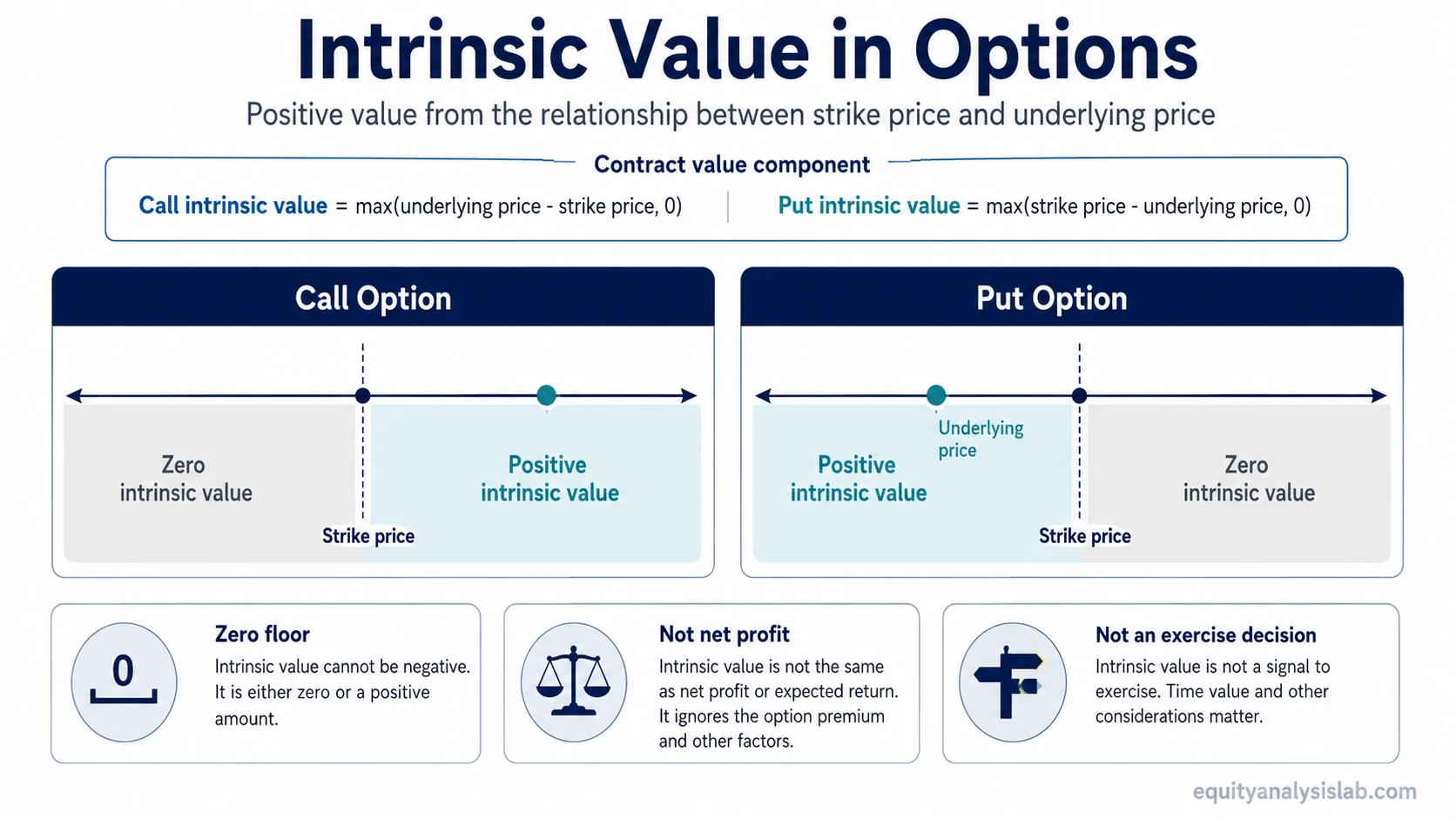
Intrinsic value in options is the positive payoff component created by the relationship between the underlying price and the strike price. A call option has intrinsic value when the underlying price is above the strike price, while a put option has intrinsic value when the underlying price is below the strike price.
Intrinsic value cannot be negative. If the strike and underlying price relationship does not create positive value for the option holder, the option’s intrinsic value is zero, even if the option still trades for a premium.
What Intrinsic Value Means in Options
Intrinsic value measures the part of an option’s value that exists because the contract is in the money. It is based only on the underlying price, the strike price, and whether the contract is a call or a put.
For a call, intrinsic value comes from the underlying price being above the strike. For a put, intrinsic value comes from the underlying price being below the strike. If neither condition is true, intrinsic value is zero.
This is an options-specific use of the term. It is not the same as estimating the fair value of a company or stock through a valuation model.
Key Points About Intrinsic Value
- Intrinsic value is the positive in-the-money value of an option contract.
- A call option has intrinsic value when the underlying price is above the strike price.
- A put option has intrinsic value when the underlying price is below the strike price.
- Out-of-the-money options have zero intrinsic value, not negative intrinsic value.
- Option premium can include extrinsic value beyond intrinsic value.
- Intrinsic value is not net profit, expected return, or an automatic exercise decision.
Intrinsic Value Formula for Calls and Puts
The formula depends on whether the option is a call or a put. Both formulas use a zero floor because intrinsic value cannot be less than zero.
| Option type | Formula | When intrinsic value is positive |
|---|---|---|
| Call option | max(underlying price – strike price, 0) | When the underlying price is above the strike price |
| Put option | max(strike price – underlying price, 0) | When the underlying price is below the strike price |
The “max” part of each formula means the result is either the positive difference or zero. A negative number is not carried forward as negative intrinsic value.
Intrinsic Value and Moneyness
Moneyness describes where the underlying price sits relative to the strike price. Intrinsic value appears only when that relationship makes the option in the money.
| Moneyness state | Call option | Put option | Intrinsic value |
|---|---|---|---|
| In the money | Underlying price is above the strike | Underlying price is below the strike | Positive |
| At the money | Underlying price is at or very near the strike | Underlying price is at or very near the strike | Zero when exactly at the strike; small only if the option is slightly in the money |
| Out of the money | Underlying price is below the strike | Underlying price is above the strike | Zero |
An in-the-money option can have intrinsic value, but that does not mean the whole premium is intrinsic value. Time remaining, implied volatility, and other pricing conditions can still affect the quoted premium.
Intrinsic Value, Premium, and Extrinsic Value
Option premium is the price paid or received for the option contract. Intrinsic value is only one possible component of that premium.
A simple way to separate the components is:
| Premium component | What it represents |
|---|---|
| Intrinsic value | The positive in-the-money value created by the underlying price and strike price relationship |
| Extrinsic value | The remaining premium beyond intrinsic value, which can reflect time, implied volatility, and other pricing inputs |
If an option has a premium of 7 and intrinsic value of 4, the remaining 3 is extrinsic value. If an option is out of the money, its intrinsic value is zero, but it may still have premium because buyers and sellers may assign value to time, volatility, or the chance that the option becomes in the money before expiration.
Example Calculation
A call with a strike price of 50 and an underlying price of 58 has intrinsic value because the underlying price is above the strike:
max(58 – 50, 0) = 8
The call’s intrinsic value is 8. That number describes the in-the-money amount, not the full trade result.
A put with a strike price of 50 and an underlying price of 44 has intrinsic value because the strike price is above the underlying price:
max(50 – 44, 0) = 6
The put’s intrinsic value is 6. These examples show contract value only. They do not include the original premium paid, transaction costs, taxes, liquidity conditions, or any broader investment result.
What Intrinsic Value Does Not Tell You
Intrinsic value answers one narrow question: how much positive value exists from the strike price and underlying price relationship. It does not answer every practical question about the option.
| Common misunderstanding | Better interpretation |
|---|---|
| Intrinsic value equals total premium | Premium may include both intrinsic value and extrinsic value. |
| Intrinsic value equals net profit | Net result depends on premium paid or received, costs, taxes, liquidity, and final contract handling. |
| Intrinsic value means the option is attractive | Intrinsic value says nothing by itself about expected return, risk, valuation, or position quality. |
| Intrinsic value decides whether to exercise | Exercise and assignment involve contract mechanics and practical considerations beyond the intrinsic value number alone. |
| Intrinsic value guarantees an easy exit | Market depth, spreads, and options liquidity conditions can affect the practical result. |
Intrinsic Value in the Option Contract
Intrinsic value is easier to interpret when the basic contract mechanics are clear. A call gives exposure to upside above the strike, while a put gives exposure to downside below the strike. The relationship between the strike and the underlying price determines whether the option has positive intrinsic value.
For a broader contract foundation, how options work explains the basic rights, obligations, strike price, expiration, and premium structure behind the calculation.
The key boundary is simple: intrinsic value is a payoff component, not a complete decision rule. Time remaining, implied volatility, liquidity, exercise style, and contract handling can all matter, but they should not be confused with the intrinsic value formula itself.
Related Options Concepts
Premium boundary: Extrinsic value explains why an option can trade above its intrinsic value, especially when time and volatility remain relevant.
Contract boundary: Assignment belongs to the mechanics of option exercise and obligation, not to the intrinsic value formula itself.
Trading-condition boundary: Options liquidity can affect spreads, market depth, and practical handling even when the intrinsic value calculation is straightforward.
FAQ
Can intrinsic value in options be negative?
No. Intrinsic value uses a zero floor. If the formula produces a negative number, the option’s intrinsic value is treated as zero.
Does intrinsic value equal option profit?
No. Intrinsic value does not include the premium paid or received, transaction costs, taxes, liquidity, or the final handling of the contract. Net result is a separate calculation.
Can an out-of-the-money option still have premium?
Yes. An out-of-the-money option has zero intrinsic value, but it can still have premium because of extrinsic value, such as time remaining and implied volatility.