
Monthly recurring revenue, or MRR, is the recurring subscription revenue from active paying customers normalized to a monthly amount. It lets investors track the size and movement of the recurring monthly base without mixing in one-time fees or billing-period differences.
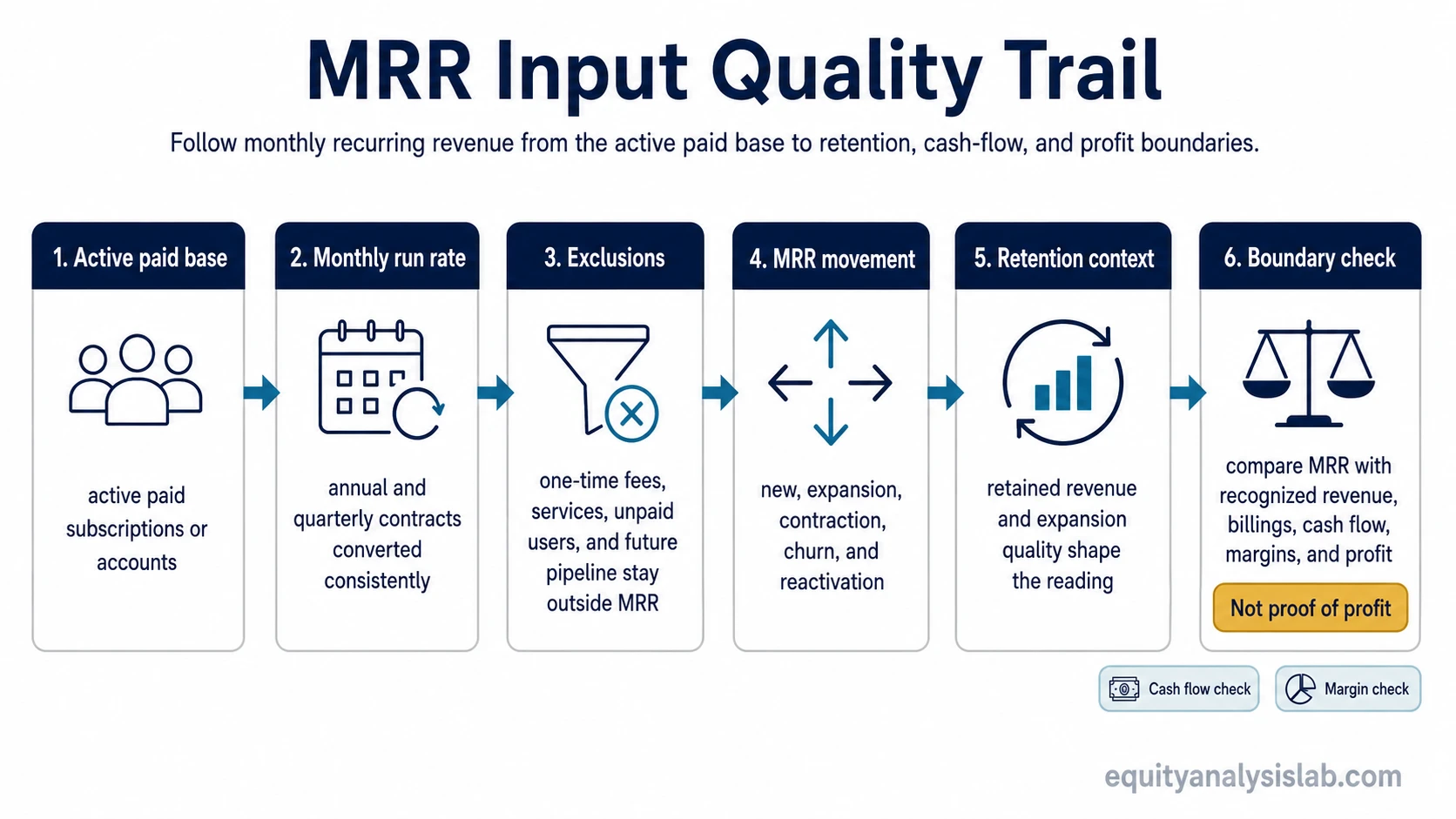
MRR Formula and Monthly Normalization
The direct calculation starts with each active recurring subscription and converts its billing interval to a monthly amount:
MRR = Σ (recurring subscription amount ÷ months in the billing interval)
A $1,200 annual subscription therefore contributes $100 of MRR. A $300 quarterly subscription contributes $100. A $100 monthly subscription contributes $100.
Both can produce the same total when they use the same active recurring base. The customer-level calculation makes contract intervals, discounts, and account-level changes easier to inspect.
Normalize each active paid subscription to one month, then add the monthly amounts.
Active paying accounts × average recurring monthly revenue per account.
What to Include and Exclude From MRR
| Revenue item | MRR treatment | Why it matters |
|---|---|---|
| Active recurring subscription fees | Include | They form the recurring monthly base MRR is designed to measure. |
| Annual or quarterly subscriptions | Normalize to a monthly amount | The billing interval should not change the monthly recurring value. |
| Recurring upgrades and add-ons | Include when active | They change the recurring amount paid by the customer. |
| Active discounts or credits | Reflect in the recurring amount | Using an undiscounted list price can overstate the recurring revenue currently being generated. |
| One-time setup fees | Exclude | They can increase reported revenue without becoming part of the recurring monthly base. |
| Non-recurring implementation or consulting work | Exclude | The payment depends on work or events that do not automatically repeat each month. |
| Free trials and unpaid users | Exclude | They do not yet represent paid recurring revenue. |
| Variable usage above a committed recurring amount | Review separately | Uncommitted usage can move from month to month and may not represent a stable recurring base. |
How MRR Changes
The ending MRR number becomes more informative after its movement is separated into the revenue added, expanded, lost, or recovered during the period.
| MRR component | What changed | Investor interpretation |
|---|---|---|
| New MRR | Recurring revenue from new customers | Shows acquisition contribution to the recurring base. |
| Expansion MRR | Existing customers increase recurring spend | Can come from upgrades, additional seats, recurring add-ons, or higher recurring usage. |
| Reactivation MRR | Previously churned customers return to a paid subscription | Adds recurring revenue without representing a new customer relationship. |
| Contraction MRR | Existing customers reduce recurring spend | Shows revenue leakage from downgrades, fewer seats, or lower recurring usage. |
| Churned MRR | Customers cancel their recurring subscription | Removes revenue from the active recurring base. |
| Net new MRR | New + expansion + reactivation − contraction − churn | Shows the net monthly change after both additions and losses are included. |
Net revenue retention isolates a related question by measuring how revenue from the existing customer base changes after expansion, contraction, and churn.
Simple Monthly Recurring Revenue Example
A SaaS company begins the month with 500 active paying accounts averaging $200 of recurring monthly revenue:
500 active accounts × $200 = $100,000 starting MRR
During the month, new customers add $20,000 of MRR and existing customers add $10,000 through expansion. Contraction removes $8,000 and churn removes another $12,000.
| Movement | Amount | Effect on MRR |
|---|---|---|
| Starting MRR | $100,000 | Opening recurring monthly base |
| New MRR | +$20,000 | New customer revenue |
| Expansion MRR | +$10,000 | More revenue from existing customers |
| Contraction MRR | −$8,000 | Reduced spend from existing customers |
| Churned MRR | −$12,000 | Cancelled recurring revenue |
| Ending MRR | $110,000 | $10,000 net increase |
MRR increased by 10%, but $20,000 of recurring revenue was also lost through contraction and churn. The movement mix therefore contains information that the ending number alone does not show.
Same MRR Growth, Different Revenue Quality
- MRR increases by 10%.
- Existing customers generate much of the increase through expansion.
- Contraction and churn remain relatively limited.
- The retained base contributes more of the growth.
- MRR also increases by 10%.
- New customer sales replace a larger amount of churned and contracted revenue.
- Discounting contributes more heavily to the new recurring base.
- More acquisition is required to produce the same headline growth rate.
The same reported growth rate can therefore come from different recurring-revenue dynamics. The movement components show whether growth is being built on the existing base or replacing revenue that has already been lost.
MRR vs ARR, Recognized Revenue, Cash Flow, and Retention
| Metric or concept | What it measures | Interpretation boundary |
|---|---|---|
| MRR | The active recurring revenue base normalized to one month | It does not establish accounting revenue, cash collection, profitability, or retention quality. |
| Annual recurring revenue | The recurring revenue base expressed on an annualized basis under the company’s chosen definition | The relationship with MRR depends on the ARR convention being used. |
| Recognized revenue | Revenue recorded for an accounting period | Recognition timing can differ from a subscription run-rate metric. |
| Billings and cash collections | Amounts invoiced or collected from customers | Payment timing can differ from both MRR and recognized revenue. |
| Retention | How much existing-customer revenue remains, expands, contracts, or leaves | A growing total MRR number can coexist with deterioration inside the retained customer base. |
Gross revenue retention removes expansion from the retention reading and helps show how much recurring revenue remains before upsells are added back.
When MRR Can Mislead
Two companies can report similar MRR and similar growth while having different churn, discounting, gross margins, acquisition costs, collections, and customer concentration.
| Potential distortion | What the headline MRR can hide | What to check |
|---|---|---|
| New sales replace churn | Total MRR rises even while revenue from the existing base is leaking. | Churned MRR, contraction MRR, GRR, and NRR. |
| Discounting supports growth | Customer count can rise while the economics of each subscription weaken. | Actual recurring amounts, pricing changes, and discount duration. |
| Non-recurring items enter the calculation | Setup, consulting, or other one-time revenue can inflate the apparent recurring base. | The company’s MRR definition and inclusion rules. |
| Normalization changes | A methodology change can create apparent movement without an equivalent change in customer economics. | Calculation consistency across periods. |
| Cash conversion is weak | Recurring revenue growth may not produce equivalent cash generation. | Collections, deferred revenue, operating cash flow, and working-capital effects. |
| Cost structure is ignored | More recurring revenue can still require high sales, support, or infrastructure spending. | Gross margin, acquisition efficiency, payback period, and operating costs. |