
Net revenue retention, or NRR, measures how recurring revenue from an existing customer base changes after expansion, contraction, and churn. Revenue from customers acquired after the starting point is excluded, so the metric isolates what happened inside the customer base that was already present.
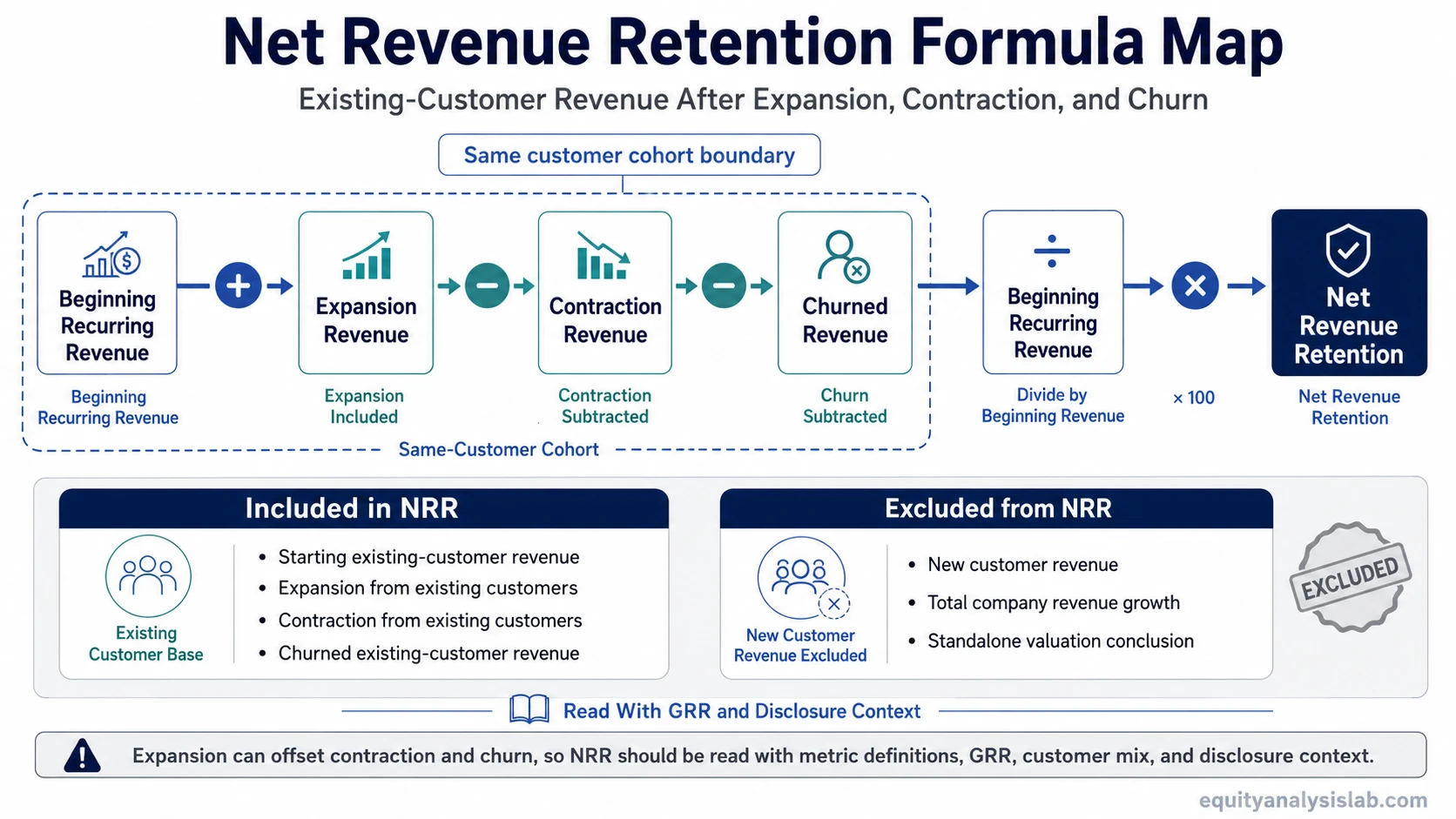
Net Revenue Retention Formula
NRR = (Beginning Recurring Revenue + Expansion Revenue – Contraction Revenue – Churned Revenue) / Beginning Recurring Revenue × 100
The denominator is recurring revenue from the starting customer base. The numerator adjusts that same base for revenue gained or lost during the measurement period.
| Formula input | What it represents | Effect on NRR |
|---|---|---|
| Beginning recurring revenue | Recurring revenue from the customer base at the beginning of the period | Creates the denominator and starting reference. |
| Expansion revenue | Additional recurring revenue from existing customers through upgrades, additional seats, cross-sells, pricing changes, or higher recurring usage | Increases NRR. |
| Contraction revenue | Recurring revenue lost when existing customers reduce spend without leaving completely | Reduces NRR. |
| Churned revenue | Recurring revenue lost when customers in the starting base leave | Reduces NRR. |
| New customer revenue | Revenue from customers acquired after the beginning of the measurement period | Excluded from NRR. |
Two Ways to Calculate NRR
NRR can be measured directly from a fixed customer cohort or reconstructed from the revenue movements that occurred during the period.
When all revenue movements correspond exactly to the starting cohort, the methods can produce the same result. Their measurement risks differ when customer timing and transaction activity become more complex.
Divide ending recurring revenue from the customers who existed at the start of the period by beginning recurring revenue from that same customer group.
Start with beginning recurring revenue, add expansion, subtract contraction and churn, then divide by beginning recurring revenue.
The SaaS Metrics Standards Board describes the cohort method as the preferred approach in most situations because it keeps the customer set fixed. It also documents the formula method as useful for businesses with shorter measurement periods, smaller transactions, or rapid customer growth, while noting that longer measurement windows can create mismatches between beginning revenue and later churn or expansion.
ChartMogul presents NRR directly as current recurring revenue from the starting customer cohort divided by recurring revenue from that same cohort at the beginning of the comparison period.
If a monthly or quarterly retention ratio is annualized, the periods compound. Multiplying the percentage change by 12 or 4 is not equivalent to compounding the retention ratio over those periods.
What Counts in NRR and What Does Not
The measured customer set should remain consistent. Revenue changes belong in NRR only when they relate to customers in the starting cohort and fall inside the company’s recurring-revenue definition.
| Revenue item | Included in NRR? | Reason |
|---|---|---|
| Seat expansion from an existing customer | Yes | It increases recurring revenue from the starting cohort. |
| Upgrade to a higher plan | Yes | It is expansion within an existing account. |
| Usage growth from an existing customer | Depends on the recurring-revenue definition | It belongs in the calculation when the company treats that usage as part of the recurring revenue base. |
| Downgrade by an existing customer | Yes, as contraction | It reduces recurring revenue while the customer remains in the cohort. |
| Cancellation by an existing customer | Yes, as churn | It removes recurring revenue from the starting cohort. |
| Revenue from a new customer | No | It represents new customer acquisition rather than retention or expansion inside the starting base. |
| One-time implementation or services revenue | Usually no | NRR normally uses recurring revenue rather than one-time revenue. |
Companies do not always use the same recurring-revenue base. The calculation may rely on MRR, ARR, contracted recurring revenue, subscription revenue, or another disclosed measure. Peer comparison starts with the company’s definition.
Net Revenue Retention Calculation Example
Assume a SaaS company begins the year with $10 million of recurring revenue from existing customers. During the year, those customers add $2 million of expansion revenue, reduce spending by $700,000, and churn $500,000 of recurring revenue.
Beginning recurring revenue: $10,000,000
Expansion revenue: $2,000,000
Contraction revenue: $700,000
Churned revenue: $500,000
NRR = ($10,000,000 + $2,000,000 – $700,000 – $500,000) / $10,000,000 × 100
NRR = 108%
The starting customer base produced 8% more recurring revenue at the end of the period. Some revenue was still lost through contraction and churn. Expansion from other accounts was large enough to more than offset those losses.
Decomposing NRR Into Retention and Expansion
When NRR and GRR use the same customer cohort, recurring-revenue definition, measurement period, and denominator, the net result can be separated into retained revenue and expansion contribution:
NRR = GRR + Expansion Contribution
In the $10 million example, contraction and churn remove $1.2 million before expansion is considered.
GRR = ($10.0M – $0.7M – $0.5M) / $10.0M = 88%
Expansion contribution = $2.0M / $10.0M = 20 percentage points
NRR = 88% + 20% = 108%
The decomposition separates revenue preservation from account expansion. A 108% NRR built on 88% GRR describes a different customer-base pattern from the same NRR built on much stronger gross retention.
Net Revenue Retention vs Gross Revenue Retention
Gross revenue retention excludes expansion revenue. NRR includes it.
| Metric | Expansion included? | Main analytical question |
|---|---|---|
| Net revenue retention | Yes | Did recurring revenue from the starting customer base expand or contract after all customer-level changes? |
| Gross revenue retention | No | How much of the starting recurring revenue survived contraction and churn before expansion? |
NRR can exceed 100% because expansion is included. GRR cannot exceed 100% because upsells and other expansion do not increase it.
Same NRR, Different Retention Economics
Two companies can start with the same recurring revenue and finish with the same NRR while arriving there through very different customer behavior.
| Metric | Company A | Company B |
|---|---|---|
| Beginning recurring revenue | $10.0M | $10.0M |
| Contraction + churn | $0.5M | $2.0M |
| Expansion revenue | $1.5M | $3.0M |
| GRR | 95% | 80% |
| Expansion contribution | 15 percentage points | 30 percentage points |
| NRR | 110% | 110% |
Company A preserves more of its starting revenue and needs less expansion to reach 110%. Company B loses more of the original base but offsets that loss with stronger expansion. The headline NRR is identical; the underlying retention economics are not.
Net Revenue Retention vs Net Dollar Retention, ARR, and MRR
| Metric | Primary role | Interpretation boundary |
|---|---|---|
| NRR | Measures recurring-revenue change inside a starting customer cohort after expansion, contraction, and churn. | Excludes revenue from newly acquired customers. |
| Net dollar retention | Common alternate name for the same net retention concept. | Company-specific definitions should still be checked before peer comparison. |
| Annual recurring revenue | Expresses recurring revenue at annual scale. | Total ARR can grow through new customers even when revenue from the starting cohort weakens. |
| Monthly recurring revenue | Expresses the recurring revenue base at monthly scale. | MRR can be an input to NRR, but MRR itself does not isolate a fixed starting cohort. |
What Drives Net Revenue Retention
| NRR driver | What to examine | Why the source matters |
|---|---|---|
| Seat expansion | Whether customers continue adding users or the increase is concentrated in temporary implementation periods | The persistence of account expansion can differ by adoption pattern. |
| Usage growth | Whether higher recurring usage persists across periods | Usage-driven expansion can fall if customer activity declines. |
| Price increases | Whether higher prices are accompanied by stable retention and usage | Pricing can lift NRR while also changing future contraction or churn risk. |
| Cross-sell and upgrades | Whether customers adopt additional products or higher plans | Expansion can come from greater account depth rather than new-customer acquisition. |
| Customer concentration | Whether a small number of large accounts contribute disproportionately to expansion | Aggregate NRR can become more sensitive to changes in a few accounts. |
What NRR Can Hide
Expansion from some customers can offset churn, contraction, or concentration elsewhere. The metric also does not show the margin or cash cost required to support that recurring revenue.
| Potential blind spot | What NRR can hide | Investor check |
|---|---|---|
| Customer churn | Large expansion from remaining accounts can offset revenue lost when other customers leave. | Compare NRR with GRR and customer-count trends. |
| Revenue contraction | Upsells elsewhere can offset customers reducing seats, usage, or contract value. | Review contraction, downsell commentary, usage trends, and segment changes. |
| Margin economics | NRR measures recurring revenue movement rather than the cost of supporting that revenue. | Review gross margin, operating margin, support costs, and cash generation. |
| Customer concentration | A small group of expanding accounts can materially influence the aggregate percentage. | Check customer mix and concentration disclosures. |
| Pricing dependence | Higher prices can increase recurring revenue without equivalent growth in product usage. | Compare pricing changes with retention and usage behavior. |
Comparing NRR Across Public Companies
NRR is not a standardized accounting measure. Companies can use different recurring-revenue bases, customer cohorts, measurement periods, product scopes, and treatments of acquisitions or usage revenue.
| Comparison item | What to verify |
|---|---|
| Revenue base | Whether the metric uses MRR, ARR, contracted recurring revenue, subscription revenue, or another defined measure. |
| Customer cohort | Which customers qualify for the starting cohort and whether a minimum customer age is required. |
| Measurement period | Whether the company reports annual, quarterly, monthly, trailing-period, or annualized retention. |
| Expansion treatment | Which upgrades, usage changes, cross-sells, and pricing changes are included. |
| Business mix | Whether the metric covers the entire customer base or only selected products, segments, or customer sizes. |
| Acquisitions and divestitures | Whether acquired or divested customers are included immediately, excluded, or incorporated after a defined period. |
A peer comparison is strongest when the underlying cohort rules, revenue definitions, measurement windows, and business models are sufficiently similar for the percentages to describe comparable economics.