
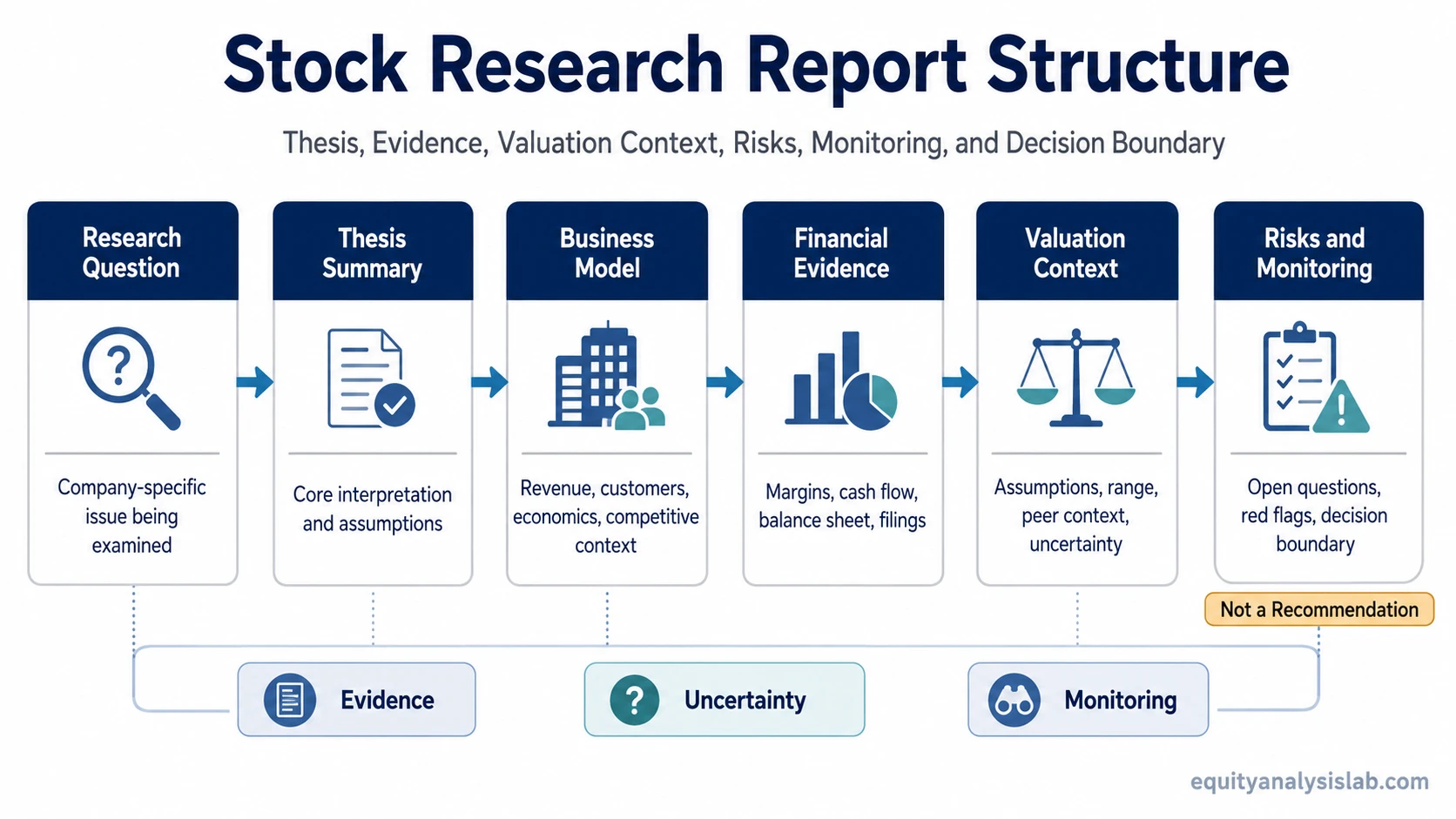
A stock research report template is a structured document for recording a company-specific thesis, the evidence supporting or challenging it, valuation assumptions, risks, unresolved questions, and monitoring conditions.
The template is most useful when it preserves the difference between evidence and interpretation. A completed document should show what is known, what is still assumed, what could weaken the thesis, and what needs to be reviewed next.
Definition: A stock research report template is a repeatable structure for documenting company research, including the thesis, evidence base, valuation context, risk factors, monitoring inputs, and unresolved assumptions.
Boundary: Completing the template does not prove that a company is attractive, undervalued, safe, or suitable for investment.
Key Points
- A stock research template creates a consistent research record for one company or security idea.
- Evidence supporting the thesis should remain separate from evidence that challenges it.
- Assumptions and unresolved questions should stay visible instead of being converted into confident conclusions.
- The template is different from a checklist or watchlist because it stores the substance of the research rather than only process gates or candidate tracking.
- A useful template ends with monitoring conditions and a decision boundary, not an automatic approval.
What a Stock Research Report Template Should Capture
A useful research template creates a record that another review can inspect. It should make clear why the company is being researched, what evidence supports the current thesis, what evidence creates uncertainty, which assumptions affect valuation, and what developments could change the interpretation.
The document should also preserve disagreement inside the evidence. Strong revenue growth can coexist with weaker margins. Reported earnings can rise while cash conversion deteriorates. A business can have attractive economics while the current valuation already assumes substantial future growth.
The template helps keep those observations visible at the same time instead of compressing them into one bullish or bearish conclusion.
Copyable Stock Research Report Template
The following structure can be copied into a research document and adapted to the company, industry, and available disclosures.
COMPANY
Company:
Ticker:
Industry:
Research date:
Primary filings reviewed:
Next review date:
1. WORKING THESIS
Core thesis:
Why the opportunity may exist:
What must be true:
Evidence currently supporting the thesis:
Evidence currently challenging the thesis:
What would materially weaken or invalidate the thesis:
2. BUSINESS MODEL
Primary revenue sources:
Key products or services:
Main customer groups:
Important cost drivers:
Capital intensity:
Competitive position:
Key operating drivers:
Customer or channel dependencies:
3. FINANCIAL EVIDENCE
Revenue trend:
Gross margin trend:
Operating margin trend:
Operating cash flow:
Free cash flow:
Debt and liquidity:
Working-capital changes:
Share-count trend:
Important accounting issues:
Evidence supporting the thesis:
Evidence contradicting the thesis:
4. VALUATION CONTEXT
Primary valuation method:
Current valuation multiple or range:
Historical or peer context:
Key assumptions:
Most sensitive assumption:
Expectations that appear embedded in the current price:
Conditions under which the valuation interpretation would change:
5. RISKS
Thesis-breaking risk:
Financial risk:
Competitive risk:
Execution risk:
Industry or macro risk:
Regulatory risk where relevant:
Risk that remains unresolved:
6. OPEN QUESTIONS
Question 1:
Question 2:
Question 3:
Evidence needed to answer them:
7. MONITORING
Metric or event to monitor:
Why it matters:
Current state:
Expected direction:
Condition that would change the interpretation:
Next source or filing to review:
8. DECISION BOUNDARY
Evidence still required:
Assumptions still unresolved:
Risks that cannot yet be bounded:
What must be true before the research can move forward:
What evidence would require the thesis to be revised:
Track the Status of Each Research Claim
Not every statement in a research report has the same evidentiary strength. Assigning a status to important claims helps prevent an assumption from gradually being treated as an established fact.
| Evidence Status | Meaning | How It Should Be Used |
|---|---|---|
| Confirmed | Directly supported by a filing, reported financial data, contractual disclosure, or other primary evidence. | Can be treated as part of the established evidence base unless later information changes it. |
| Supported | Several pieces of evidence point in the same direction, but the conclusion still requires interpretation. | Use as supporting evidence while keeping the underlying assumptions visible. |
| Unresolved | Evidence is incomplete, conflicting, or unavailable. | Keep the question open and identify what information would resolve it. |
| Assumption | The research case requires the statement to be true, but it has not been directly established. | Make it explicit and test how sensitive the thesis or valuation is to it. |
| Thesis breaker | A condition or piece of evidence that would materially invalidate the current interpretation. | Monitor explicitly rather than allowing the thesis to change after contradictory evidence appears. |
Research discipline: an unresolved claim should remain unresolved in the document. Completing the template should not automatically upgrade weak evidence into a stronger evidence status.
Core Sections and the Question Each One Answers
| Template Section | Main Research Question | Common Failure |
|---|---|---|
| Working thesis | What interpretation is currently being tested? | Writing a conclusion first and using later sections only to defend it. |
| Business model | How does the company create revenue, profit, and cash flow? | Repeating the company description without identifying the economic drivers. |
| Financial evidence | Do the reported numbers support or challenge the thesis? | Using growth or earnings without checking margins, cash flow, leverage, and balance-sheet changes. |
| Valuation context | What assumptions are required by the current valuation? | Treating one valuation estimate as a precise conclusion. |
| Risks | What could materially change or invalidate the thesis? | Listing generic risk factors that are not connected to the research case. |
| Open questions | What important information is still missing? | Removing uncertainty from the final document because it makes the report look incomplete. |
| Monitoring | Which future evidence can confirm, weaken, or change the interpretation? | Tracking metrics without defining why they matter to the thesis. |
| Decision boundary | What still needs to be true before research can move forward? | Treating completion of the document as an investment approval. |
Where the Template Fits in the Investment Research Process
A stock research report template is one document inside the broader investment research process. The process determines how an idea moves from initial screening through evidence collection, interpretation, risk review, monitoring, and a later decision boundary.
The template records the substance of that work for a specific company. It should normally be used once an idea deserves structured research, rather than as a substitute for deciding which companies are worth researching in the first place.
Workflow: idea intake → evidence collection → research template → risk review → monitoring requirements → separate decision boundary.
Example: How One Research Question Moves Through the Template
Assume an investor notices that a company has reported 25% revenue growth. That is an observation, not yet a complete thesis.
| Template Field | Illustrative Entry |
|---|---|
| Initial observation | Revenue increased 25%. |
| Working thesis | Growth may indicate strengthening customer demand. |
| Financial evidence | Revenue +25%; gross margin 68% → 61%; receivables +42%; operating cash flow +4%. |
| Interpretation | Growth is confirmed, but the economics of incremental revenue are less clear because margin and cash-conversion evidence are weaker. |
| Open question | Why are receivables growing materially faster than revenue? |
| Monitoring condition | Receivables growth should move closer to revenue growth if collection quality normalizes. |
| Thesis breaker | Persistent revenue growth accompanied by worsening margins and cash conversion would materially weaken the interpretation that growth is improving the economics of the business. |
The template changes the analytical path. Revenue growth remains part of the evidence, but weaker gross margin, faster receivables growth, and limited operating cash flow improvement prevent the headline number from becoming the conclusion by itself.
Stock Research Template vs Checklist vs Watchlist
A stock research template, checklist, and watchlist can support the same research system, but each performs a different job.
| Tool | Main Job | Best Use | Common Misuse |
|---|---|---|---|
| Stock research report template | Documents thesis, evidence, valuation context, risks, unresolved questions, monitoring, and decision boundary. | Building a structured research record around one company or security idea. | Treating a completed document as proof of investment merit. |
| Stock research checklist | Tests whether required review steps or evidence gates have been addressed. | Checking process completeness before moving to the next stage. | Using checkmarks as a substitute for evidence quality or interpretation. |
| Stock watchlist | Organizes candidates, monitoring notes, and follow-up conditions. | Tracking ideas that do not yet require a full research packet. | Allowing candidate tracking to replace actual research prioritization. |
A stock watchlist is useful for candidate monitoring. The research template becomes useful when a particular company requires a deeper evidence record.
Common Mistakes With Stock Research Templates
Writing the thesis after the conclusion is already fixed: this turns the document into a confirmation exercise instead of a research record.
Equating completion with evidence quality: every field can be filled while the underlying evidence remains weak, stale, or contradictory.
Hiding unresolved questions: an incomplete answer is analytically useful when the missing evidence could materially change the thesis.
Using generic risks: a useful risk section identifies conditions that would change the company-specific interpretation rather than repeating broad market risks.
Monitoring without thresholds: tracking revenue, margins, or cash flow is less useful if the document does not explain what change would strengthen or weaken the thesis.
Limitations of a Stock Research Report Template
A template can improve consistency, but it cannot repair weak source material, incorrect assumptions, stale financial data, poor valuation work, or biased interpretation. The structure records research quality; it does not create research quality automatically.
A useful final review should be able to identify the thesis, supporting evidence, contradictory evidence, unresolved assumptions, thesis-breaking conditions, and the future evidence required to update the case. If those elements are unclear, the document is not complete simply because every field contains text.
FAQ
What should be included in a stock research report template?
A practical template can include the working thesis, business model, financial evidence, valuation context, risks, unresolved questions, monitoring conditions, and a separate decision boundary.
Should unresolved questions remain in the final research document?
Yes. If an unanswered question could materially affect the thesis, valuation, or risk interpretation, keeping it visible is more informative than filling the section with an unsupported assumption.
Does completing a stock research report template mean the research is finished?
No. The document may still contain unresolved assumptions, missing evidence, or monitoring conditions that require future filings or operating results before the research case can be updated.