
A protective put is an options hedge that combines owned stock with a long put option on that stock. The shares preserve upside exposure, while the put creates a contractual downside boundary for a limited period. The protection has a cost because the investor pays a premium for the put.
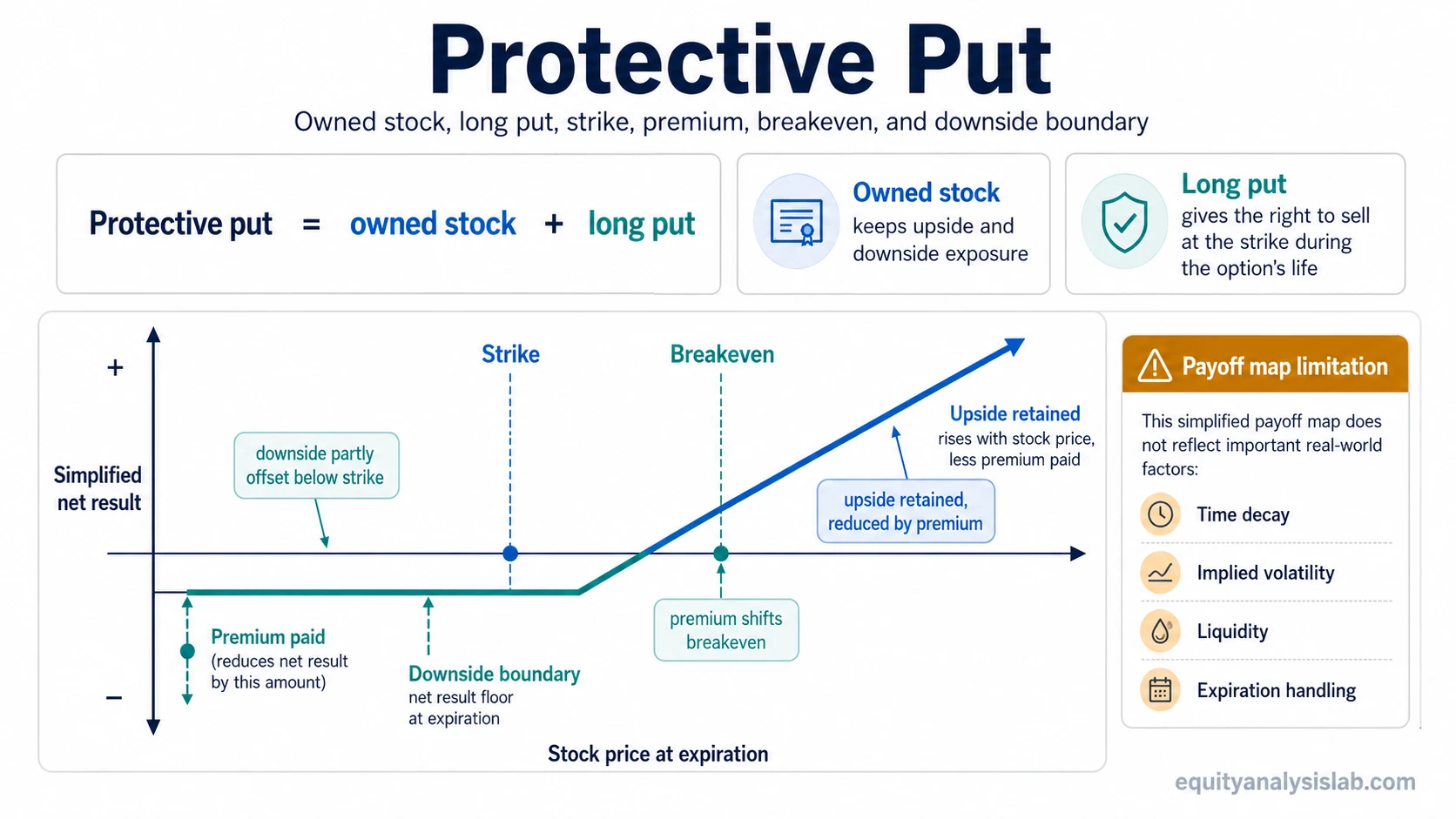
The structure remains long-biased. The put changes the downside profile of the stock position; it does not turn ownership of the shares into a bearish position or remove the need to evaluate the underlying investment thesis.
Key Points
- A protective put combines owned shares with a purchased put option.
- The investor retains stock upside while the put creates a downside selling right at the strike price.
- The premium is the cost of the hedge and affects breakeven and the final net result.
- The protection is temporary because the put has an expiration date.
- Strike, expiration, implied volatility, liquidity, and contract coverage affect how the hedge behaves in practice.
- A protective put changes risk exposure; it does not make a weak investment thesis stronger.
See a Protective Put Risk-Management Example
This short Apple example shows the basic idea of keeping stock exposure while adding a put as downside protection when the current price location appears less attractive from a risk perspective.
Important context: the video uses one Apple chart situation to illustrate the hedge. It is not a general rule that investors should avoid buying at a particular chart location, wait for a correction, or automatically use a protective put. The appropriate hedge depends on the underlying thesis, stock exposure, put premium, strike, expiration, and the risk the investor is trying to change.
How a Protective Put Works
The structure contains two positions that perform different jobs. The stock remains the primary ownership exposure, while the put acts as a temporary risk overlay.
| Component | Role | Why It Matters |
|---|---|---|
| Owned stock | Provides the underlying equity exposure. | The investor continues participating in stock gains and losses. |
| Long put | Provides the right to sell the underlying at the strike price under the contract terms. | The put can offset part of a stock decline below the protected area. |
| Strike price | Defines the contractual sale price of the put. | It determines where the downside protection becomes most visible in the expiration payoff. |
| Premium | The price paid for the put. | The hedge cost reduces the net result and changes breakeven. |
| Expiration | Defines how long the option right exists. | The hedge is temporary and must be reassessed as expiration approaches. |
| Contract coverage | Determines how much of the stock position the put actually covers. | The share exposure and option contract multiplier should be compared so the hedge is not unintentionally under- or over-sized. |
Protective Put Payoff and Breakeven
The cleanest payoff math is measured at expiration. Before expiration, the option can also change value because of time remaining, implied volatility, and liquidity.
Simultaneous stock-plus-put breakeven at expiration = stock purchase price + put premium
For a typical protective put where the strike is below the stock cost basis, a simplified downside-loss boundary at expiration can be expressed as:
Simplified maximum loss per share = stock cost basis – put strike + put premium
These formulas assume the put coverage matches the stock position and exclude commissions, taxes, dividends, bid-ask friction, early exercise considerations, and other contract-specific effects.
| Stock Price at Expiration | Put Outcome | Protective Put Interpretation |
|---|---|---|
| Below the strike | The put has intrinsic value. | The put can offset part of the decline in the owned shares. |
| Near the strike | The protection is near its main payoff boundary. | The premium still contributes to the overall economic result. |
| Above the strike | The put may expire without intrinsic value. | The investor retains the stock exposure, but the premium remains a hedge cost. |
| Above breakeven | The stock appreciation has exceeded the combined entry cost in the simplified model. | The position can show a positive net result despite the cost of the put. |
A Simple Protective Put Payoff Example
Consider a simplified simultaneous position in which stock is purchased at $50 and a $45 put is purchased for a $2 premium. The combined expiration breakeven is $52.
| Expiration Scenario | What Happens | Simplified Interpretation |
|---|---|---|
| Stock falls to $35 | The $45 put is in the money. | The put right offsets part of the loss that would exist from holding the stock without the hedge. |
| Stock finishes near $45 | The position is near the protection strike. | The hedge reduces downside exposure, but the $2 premium remains part of the total cost. |
| Stock rises to $60 | The put may expire worthless. | The stock retains its upside participation, reduced by the premium paid for protection. |
This is a payoff-mechanics example, not a forecast or a recommended stock, strike, or premium.
Protective Put vs Married Put
Protective put and married put describe closely related stock-plus-put structures. The useful distinction is usually timing.
| Structure | Typical Starting Position | Main Distinction |
|---|---|---|
| Protective put | The investor owns stock and adds a long put, or establishes both legs as a hedge structure. | The broader term focuses on protecting owned stock with a purchased put. |
| Married put | The stock and put are commonly purchased together. | The simultaneous entry makes stock cost plus put premium a cleaner combined starting cost. |
When a put is added long after the stock was originally purchased, the original stock cost basis and the new hedge cost should be kept conceptually separate. The put changes the economics from the hedge date forward, but it does not rewrite the historical stock purchase price.
What the Put Protects and What It Does Not
A protective put changes the payoff profile of the position. It does not remove every type of investment risk.
| The Put Can Change | The Put Does Not Automatically Fix |
|---|---|
| Downside exposure below the protected strike area | A deteriorating company thesis |
| The expiration payoff boundary | Overvaluation or weak expected return |
| The economic effect of a sharp stock decline during the hedge period | Concentration risk elsewhere in the portfolio |
| The contractual right to sell at the strike | Liquidity problems in the option contract |
| Part of the stock-price risk for a defined period | The cost of repeatedly purchasing new protection |
Investor-use boundary: protection is not a reason to stop reviewing the underlying company. If the investment thesis deteriorates, the existence of the put does not by itself justify continuing to hold the position.
How Strike, Premium, and Expiration Change the Hedge
Protective puts with different strikes and expiration dates can create very different risk profiles even when they hedge the same stock position.
| Input | What Changes | Main Trade-Off |
|---|---|---|
| Higher put strike | The downside boundary sits closer to the current stock price. | More protection can require a higher premium. |
| Lower put strike | More stock downside remains before the put provides the same level of expiration protection. | The option may cost less, but the investor retains more downside exposure. |
| Longer expiration | The hedge remains active for a longer period. | More time generally adds option value and can increase premium cost. |
| Higher implied volatility | The option can become more expensive because the market prices a wider expected range. | The hedge may provide the desired right at a less attractive cost. |
| Wider bid-ask spread | The executable price can differ more from a theoretical option value. | Practical hedge cost and adjustment flexibility can worsen. |
What a Protective Put Payoff Chart Does Not Show
A payoff chart is useful because it makes the expiration boundary visible. It does not show the full path of the position before expiration.
| Real-World Factor | Why It Matters | Common Misread |
|---|---|---|
| Time decay | The put can lose time value as expiration approaches. | Assuming the hedge keeps the same market value throughout its life. |
| Implied volatility | Changes in volatility expectations can alter the put price before expiration. | Looking only at stock direction and the strike. |
| Liquidity | Bid-ask spreads and contract activity affect executable prices. | Treating theoretical option value as guaranteed execution value. |
| Expiration handling | The investor must understand the consequences of holding an in-the-money or out-of-the-money put into expiration. | Assuming the payoff diagram automatically manages the position. |
| Repeated hedge cost | Renewing protection requires additional premiums over time. | Evaluating one hedge without considering cumulative insurance cost. |
Expiration, Exercise, and Assignment
The protective-put investor owns the long put right. This is different from being short an option and facing assignment as the option writer.
Near expiration, an in-the-money put can require a decision about closing the option, exercising it, or allowing broker and clearing procedures to apply. The operational result depends on the contract terms, broker rules, account permissions, and whether the investor still wants the underlying stock exposure.
If the put expires out of the money, the investor normally remains the owner of the stock and the premium paid becomes the cost of the expired protection.
Protective Put vs Nearby Option Structures
The cleanest comparison is to ask what the investor owns, what option right or obligation exists, and whether upside remains open or becomes capped.
| Structure | Main Position | Core Distinction |
|---|---|---|
| Protective put | Owned stock + long put | Retains stock upside while purchasing downside protection. |
| Long put | Long put without required stock ownership | Can represent standalone downside exposure rather than a hedge attached to owned shares. |
| Married put | Stock + long put entered together | A simultaneous-entry version of the stock-plus-put structure. |
| Collar | Owned stock + long put + short call | The short call can help offset hedge cost but caps upside above the call strike. |
| Cash-secured put | Short put backed by reserved cash | Creates a potential obligation to purchase shares rather than protecting an existing stock position. |
Protective Put vs Stop-Loss Order
Both can be used to change downside management, but their mechanics are different. A protective put is a contractual option right. A stop-loss order is an instruction intended to trigger an order after a specified price condition is reached.
| Feature | Protective Put | Stop-Loss Order |
|---|---|---|
| Protection mechanism | Purchased option contract | Order execution after a trigger condition |
| Upfront cost | Requires payment of an option premium | Does not require an option premium |
| Gap behavior | The put retains its contractual strike right subject to contract terms. | The execution price can differ from the trigger in a fast or gapping market. |
| Expiration | The protection ends when the option expires. | The order remains governed by the order type and broker instructions rather than an option expiration. |
| Position after downside event | The investor can still own the shares unless the position is exercised, sold, or otherwise changed. | A triggered and executed stop generally reduces or exits the stock position according to the order. |
Common Protective Put Mistakes
| Common Mistake | Why It Weakens the Analysis | Better Check |
|---|---|---|
| Treating the put strike as the total loss boundary | The premium is also part of the position economics. | Include the hedge cost when evaluating breakeven and downside. |
| Treating protection as free | The premium reduces the net result even when the stock rises. | Compare the cost of protection with the risk being changed. |
| Ignoring contract coverage | The number of shares protected may not match the option exposure. | Check the actual contract multiplier and total stock position. |
| Buying protection only after volatility has surged | Higher implied volatility can make the hedge more expensive. | Evaluate premium and volatility rather than looking only at the strike. |
| Assuming the put fixes a deteriorating stock thesis | The option changes downside exposure but does not repair weaker fundamentals or valuation. | Review the stock thesis separately from the hedge. |
| Rolling the put automatically | A new expiration or strike creates a new risk and cost decision. | Reassess the desired stock exposure, remaining thesis, hedge cost, and protection period before changing the position. |
| Treating the Apple Short as a universal entry rule | The video describes one chart-specific risk-management example. | Separate the example from the general mechanics of protective puts. |
Limitations of Protective Put Hedging
A protective put can make downside more defined for a period, but that protection has a premium cost and an expiration date. Repeatedly maintaining protection can become expensive, especially when implied volatility is elevated.
The hedge also does not solve company-specific problems. A stock can become less attractive because the investment thesis deteriorates, valuation changes, or the business outlook weakens even while the put successfully limits part of the downside.
A protective put is therefore best understood as risk packaging around an equity position. It changes the payoff and downside boundary for a defined period, but it does not make the stock safe, remove the need for thesis review, or determine whether the position should be held.