
A long put option is a purchased put contract that gives the holder the right to sell the underlying at a fixed strike price under the contract’s exercise terms. The buyer pays a premium for that right and generally uses the position when expecting the underlying price to fall.
A long put is a bought put option. The premium sets the main defined loss boundary, while the final result depends on the strike price, the underlying price, time remaining, implied volatility, liquidity, and how the contract is handled near expiration.
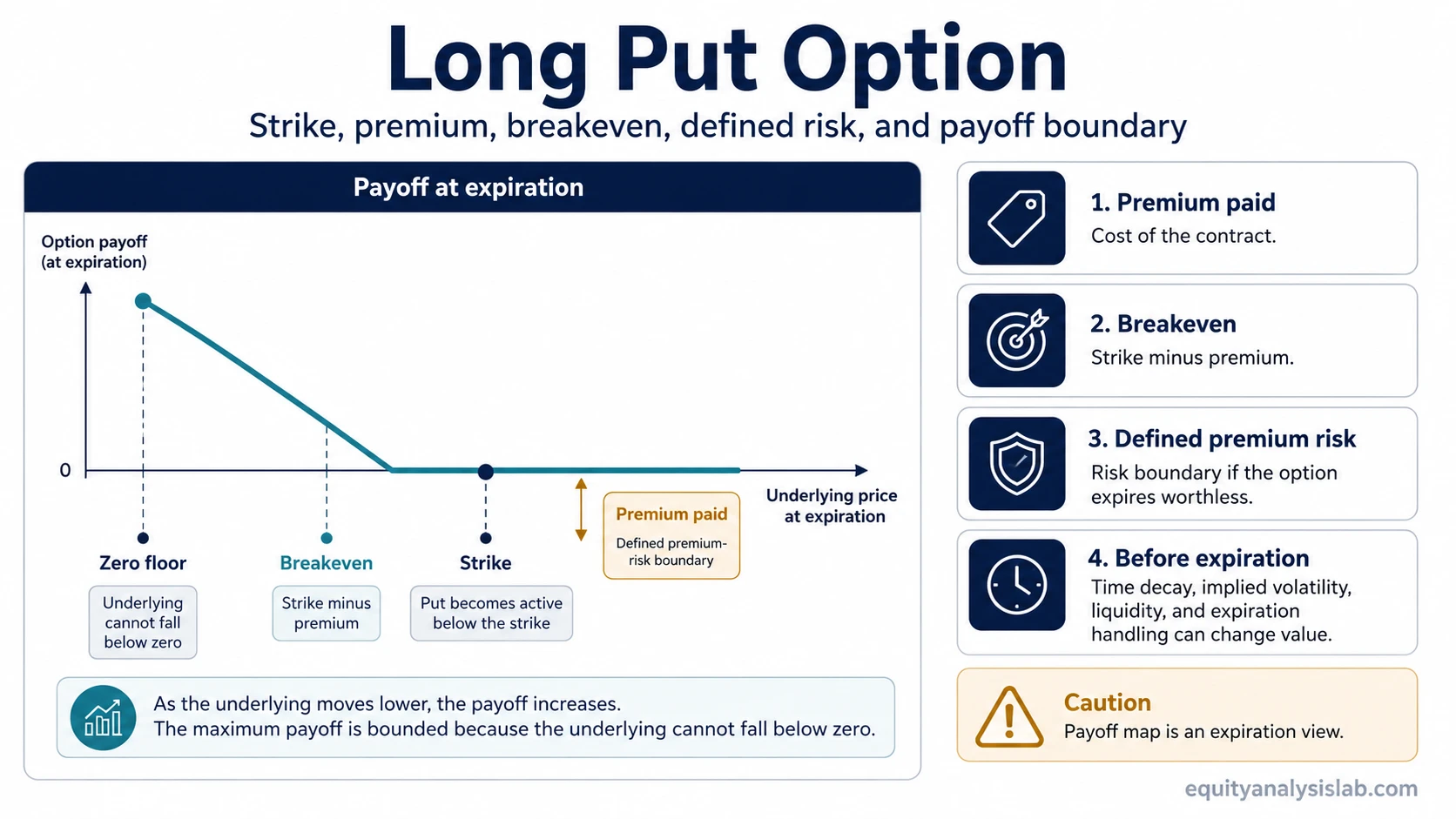
Long Put Option Key Points
- A long put gives the buyer the right to sell the underlying at the strike price under the contract terms.
- The buyer pays an option premium, which is normally the maximum loss before fees and commissions.
- Breakeven at expiration equals the strike price minus the premium paid.
- For a standard equity put, profit potential increases as the stock falls toward zero.
- Time decay, implied volatility, liquidity, and expiration handling affect the option before expiration.
How a Long Put Contract Works
The structure is straightforward. The buyer pays a premium for the right to sell the underlying at a fixed strike price. The contract also has an expiration date, which limits how much time the expected decline has to develop.
| Input | What it controls | Why it matters |
|---|---|---|
| Underlying price | The market price of the asset tied to the option | Determines the put’s intrinsic value relative to the strike. |
| Strike price | The price at which the holder has the right to sell the underlying | Sets the main payoff reference point. |
| Premium paid | The cost of buying the option | Creates the main loss boundary and moves breakeven below the strike. |
| Expiration date | The contract deadline | Determines how much time remains for the expected move to develop. |
| Implied volatility | The market price of expected future movement | Can change the option’s value before expiration even when the underlying price moves very little. |
| Liquidity | The ease of trading the contract | Bid-ask spreads and market depth affect the price available to enter or exit. |
At expiration, the calculation becomes simpler. When the underlying price is below the strike, the put has intrinsic value equal to the difference between the strike and the underlying price. When the underlying finishes at or above the strike, the put has no intrinsic value.
Long Put Payoff and Breakeven
A long put has one breakeven point at expiration:
Breakeven = strike price – premium paid
The expiration profit or loss per share can be written as:
Long put P/L at expiration = max(strike price – underlying price, 0) – premium paid
The maximum loss is normally the premium paid, plus any fees or commissions. For a standard equity put, the stock price can fall as low as zero, which creates a theoretical maximum profit per share of:
Theoretical maximum profit = strike price – premium paid
That maximum occurs only if the stock reaches zero at expiration. In most real trades, the position is closed earlier or the stock finishes somewhere between the strike and zero.
| Underlying price at expiration | Put status | Result for the long put buyer |
|---|---|---|
| Above the strike | Out of the money | The option has no intrinsic value and the premium is lost if held through expiration. |
| At the strike | At the money | The option has no intrinsic value, so the premium remains the loss. |
| Below the strike but above breakeven | In the money | The option has intrinsic value, although it has not yet recovered the full premium. |
| At breakeven | In the money | Intrinsic value equals the premium paid before fees. |
| Below breakeven | In the money | Intrinsic value exceeds the original premium and the expiration payoff is positive before costs. |
Long Put Example
Assume a stock is trading at $50. An investor buys a $50 strike put for a $3 premium. The breakeven at expiration is $47.
| Stock price at expiration | Put intrinsic value | Profit / loss per share before costs |
|---|---|---|
| $55 | $0 | -$3 |
| $50 | $0 | -$3 |
| $48 | $2 | -$1 |
| $47 | $3 | $0 |
| $44 | $6 | +$3 |
| $0 | $50 | +$47 |
The example shows why the strike and breakeven are different. At $48, the put is already in the money because the stock is below the $50 strike, yet the position still has a $1 loss per share after the original $3 premium.
At $44, intrinsic value reaches $6 per share. After subtracting the $3 premium, the expiration profit is $3 per share before fees and commissions.
Before expiration, market value can differ from this table because the option still contains time value and responds to changes in implied volatility and liquidity.
Why Time Decay and Implied Volatility Matter
A long put usually loses time value as expiration approaches when other pricing inputs remain unchanged. This time-decay effect means the expected decline has to arrive within the life of the contract. A slow move can produce a much different result from a sharp decline that happens soon after entry.
Implied volatility also affects the option premium. Higher implied volatility generally supports the value of a long option because the market is pricing a wider range of possible outcomes. A decline in implied volatility can reduce the put’s value even while the underlying moves modestly lower.
This is why traders often separate the expiration payoff from the live option price. The expiration formula depends mainly on the strike, premium, and final underlying price. Before expiration, time remaining, implied volatility, interest rates, dividends where relevant, and market liquidity also affect the premium.
At the market-indicator level, put demand is often summarized differently through the put call ratio. That indicator measures broader options activity and serves a different purpose from the payoff analysis of one long put position.
Expiration and Exercise
A long put can usually be sold to close before expiration. Depending on the contract and exercise style, the holder may also have the ability to exercise the option and sell the underlying at the strike price.
If the put finishes out of the money, it normally expires worthless. An in-the-money contract may be subject to automatic exercise rules, broker thresholds, account permissions, and position requirements.
These operational details matter because an expiration payoff diagram only shows the economics of the option. The actual account outcome can also depend on whether the contract is sold, exercised, or held through expiration.
Long Put Payoff Chart: What It Leaves Out
The payoff chart is an expiration snapshot. It shows the strike, breakeven, maximum loss, and downside payoff shape clearly, while several live-market factors remain outside the diagram.
- Liquidity: wide bid-ask spreads can reduce the price available when entering or closing the position.
- Time decay: the option can lose time value while the expected move develops.
- Implied volatility: changes in volatility expectations can move the premium before expiration.
- Expiration handling: an in-the-money contract can create exercise or resulting-position consequences.
- Fees and commissions: actual account results can differ slightly from simplified payoff calculations.
Long Put vs Nearby Option Structures
Several options strategies use put contracts, yet the position structure and investor objective can be very different.
| Concept | Main structure | Core distinction |
|---|---|---|
| Protective put | Owned shares plus a bought put | Uses a put to define downside risk around an existing stock position. |
| Long call | Bought call option | Uses premium to seek upside exposure. |
| Short put | Sold put option | The seller receives premium and takes on an obligation if assigned. |
| Cash-secured put | Short put backed by cash | Combines put selling with cash reserved for a possible share purchase. |
| Short stock | Borrowed shares sold short | Creates direct short exposure without using a purchased option contract. |
A long put buyer owns a contractual right and pays premium up front. A short put seller receives premium and accepts an obligation. A protective put combines the purchased put with an existing long stock position.
When a Long Put Is In the Money or Out of the Money
A put is in the money when the underlying price is below the strike price. It is out of the money when the underlying trades above the strike.
Moneyness describes intrinsic value. Profitability also includes the premium paid. In the $50 strike and $3 premium example, a stock price of $48 makes the put $2 in the money while the overall position still shows a $1 loss per share at expiration.
Common Long Put Mistakes
Expecting every decline to produce a profit. The move has to be large enough to cover the premium, and the timing matters when the position is closed before expiration.
Ignoring time and volatility. A trader can correctly anticipate a lower stock price and still receive a weaker result if the move develops slowly or implied volatility falls.
Underestimating the premium at risk. Defined risk makes the maximum loss easier to calculate. The full premium can still be lost when the option expires worthless.
Related Concepts
To understand the contract itself, start with the put option. To understand cost and breakeven, focus on option premium. Protective put, short put, and cash-secured put use related contracts with different position structures and objectives.
FAQ
What is the maximum loss on a long put?
The maximum loss is normally the premium paid for the put, plus any fees or commissions, when the option expires worthless.
What is the breakeven on a long put?
At expiration, the breakeven is the strike price minus the premium paid. A $50 strike put purchased for $3 therefore has a $47 breakeven before fees.
Can a long put profit be unlimited?
No. For a standard equity put, the stock price cannot fall below zero. The theoretical maximum profit per share at expiration is therefore the strike price minus the premium paid, before fees and commissions.